Institute of Infection and Global Health, University of Liverpool, Neston, Wirral, UK.
Institute of Veterinary Science, University of Liverpool, Neston, Wirral, UK.
J Feline Med Surg. 2020 Jun;22(6):602-607. doi: 10.1177/1098612X19866521. Epub 2019 Aug 14.
Feline calicivirus (FCV) is a highly variable and globally important feline pathogen for which vaccination has been the mainstay of control. Here, we test whether the continued use of FCV-F9, one of the most frequently used vaccine strains globally, is driving the emergence of vaccine-resistant viruses in the field.
This study made use of two representative panels of field isolates previously collected from cats visiting randomly selected veterinary practices across the UK as part of separate cross-sectional studies from 2001 and 2013/2014. Phylogenetic analysis and in vitro virus neutralisation tests were used to compare the genetic and antigenic relationships between these populations and FCV-F9.
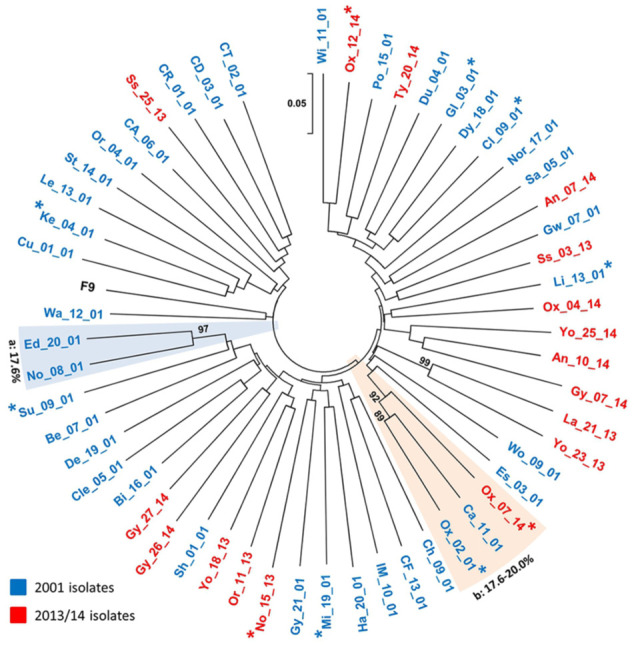
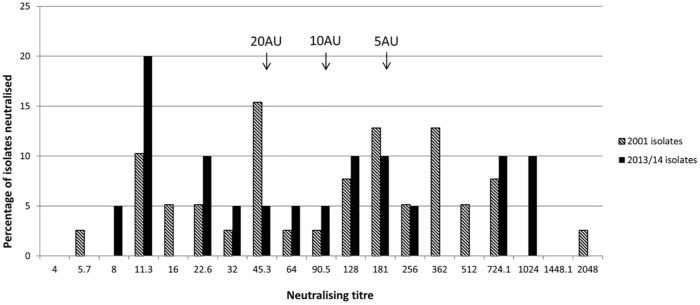
Phylogenetic analysis showed a typically radial distribution dominated by 52 distinct strains, with strains from both 2001 and 2013/2014 intermingled. The sequence for FCV-F9 appeared to be integral to this phylogeny and there were no significant differences in the genetic distances within each studied population (intra-population distances), or between them (inter-population distances), or between each population and FCV-F9. A 1 in 8 dilution neutralised 97% and 100% of the 2001 and 2013/14 isolates, respectively, and a 1 in 16 dilution neutralised 87% and 75% of isolates, respectively. There was no significant difference either in variance between the FCV-F9 neutralising titres for the two populations, or in the distribution of neutralisation titres across the two populations.
Although FCV is a highly variable virus, we found no evidence for a progressive divergence of field virus from vaccine strain FCV-F9, either phylogenetically or antigenically, with FCV-F9 antisera remaining broadly and equally cross-reactive to two geographically representative and temporally separated FCV populations. We suggest this may be because the immunodominant region of the FCV capsid responsible for neutralisation may have structural constraints preventing its longer term progressive antigenic evolution.
猫杯状病毒(FCV)是一种高度变异的全球性重要猫科病原体,疫苗接种一直是其主要控制手段。在这里,我们测试了全球使用最广泛的疫苗株之一 FCV-F9 的持续使用是否正在导致该病毒在野外出现耐药性。
本研究利用了两个代表面板,这些面板是从 2001 年和 2013/2014 年分别进行的两项独立横断面研究中在英国随机选择的兽医诊所就诊的猫身上收集的。使用系统进化分析和体外病毒中和试验比较了这些群体与 FCV-F9 之间的遗传和抗原关系。
系统进化分析显示,以 52 个不同菌株为特征的典型放射状分布,2001 年和 2013/2014 年的菌株混合在一起。FCV-F9 的序列似乎是该系统进化树的一个组成部分,并且在每个研究群体(群体内距离)或它们之间(群体间距离)或每个群体与 FCV-F9 之间的遗传距离没有显著差异。1:8 稀释度分别中和了 2001 年和 2013/14 年分离株的 97%和 100%,而 1:16 稀释度分别中和了 87%和 75%的分离株。FCV-F9 对两个群体的中和滴度之间的方差或两个群体之间的中和滴度分布也没有显著差异。
尽管 FCV 是一种高度变异的病毒,但我们没有发现野外病毒从疫苗株 FCV-F9 逐渐进化的证据,无论是在系统进化上还是在抗原性上,FCV-F9 抗血清对两个具有地理代表性和时间上分离的 FCV 群体仍然具有广泛而均等的交叉反应性。我们认为,这可能是因为负责中和的 FCV 衣壳的免疫显性区域可能具有结构限制,阻止了其长期的渐进抗原进化。