Department of Nephrology, Hunan Provincial People's Hospital, The First Affiliated Hospital of Hunan Normal University, No.61, West Jiefang Road, Changsha, 410005, Hunan Province, People's Republic of China.
Department of Nephrology, Xiangya Hospital, Central South University, Changsha, 410008, People's Republic of China.
BMC Nephrol. 2019 Aug 14;20(1):319. doi: 10.1186/s12882-019-1506-8.
Chronic kidney disease (CKD) has been considered as a major health problem in the world. Increasing uric acid (UA) could induce vascular endothelial injury, which is closely related to microinflammation, oxidative stress, and disorders of lipids metabolism. However, the specific mechanism that UA induces vascular endothelial cells injury in early CKD remains unknown.
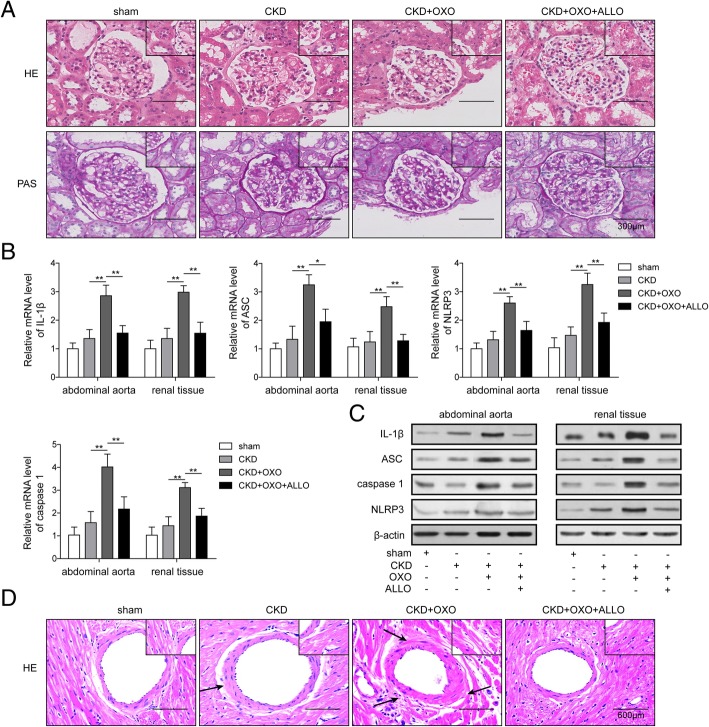
Human umbilical vein endothelial cells (HUVECs) were cultured and subjected to different concentrations of UA for different periods. Early CKD rat model with elevated serum UA was established. Western blotting and quantitative real-time PCR (qPCR) were applied for measuring protein and mRNA expression of different cytokines. The animals were sacrificed and blood samples were collected for measurement of creatinine, UA, IL-1β, TNF-α, and ICAM-1. Renal tissues were pathologically examined by periodic acid-Schiff (PAS) or hematoxylin-eosin (HE) staining.
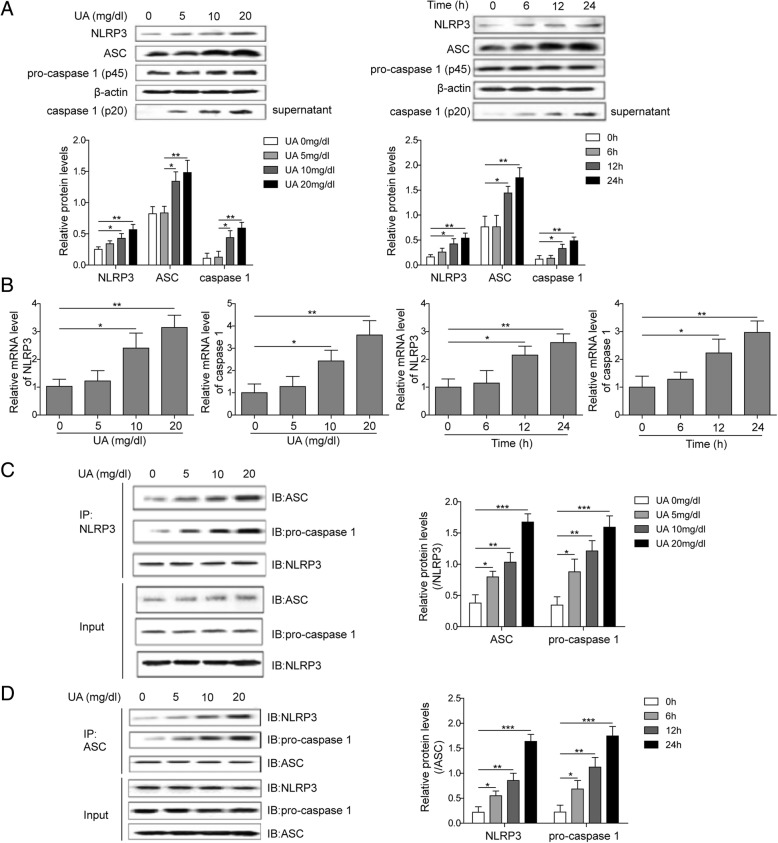
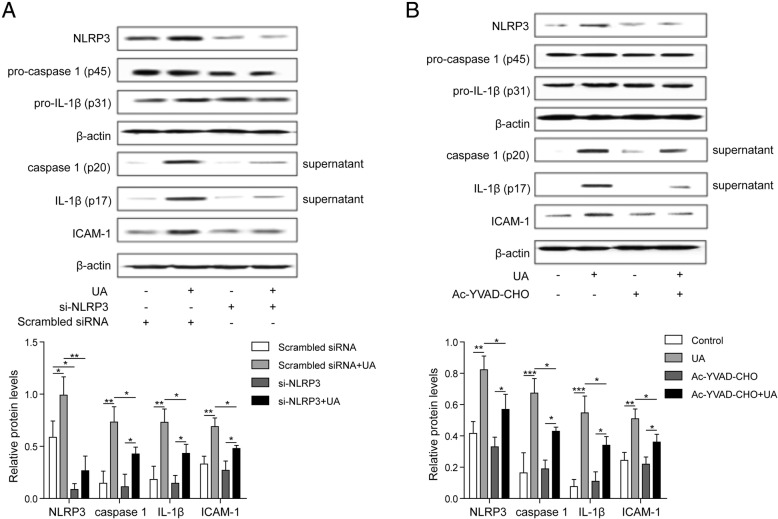
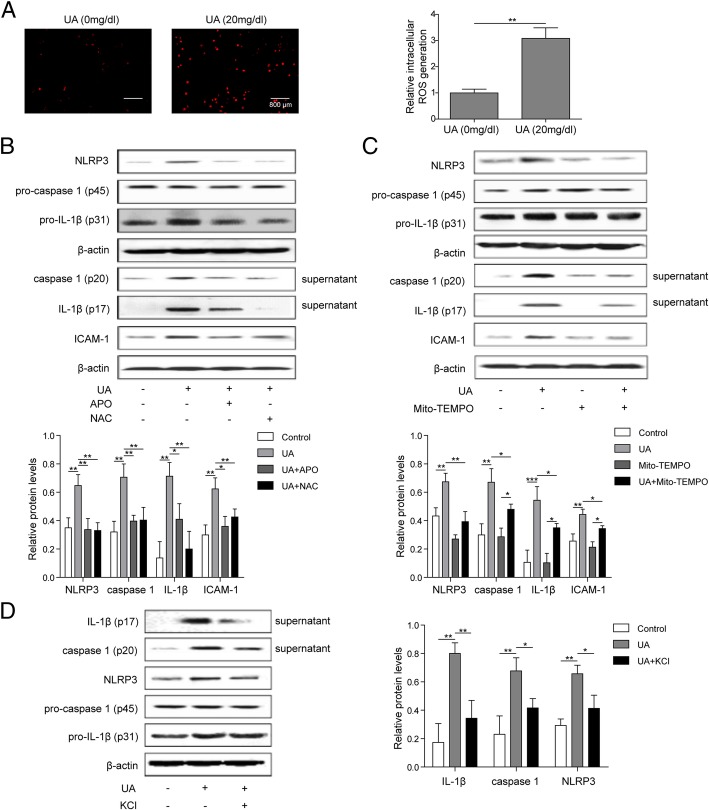
The expression of IL-1β, ICAM-1, NLRP3 complexes, and activation of NLRP3 inflammasome could be induced by UA, but the changes induced by UA were partially reversed by siRNA NLRP3 or caspase 1 inhibitor. Furthermore, we identified that UA regulated the activation of NLRP3 inflammasome by activating ROS and K efflux. In vivo results showed that UA caused the vascular endothelial injury by activating NLRP3/IL-1β pathway. While allopurinol could reduce UA level and may have protective effects on cardiovascular system.
UA could regulate NLRP3/IL-1β signaling pathway through ROS activation and K efflux and further induce vascular endothelial cells injury in early stages of CKD.
慢性肾脏病(CKD)已被认为是全球的一个主要健康问题。尿酸(UA)的增加可诱导血管内皮损伤,这与微炎症、氧化应激和脂质代谢紊乱密切相关。然而,UA 在早期 CKD 中诱导血管内皮细胞损伤的确切机制尚不清楚。
培养人脐静脉内皮细胞(HUVEC),并用不同浓度的 UA 处理不同时间。建立血清 UA 升高的早期 CKD 大鼠模型。Western blot 和实时定量 PCR(qPCR)用于测量不同细胞因子的蛋白和 mRNA 表达。处死动物并采集血液样本,用于测量肌酐、UA、IL-1β、TNF-α和 ICAM-1。用过碘酸-Schiff(PAS)或苏木精-伊红(HE)染色对肾脏组织进行病理检查。
UA 可诱导 IL-1β、ICAM-1、NLRP3 复合物和 NLRP3 炎性小体的激活,但 UA 诱导的变化可被 siRNA NLRP3 或 caspase 1 抑制剂部分逆转。此外,我们发现 UA 通过激活 ROS 和 K 外流来调节 NLRP3 炎性小体的激活。体内结果表明,UA 通过激活 NLRP3/IL-1β 通路引起血管内皮损伤。而别嘌醇可降低 UA 水平,对心血管系统可能具有保护作用。
UA 可通过 ROS 激活和 K 外流调节 NLRP3/IL-1β 信号通路,进而在 CKD 早期诱导血管内皮细胞损伤。