Heart Assessment, Royal Brompton and Harefield NHS Foundation Trust, London, Middlesex, UK.
Faculty of Medicine, NHLI, Imperial College London, London, United Kingdom.
Open Heart. 2019 Jul 29;6(2):e001044. doi: 10.1136/openhrt-2019-001044. eCollection 2019.
The aims of this study were to evaluate the inconsistency of aortic stenosis (AS) severity between CT aortic valve area (CT-AVA) and echocardiographic Doppler parameters, and to investigate potential underlying mechanisms using computational fluid dynamics (CFD).
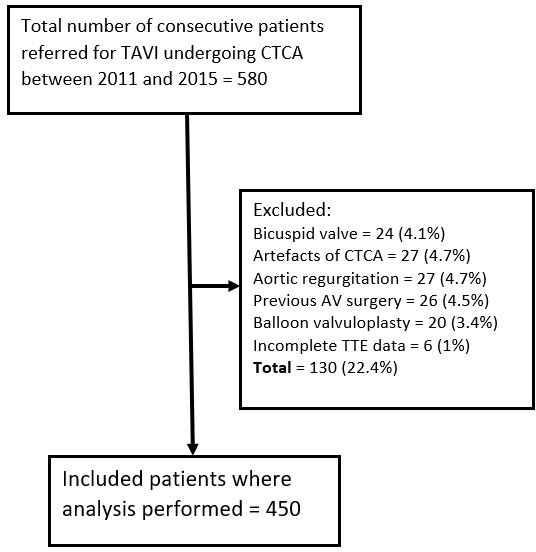
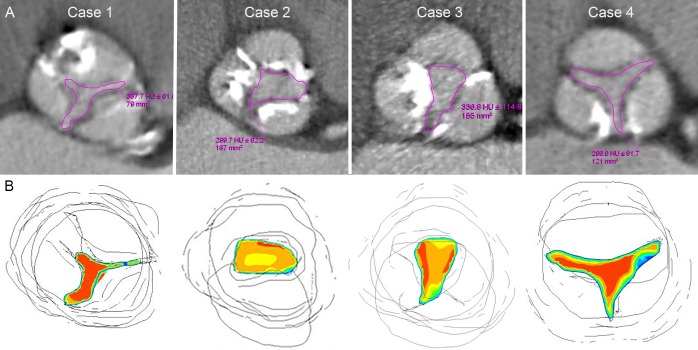
A total of 450 consecutive eligible patients undergoing transcatheter AV implantation assessment underwent CT cardiac angiography (CTCA) following echocardiography. CT-AVA derived by direct planimetry and echocardiographic parameters were used to assess severity. CFD simulation was performed in 46 CTCA cases to evaluate velocity profiles.
A CT-AVA>1 cm was present in 23% of patients with echocardiographic peak velocity≥4 m/s (r=-0.33) and in 15% patients with mean Doppler gradient≥40 mm Hg (r=-0.39). Patients with inconsistent severity grading between CT and echocardiography had higher stroke volume index (43 vs 38 mL/m, p<0.003) and left ventricular outflow tract (LVOT) flow rate (235 vs 192 cm/s, p<0.001). CFD simulation revealed high flow, either in isolation (p=0.01), or when associated with a skewed velocity profile (p=0.007), as the main cause for inconsistency between CT and echocardiography.
Severe AS by Doppler criteria may be associated with a CT-AVA>1 cm in up to a quarter of patients. CFD demonstrates that haemodynamic severity may be exaggerated on Doppler analysis due to high LVOT flow rates, with or without skewed velocity profiles, across the valve orifice. These factors should be considered before making a firm diagnosis of severe AS and evaluation with CT can be helpful.
本研究旨在评估 CT 主动脉瓣口面积(CT-AVA)与超声心动图多普勒参数评估主动脉瓣狭窄(AS)严重程度的不一致性,并通过计算流体动力学(CFD)研究潜在的机制。
对 450 例连续的经导管主动脉瓣植入术评估患者在超声心动图检查后进行 CT 心脏血管造影(CTCA)。采用直接平面测量法获得 CT-AVA,并采用超声心动图参数评估严重程度。对 46 例 CTCA 病例进行 CFD 模拟,以评估速度剖面。
超声心动图峰值速度≥4 m/s(r=-0.33)的患者中,有 23%的 CT-AVA>1 cm;平均多普勒梯度≥40 mm Hg(r=-0.39)的患者中有 15%的 CT-AVA>1 cm。CT 和超声心动图严重程度分级不一致的患者的每搏量指数(43 比 38 mL/m,p<0.003)和左心室流出道(LVOT)流速(235 比 192 cm/s,p<0.001)更高。CFD 模拟显示,高流量(单独存在或与速度剖面偏斜相关)是导致 CT 和超声心动图之间不一致的主要原因(p=0.01 或 p=0.007)。
多普勒标准评估的严重 AS 患者中,多达四分之一的患者 CT-AVA>1 cm。CFD 表明,由于 LVOT 流速较高,无论是否存在速度剖面偏斜,瓣口的血流动力学严重程度可能在多普勒分析中被夸大。在做出严重 AS 的明确诊断之前,应考虑这些因素,而 CT 评估可能会有所帮助。