Department of Medical Bioscience, University of the Western Cape, Bellville 7535, South Africa.
Int J Environ Res Public Health. 2019 Aug 14;16(16):2914. doi: 10.3390/ijerph16162914.
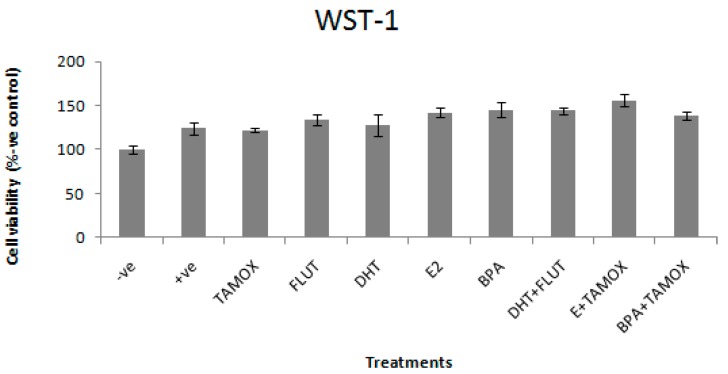
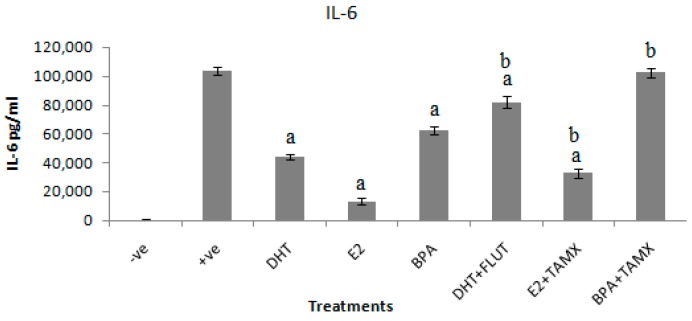
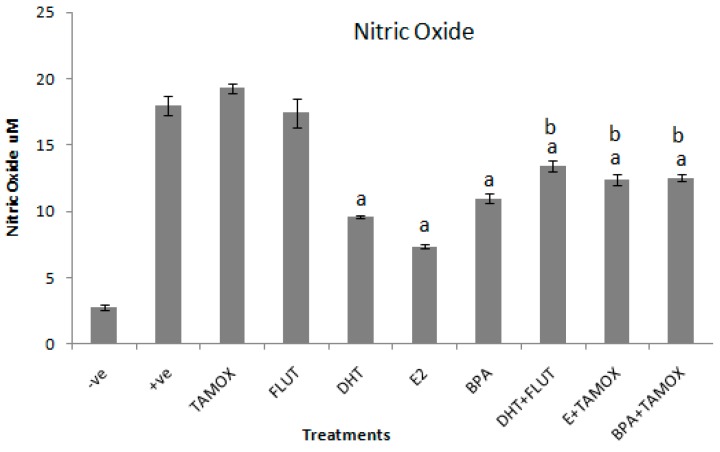
Endocrine disrupting chemicals (EDCs) are common pollutants in the environment and can induce disruption of the endocrine and immune systems. The present study evaluated the effects of selected common environmental EDCs on secretion of inflammatory biomarkers by RAW264.7 cells. The EDCs investigated were Estradiol (E2), 5α-dihydrotestosterone (DHT), and Bisphenol A (BPA). To evaluate if the effects caused by EDCs were modulated by steroid hormone receptors, antagonists of estrogen and androgen receptors were used. The steroid receptor antagonists used were Tamoxifen, an estrogen receptor antagonist, and Flutamide, an androgen receptor antagonist. Secretion of biomarkers of inflammation, namely nitric oxide (NO) and interleukin 6 (IL-6), were monitored. The NO was determined using Griess reaction and IL-6 was measured by enzyme linked immunosorbent assay (ELISA). Although 5 μg/mL E2, DHT, and BPA were not toxic to RAW264.7 cell cultures, the same treatments significantly ( < 0.001) reduced both NO and IL-6 secretion by lipopolysaccharide (LPS)-stimulated RAW264.7 cell cultures. The suppression of NO and IL-6 secretion indicate inhibition of inflammation by DHT, E2, and BPA. The inhibitory effects of DHT, E2 and BPA are partially mediated via their cellular receptors, because the effects were reversed by their respective receptor antagonists. Flutamide reversed the effects of DHT, while Tamoxifen reversed the effects of E2 and BPA. In conclusion, E2, BPA, and DHT inhibit the synthesis of inflammation biomarkers by LPS-stimulated RAW264.7 cells. The inhibitory effects of EDCs can be partially reversed by the addition of an estrogen receptor antagonist for E2 and BPA, and an androgenic receptor antagonist for DHT. The inhibition of inflammatory response in stimulated RAW264.7 cells may be a useful bioassay model for monitoring estrogenic and androgenic pollutants.
内分泌干扰化学物质(EDCs)是环境中的常见污染物,可引起内分泌和免疫系统紊乱。本研究评估了选定的常见环境 EDC 对 RAW264.7 细胞分泌炎症生物标志物的影响。研究的 EDC 是雌二醇(E2)、5α-二氢睾酮(DHT)和双酚 A(BPA)。为了评估 EDC 引起的影响是否被类固醇激素受体调节,使用了雌激素和雄激素受体拮抗剂。使用的类固醇受体拮抗剂是他莫昔芬,一种雌激素受体拮抗剂,和氟他胺,一种雄激素受体拮抗剂。监测炎症生物标志物,即一氧化氮(NO)和白细胞介素 6(IL-6)的分泌。使用格里夫斯反应测定 NO,通过酶联免疫吸附试验(ELISA)测定 IL-6。尽管 5μg/mL 的 E2、DHT 和 BPA 对 RAW264.7 细胞培养物没有毒性,但相同的处理显著(<0.001)降低了脂多糖(LPS)刺激的 RAW264.7 细胞培养物中 NO 和 IL-6 的分泌。NO 和 IL-6 分泌的抑制表明 DHT、E2 和 BPA 抑制炎症。DHT、E2 和 BPA 的抑制作用部分通过其细胞受体介导,因为其各自的受体拮抗剂可逆转作用。氟他胺逆转了 DHT 的作用,而他莫昔芬逆转了 E2 和 BPA 的作用。总之,E2、BPA 和 DHT 抑制 LPS 刺激的 RAW264.7 细胞中炎症生物标志物的合成。EDC 的抑制作用可以通过添加雌激素受体拮抗剂(E2 和 BPA)和雄激素受体拮抗剂(DHT)部分逆转。刺激的 RAW264.7 细胞中炎症反应的抑制可能是监测雌激素和雄激素污染物的有用生物测定模型。