Centre for Advanced Electron Spin Resonance (CÆSR), Department of Chemistry, University of Oxford, South Parks Road, Oxford, OX1 3QR, UK.
School of Molecular Sciences, Department of Chemistry and Biochemistry, Arizona State University, Tempe, AZ, 85281, USA.
Nat Commun. 2019 Aug 16;10(1):3707. doi: 10.1038/s41467-019-11655-2.
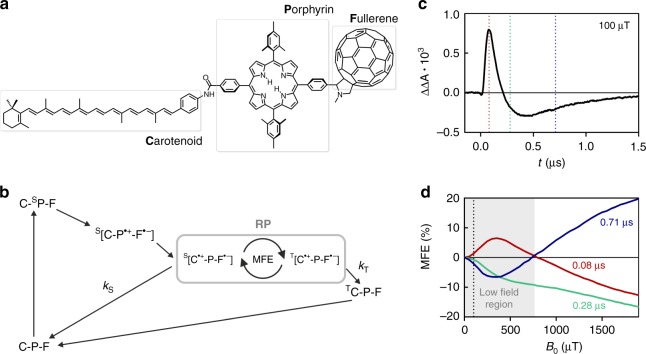
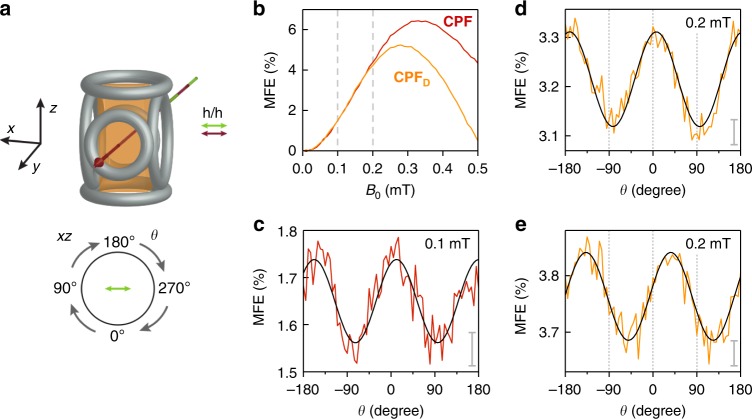
The fact that many animals, including migratory birds, use the Earth's magnetic field for orientation and compass-navigation is fascinating and puzzling in equal measure. The physical origin of these phenomena has not yet been fully understood, but arguably the most likely hypothesis is based on the radical pair mechanism (RPM). Whilst the theoretical framework of the RPM is well-established, most experimental investigations have been conducted at fields several orders of magnitude stronger than the Earth's. Here we use transient absorption spectroscopy to demonstrate a pronounced orientation-dependence of the magnetic field response of a molecular triad system in the field region relevant to avian magnetoreception. The chemical compass response exhibits the properties of an inclination compass as found in migratory birds. The results underline the feasibility of a radical pair based avian compass and also provide further guidelines for the design and operation of exploitable chemical compass systems.
事实上,许多动物,包括候鸟,都利用地球磁场进行定向和罗盘导航,这既令人着迷,又令人费解。这些现象的物理起源尚未完全理解,但可以说最有可能的假设是基于自由基对机制(RPM)。虽然 RPM 的理论框架已经很完善,但大多数实验研究都是在比地球磁场强几个数量级的磁场中进行的。在这里,我们使用瞬态吸收光谱在与鸟类磁受体相关的场区域中证明了分子三联体系统的磁场响应具有明显的方向依赖性。化学罗盘的响应表现出迁移鸟类中发现的倾斜罗盘的特性。这些结果强调了基于自由基对的鸟类罗盘的可行性,也为可利用的化学罗盘系统的设计和操作提供了进一步的指导。