Institut für Ionenphysik und Angewandte Physik, Leopold-Franzens-Universität Innsbruck, Technikerstraße 25, 6020, Innsbruck, Austria.
J Am Soc Mass Spectrom. 2019 Oct;30(10):1946-1955. doi: 10.1007/s13361-019-02294-4. Epub 2019 Aug 16.
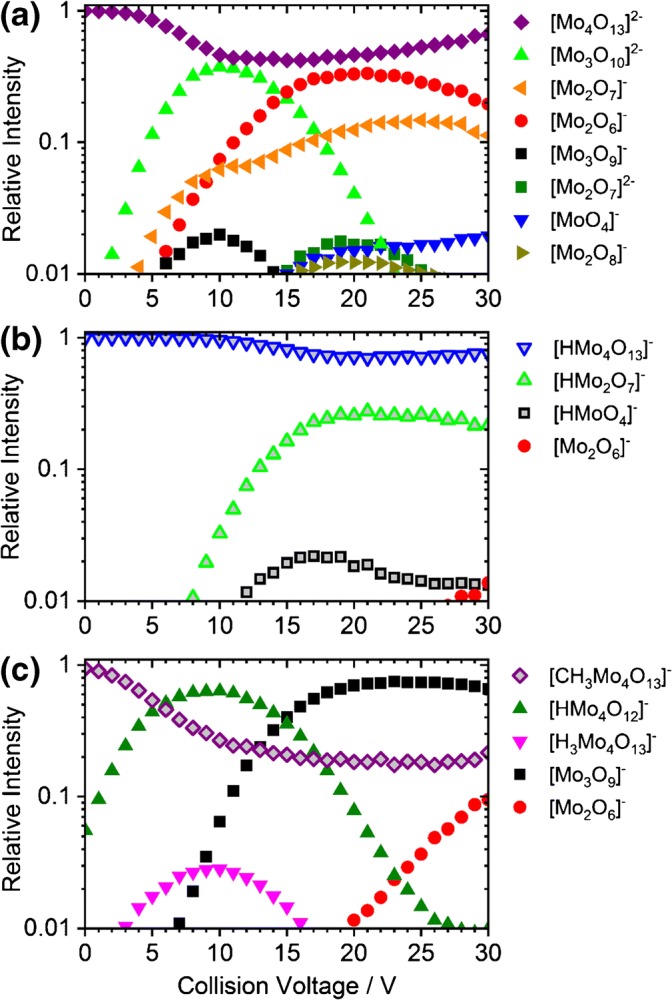
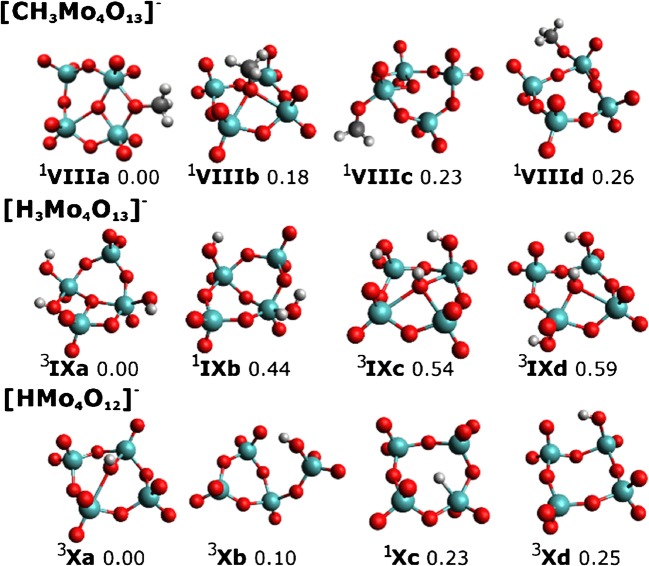
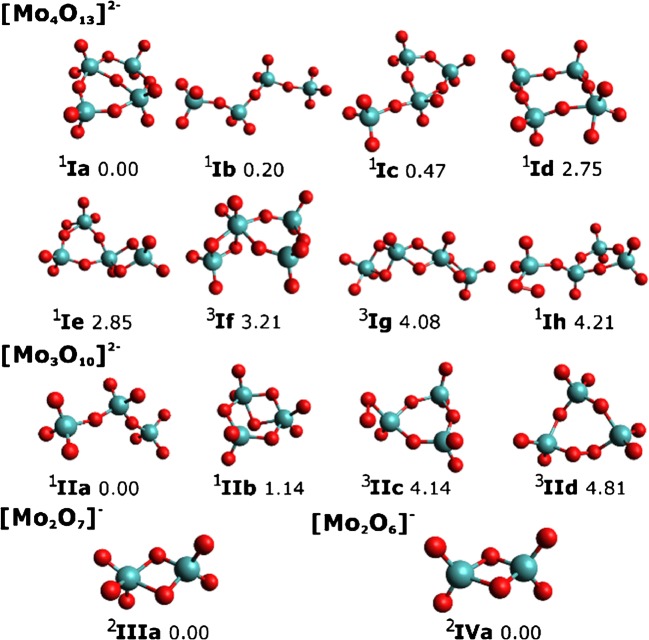
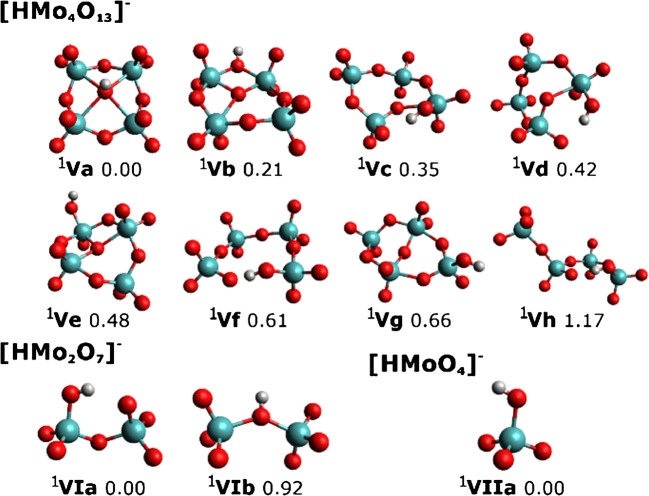
Molybdenum oxide-based catalysts are widely used for the ammoxidation of toluene, methanation of CO, or hydrodeoxygenation. As a first step towards a gas-phase model system, we investigate here structural properties of mass-selected [MoO], [HMoO], and [CHMoO] by a combination of collision-induced dissociation (CID) experiments and quantum chemical calculations. According to calculations, the common structural motif is an eight-membered ring composed of four MoO units and four O atoms. The 13th O atom is located above the center of the ring and connects two to four Mo centers. For [MoO] and [HMoO], dissociation requires opening or rearrangement of the ring structure, which is quite facile for the doubly charged [MoO], but energetically more demanding for [HMoO]. In the latter case, the hydrogen atom is found to stay preferentially with the negatively charged fragments [HMoO] or [HMoO]. The doubly charged species [MoO] loses one MoO unit at low energies while Coulomb explosion into the complementary fragments [MoO] and [MoO] dominates at elevated collision energies. [CHMoO] affords rearrangements of the methyl group with low barriers, preferentially eliminating formaldehyde, while the ring structure remains intact. [CHMoO] also reacts efficiently with water, leading to methanol or formaldehyde elimination.
基于氧化钼的催化剂广泛应用于甲苯的氨氧化、CO 的甲烷化或加氢脱氧。作为气相模型体系研究的第一步,我们通过碰撞诱导解离(CID)实验和量子化学计算相结合,研究了质量选择的[MoO]、[HMoO]和[CHMoO]的结构特性。根据计算,常见的结构基元是由四个 MoO 单元和四个 O 原子组成的八元环。第十三个 O 原子位于环的中心上方,连接两个到四个 Mo 中心。对于[MoO]和[HMoO],解离需要打开或重排环结构,对于双电荷的[MoO]来说,这是相当容易的,但对于[HMoO]来说,能量要求更高。在后一种情况下,发现氢原子优先与带负电荷的碎片[HMoO]或[HMoO]结合。双电荷物种[MoO]在低能量下失去一个 MoO 单元,而在较高的碰撞能量下,库仑爆炸成互补碎片[MoO]和[MoO]占主导地位。[CHMoO]可以通过低能垒进行甲基的重排,优先消除甲醛,而环结构保持完整。[CHMoO]也能与水高效反应,导致甲醇或甲醛消除。