Department of Biotechnology and Food Technology, Faculty of Science, University of Johannesburg, Johannesburg, South Africa.
Department of Chemical Engineering, Faculty of Engineering and the Built Environment, University of Johannesburg, Johannesburg, South Africa.
Microbiologyopen. 2019 Dec;8(12):e914. doi: 10.1002/mbo3.914. Epub 2019 Aug 17.
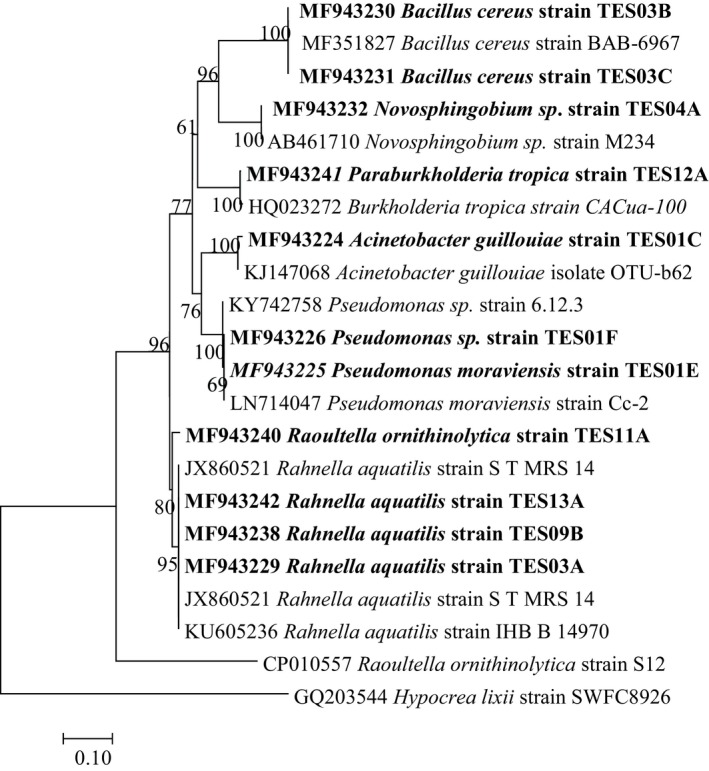
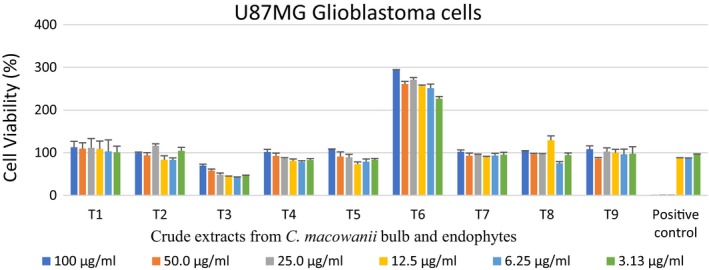
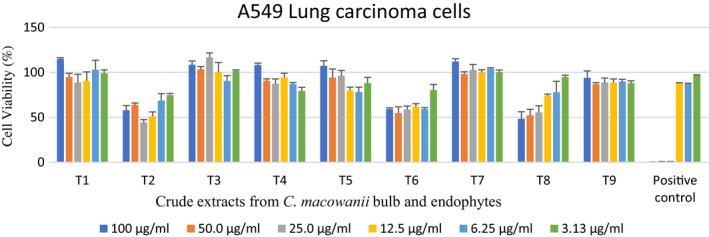
The results from this study revealed that crude extracts isolated from bacterial endophytes obtained from Crinum macowanii bulbs showed activity against both Gram-positive and Gram-negative pathogenic bacteria, while Acinetobacter guillouiae crude extracts displayed anticancer activity. This study aimed to isolate and characterize bacterial endophytes and their crude extracts from C. macowanii bulbs. Endophytes were isolated using validated surface sterilization techniques, followed by phenotypic and genotypic profiles of the isolates. Crude extracts were extracted from the endophytes using ethyl acetate, while methanol:dichloromethane (1:1) was used to obtain crude extracts from the bulbs. Antibacterial activity of crude extract from each endophyte was investigated against selected pathogenic strains using the broth microdilution method, and anticancer activity against U87MG glioblastoma and A549 lung carcinoma cells was determined by the MTS (3-(4,5-dimethylthiazol-2-yl)-5-(3-carboxymethoxy-phenyl)-2-(4-sulfophenyl)-2H-tetrazolium) assay. Acinetobacter guillouiae, Pseudomonas moraviensis, Pseudomonas sp., Rahnella aquatilis, Bacillus cereus, Novosphingobium sp., Raoultella ornithinolytica, and Burkholderia tropica were successfully isolated. The crude extracts from the majority of endophytes showed antibacterial activity, ranging from 0.125 to >16.00 mg/ml against Gram-negative and Gram-positive pathogenic bacteria. Acinetobacter guillouiae extracts showed a high bioactive potential against U87MG glioblastoma cell lines by reducing their growth by 50% at concentrations of 12.5, 6.25, and 3.13 µg/ml. Crude extracts isolated from C. macowanii bulbs showed potential for possible drug lead against common pathogenic bacteria.
本研究结果表明,从 Crinum macowanii 鳞茎中分离得到的细菌内生菌粗提取物对革兰氏阳性和革兰氏阴性致病菌均具有活性,而 Acinetobacter guillouiae 粗提取物则具有抗癌活性。本研究旨在从 C. macowanii 鳞茎中分离和鉴定内生细菌及其粗提取物。采用经过验证的表面消毒技术分离内生菌,然后对分离株进行表型和基因型分析。采用乙酸乙酯从内生菌中提取粗提取物,而采用甲醇:二氯甲烷(1:1)从鳞茎中提取粗提取物。采用肉汤微量稀释法测定每种内生菌粗提取物对选定致病菌株的抗菌活性,采用 MTS(3-(4,5-二甲基噻唑-2-基)-5-(3-羧基甲氧基苯基)-2-(4-磺基苯基)-2H-四唑)测定法测定对 U87MG 神经胶质瘤和 A549 肺癌细胞的抗癌活性。成功分离出 Acinetobacter guillouiae、Pseudomonas moraviensis、Pseudomonas sp.、Rahnella aquatilis、Bacillus cereus、Novosphingobium sp.、Raoultella ornithinolytica 和 Burkholderia tropica。大多数内生菌的粗提取物均表现出抗菌活性,对革兰氏阴性和革兰氏阳性致病菌的抑菌浓度范围为 0.125 至 >16.00mg/ml。Acinetobacter guillouiae 提取物对 U87MG 神经胶质瘤细胞系具有较高的生物活性潜力,其在浓度为 12.5、6.25 和 3.13μg/ml 时可将细胞生长抑制 50%。从 C. macowanii 鳞茎中分离出的粗提取物可能对常见致病菌具有潜在的药物先导作用。