Department of Preventive Medicine and Community Health The University of Texas Medical Branch, Galveston, TX 77555.
Department of Obstetrics and Gynecology, The University of Texas Medical Branch, Galveston, TX 77555.
Nutr Res. 2019 Aug;68:70-81. doi: 10.1016/j.nutres.2019.06.007. Epub 2019 Jul 3.
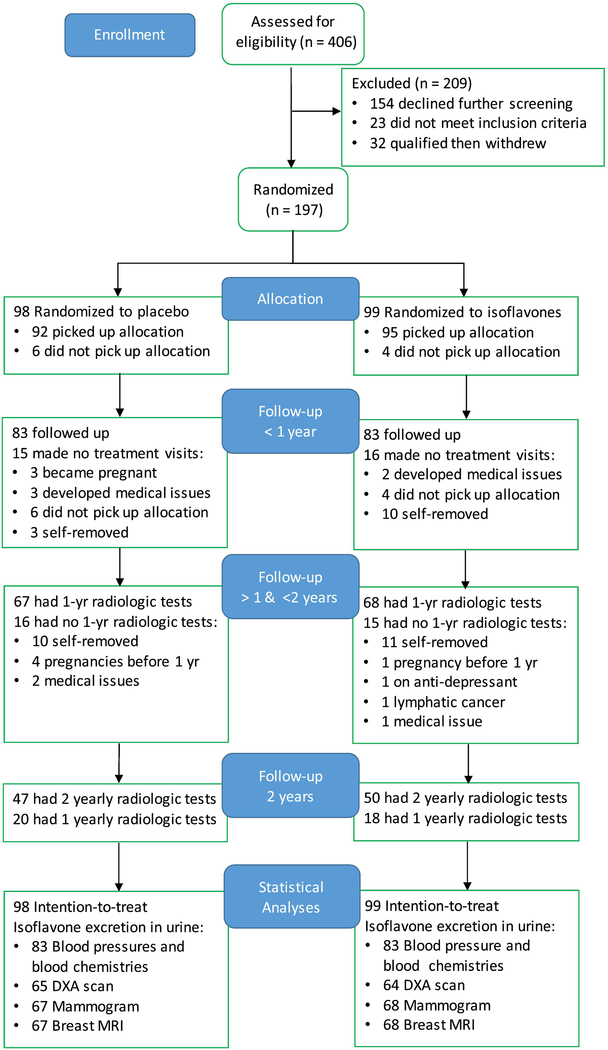
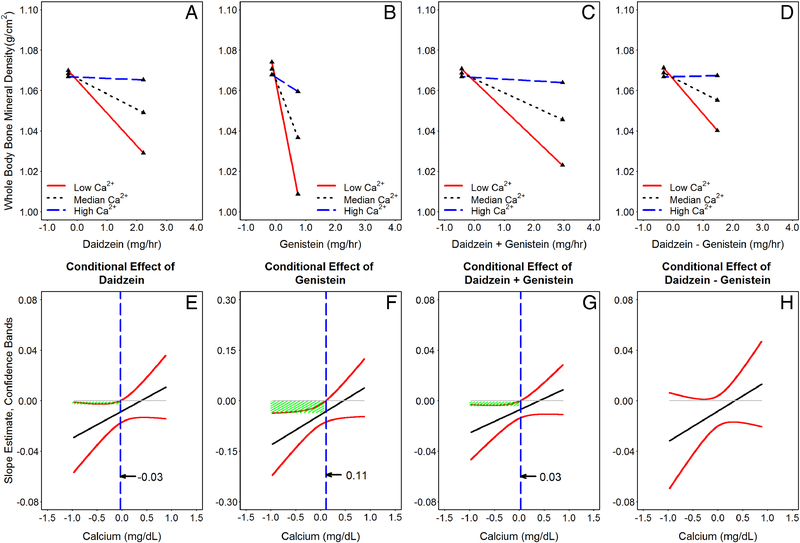
Soy isoflavones are potentially beneficial phytoestrogens, but their tissue-selective effects in women are poorly understood. We tested the hypothesis that soy isoflavones affect bone mineral density (BMD), which may be influenced by individual differences in isoflavone metabolism and serum calcium levels. Ninety-nine healthy premenopausal women were randomized to isoflavones (136.6 mg aglycone equivalence) and 98 to placebo for 5 days per week for up to 2 years. BMD, serum calcium, and urinary excretion of daidzein and genistein were measured before and during treatment. In 129 adherent subjects, we found that isoflavone exposure, determined by urinary excretion levels, but not by dose assignment, interacted with serum calcium in affecting whole body BMD, but not hip and spine BMD. The regression coefficient was -0.042 for genistein excretion (GE) and 0.091 for the interaction between GE and serum calcium (all P < .05). Daidzein excretion had similar but marginal effect. Genistein significantly decreased whole body BMD only at low normal serum calcium levels but increased whole body BMD at higher serum calcium levels. Comparing maximum to minimum GE, mean changes in whole body BMD were +0.033 and -0.113 g/cm at serum calcium levels of 10 and 8.15 mg/dL, respectively. These associations were not evident by intention-to-treat analysis, which could not model for inter-individual differences in isoflavone metabolism. In summary, soy isoflavones decrease whole body BMD only when serum calcium is low. Isoflavones are dietary substances that may influence calcium homeostasis by releasing calcium from bone while sparing the common fracture risk sites hip and spine.
大豆异黄酮是一种潜在有益的植物雌激素,但它们在女性中的组织选择性作用尚未被充分了解。我们假设大豆异黄酮会影响骨密度(BMD),而这可能受到个体异黄酮代谢和血清钙水平的影响。我们将 99 名健康的绝经前妇女随机分为异黄酮组(136.6 毫克苷元当量)和安慰剂组,每周 5 天,持续 2 年。在治疗前和治疗期间,测量了 BMD、血清钙和大豆苷元和染料木黄酮的尿排泄量。在 129 名依从性良好的受试者中,我们发现异黄酮的暴露程度,通过尿排泄水平而不是剂量分配来确定,与血清钙相互作用影响全身 BMD,但不影响髋部和脊柱 BMD。染料木黄酮排泄的回归系数为-0.042(GE),GE 与血清钙之间的相互作用的回归系数为 0.091(均 P<.05)。大豆苷元排泄也有类似但边缘显著的影响。只有在血清钙正常低值时,大豆异黄酮才会显著降低全身 BMD,但在较高的血清钙水平时会增加全身 BMD。比较 GE 的最高值和最低值,血清钙水平为 10 和 8.15 mg/dL 时,全身 BMD 的平均变化分别为+0.033 和-0.113 g/cm。这些关联在意向治疗分析中并不明显,因为该分析无法对异黄酮代谢的个体差异进行建模。总之,只有当血清钙低时,大豆异黄酮才会降低全身 BMD。大豆异黄酮是一种膳食物质,通过从骨骼中释放钙来影响钙稳态,同时避免髋部和脊柱等常见骨折风险部位。