Academic Department of Diabetes and Endocrinology, Queen Alexandra Hospital, Portsmouth, UK.
Raja Isteri Pengiran Anak Saleha Hospital, Bandar Seri Begawan, 1710, Brunei Darussalam.
BMC Gastroenterol. 2021 Apr 1;21(1):144. doi: 10.1186/s12876-021-01660-5.
Non-alcoholic fatty liver disease (NAFLD) is associated with increased cardiovascular risk irrespective of conventional risk factors. The role of gut-liver interaction is implicated in its development. We investigated the effects of VSL#3 probiotic supplementation on biomarkers of cardiovascular risk and liver injury in patients with NAFLD.
A randomised, double-blinded, placebo-controlled, proof-of-concept study was undertaken. Patients with NAFLD were randomly allocated to take 2 sachets VSL#3 probiotic or placebo twice daily for 10 weeks. Measurements of endothelial function (digital photoplethysmography, sVCAM-1 and cGMP), oxidative stress (glutathione ratio and LHP), inflammation (hsCRP), insulin resistance (HOMA-IR) and liver injury [transaminases, fibrosis risk score and acoustic structure quantification (ASQ)] were undertaken before and after intervention. Difference in baseline characteristics between the treatment groups was analysed using independent t-test or Mann Whitney U test for non-parametric data. Independent t-test was used to compare the outcomes at the end of the study between the two treatment groups. Wilcoxon Signed Rank test was used to determine the difference in fibrosis risk scores before and after treatment. Spearman's correlation was used to determine any association between cardiovascular and hepatic markers at baseline.
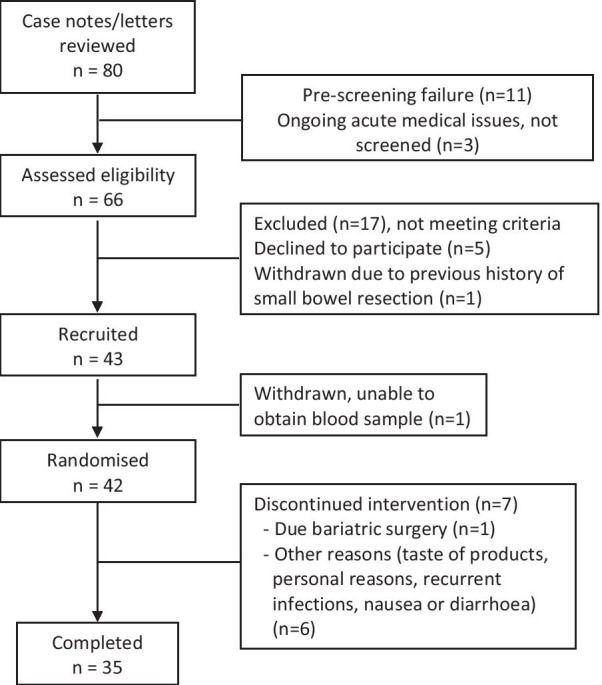
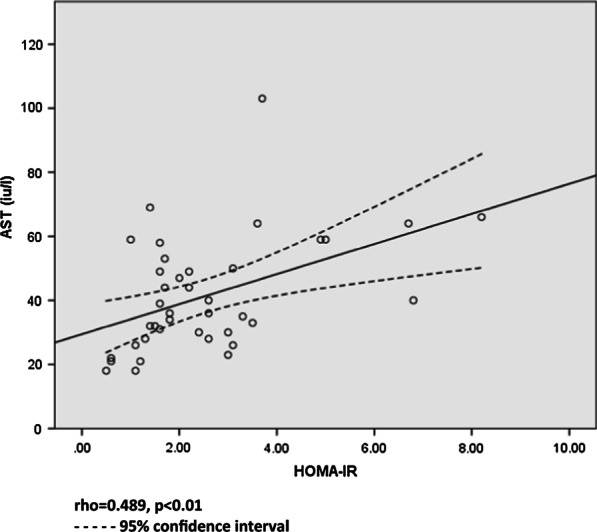
Thirty-five patients completed the study (28 males and 7 females) with a mean age of 57 ± 8 years, body mass index of 32.6 ± 5.0 kg/m and a relatively short duration of NAFLD (median duration 0.3 IQR 2.0 years). No significant difference was observed in biomarkers of cardiovascular risk and liver injury following VSL#3 supplementation. Significant correlations were noted between sVCAM-1 and hsCRP (rho = 0.392, p = 0.01), and HOMA-IR and AST (rho = 0.489, p < 0.01) at baseline.
This is the first study to evaluate the effect of VSL#3 on ASQ in patients with NAFLD. VSL#3 did not significantly improve markers of cardiovascular risk and liver injury in patients with NAFLD. However, the study supports an association between endothelial dysfunction and inflammation in patients with NAFLD and suggests that NAFLD is linked with insulin resistance.
ISRCTN05474560 ( https://doi.org/10.1186/ISRCTN05474560 ) Registered 9 August 2012 (retrospectively registered).
非酒精性脂肪性肝病(NAFLD)与心血管风险增加有关,而不论传统危险因素如何。肠道-肝脏相互作用在其发病机制中起作用。我们研究了 VSL#3 益生菌补充剂对 NAFLD 患者心血管风险和肝损伤生物标志物的影响。
进行了一项随机、双盲、安慰剂对照的概念验证研究。将 NAFLD 患者随机分配每天服用 2 袋 VSL#3 益生菌或安慰剂两次,共 10 周。在干预前后测量内皮功能(数字光体积描记法、sVCAM-1 和 cGMP)、氧化应激(谷胱甘肽比和 LHP)、炎症(hsCRP)、胰岛素抵抗(HOMA-IR)和肝损伤[转氨酶、纤维化风险评分和声学结构定量(ASQ)]。使用独立 t 检验或非参数数据的曼-惠特尼 U 检验分析治疗组之间基线特征的差异。使用独立 t 检验比较两组治疗结束时的结局。使用 Wilcoxon 符号秩检验确定治疗前后纤维化风险评分的差异。使用 Spearman 相关系数确定基线时心血管和肝脏标志物之间的任何关联。
35 名患者完成了研究(28 名男性和 7 名女性),平均年龄 57±8 岁,体重指数 32.6±5.0kg/m2,NAFLD 持续时间相对较短(中位数持续时间 0.3 IQR 2.0 年)。VSL#3 补充后,心血管风险和肝损伤的生物标志物无明显变化。在基线时,sVCAM-1 与 hsCRP 之间存在显著相关性(rho=0.392,p=0.01),HOMA-IR 与 AST 之间存在显著相关性(rho=0.489,p<0.01)。
这是第一项评估 VSL#3 对 NAFLD 患者 ASQ 影响的研究。VSL#3 并未显著改善 NAFLD 患者的心血管风险和肝损伤标志物。然而,该研究支持 NAFLD 患者内皮功能障碍和炎症之间存在关联,并表明 NAFLD 与胰岛素抵抗有关。
ISRCTN05474560(https://doi.org/10.1186/ISRCTN05474560)于 2012 年 8 月 9 日注册(追溯注册)。