Eniu Alexandru, Cherny Nathan I, Bertram Melanie, Thongprasert Sumitra, Douillard Jean-Yves, Bricalli Gracemarie, Vyas Malvika, Trapani Dario
Department of Breast Tumors, Cancer Institute Ion Chiricuta, Cluj-Napoca, Romania.
Chair of the Global Policy Committee, European Society for Medical Oncology, Lugano, Switzerland.
ESMO Open. 2019 Jul 17;4(4):e000483. doi: 10.1136/esmoopen-2018-000483. eCollection 2019.
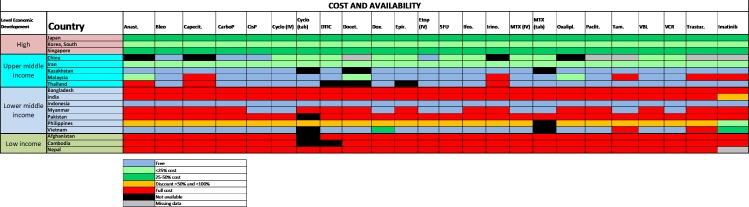
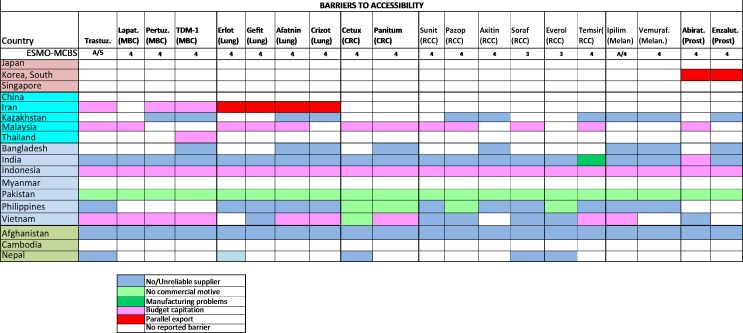
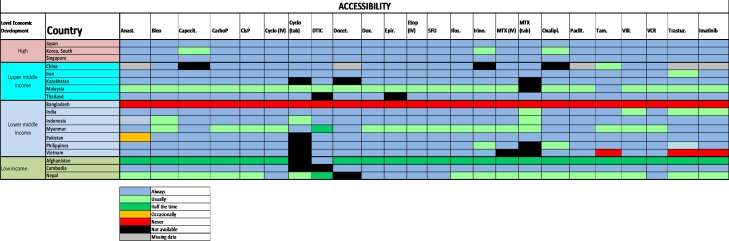
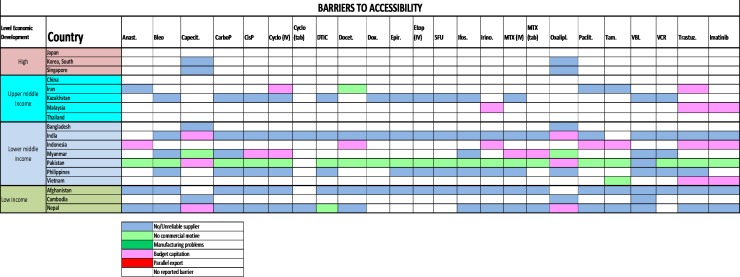
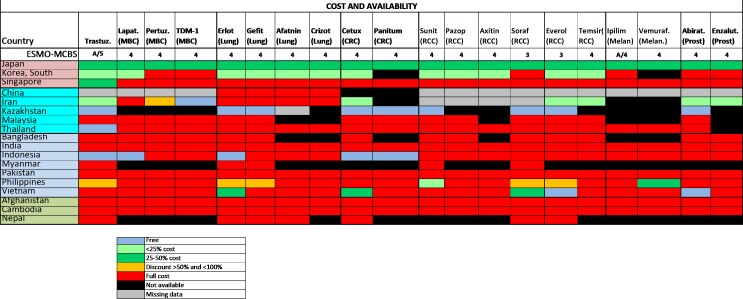
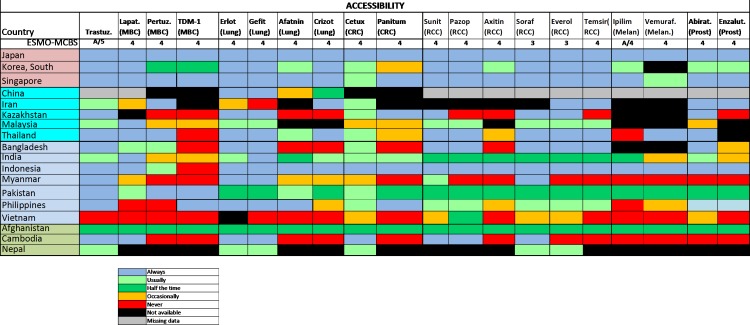
This review article is an overview of the session at the European Society for Medical Oncology (ESMO) Asia 2018 Congress entitled: 'Cancer medicines in Asia and Asia-Pacific: What is available, and is it effective enough?'. The article provides an overview of the session speakers' views on the impact that the lack of accessibility and availability of medicines has on patient outcomes in the treatment of breast cancer, colorectal cancer and lung cancer, responsible for more than one-third of cancer deaths in the Asian region. It also lists the various global policy initiatives that ESMO supports to promote the best cancer care in the Asian and Asia-Pacific region. The review presents extrapolated data from the 'ESMO International Consortium Study on the availability, out-of-pocket costs and accessibility of antineoplastic medicines in countries outside of Europe', which reveals several disparities among Asian countries, across the different income levels. In low- and middle-income countries, some barriers to the accessibility of anticancer medicines include the lack of government reimbursement, budget allocation for healthcare and quality-assured generic and biosimilar medicines, as well as shortages and patent rights. Throughout the article, the session presenters provide their views on strategies that can be considered to overcome these barriers.
这篇综述文章概述了在2018年欧洲肿瘤内科学会(ESMO)亚洲大会上题为“亚洲及亚太地区的癌症药物:有哪些药物可用,其疗效是否足够?”的会议内容。本文概述了会议发言者对于药物可及性和可用性的缺乏对乳腺癌、结直肠癌和肺癌治疗中患者治疗结果的影响的看法,这三种癌症导致了亚洲地区超过三分之一的癌症死亡。文章还列出了ESMO支持的各种全球政策倡议,以促进亚洲及亚太地区的最佳癌症治疗。该综述展示了“ESMO国际联盟关于欧洲以外国家抗肿瘤药物的可用性、自付费用和可及性的研究”中的推断数据,这些数据揭示了亚洲不同收入水平国家之间的一些差异。在低收入和中等收入国家,抗癌药物可及性的一些障碍包括缺乏政府报销、医疗保健预算分配以及质量有保证的仿制药和生物类似药,还有药品短缺和专利权问题。在整篇文章中,会议发言者就可以考虑用来克服这些障碍的策略发表了他们的看法。