Institute of Biology Leiden, Leiden University, Leiden, Netherlands.
Front Cell Infect Microbiol. 2019 Aug 2;9:279. doi: 10.3389/fcimb.2019.00279. eCollection 2019.
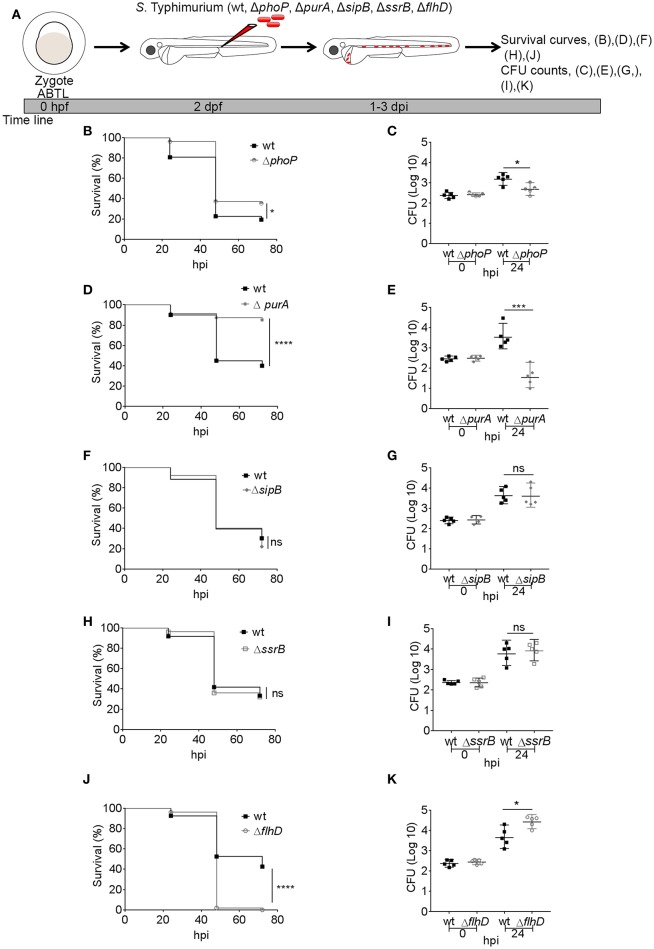
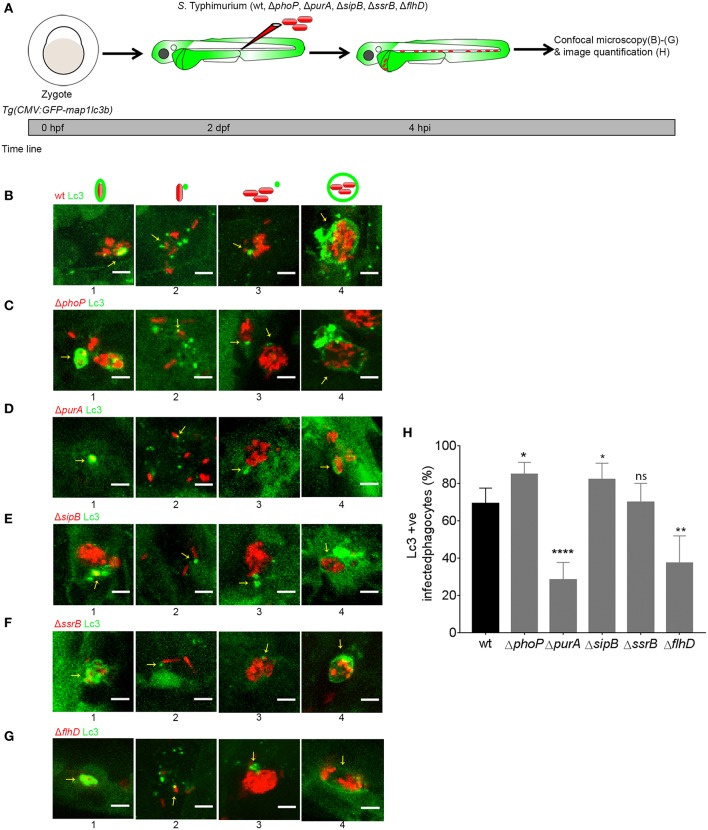
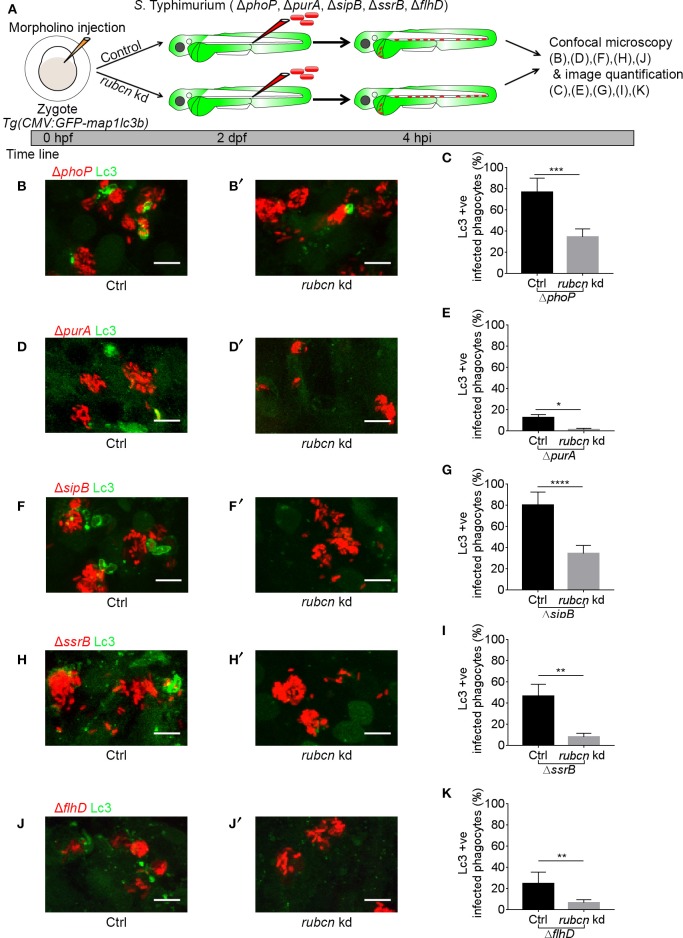
Intracellular pathogens such as depend on their molecular virulence factors to evade host defense responses like autophagy. Using a zebrafish systemic infection model, we have previously shown that phagocytes, predominantly macrophages, target Typhimurium by an autophagy-related pathway known as Lc3-associated phagocytosis (LAP), which is dependent on the host protein Rubicon. Here, we explore the influence of virulence factors on pathogenicity in the zebrafish model and induction of LAP as a defense response. We investigated five mutant strains that all could trigger GFP-Lc3 recruitment as puncta or rings around single bacteria or bacterial clusters, in a Rubicon-dependent manner. We found that . Typhimurium strains carrying mutations in PhoP or PurA, responsible for adaptation to the intracellular environment and efficient metabolism of purines, respectively, are attenuated in the zebrafish model. However, both strains show increased virulence when LAP is inhibited by knockdown of Rubicon. Mutations in type III secretion systems 1 and 2, SipB and SsrB, which are important for invading and replicating in non-phagocytic cells, did not affect the ability to establish successful infection in the zebrafish model. This observation is in line with our previous characterization of this infection model revealing that macrophages actively phagocytose the majority of . Typhimurium. In contrast to SipB mutants, SsrB mutants were unable to become more virulent in Rubicon-deficient hosts, suggesting that type III system 2 effectors are important for intracellular replication of in the absence of LAP. Finally, we found that mutation of FlhD, required for production of flagella, renders . Typhimurium hypervirulent both in wild type zebrafish embryos and in Rubicon-deficient hosts. FlhD mutation also led to lower levels of GFP-Lc3 recruitment compared with the wild type strain, indicating that recognition of flagellin by the host innate immune system promotes the LAP response. Together, our results provide new evidence that the Rubicon-dependent LAP process is an important defense mechanism against . Typhimurium.
细胞内病原体,如 ,依赖于其分子毒力因子来逃避宿主防御反应,如自噬。我们之前使用斑马鱼系统感染模型表明,吞噬细胞,主要是巨噬细胞,通过一种称为 Lc3 相关吞噬作用(LAP)的自噬相关途径靶向 沙门氏菌 Typhimurium,该途径依赖于宿主蛋白 Rubicon。在这里,我们探讨了 毒力因子对斑马鱼模型中的致病性和 LAP 作为防御反应的诱导的影响。我们研究了五个突变株,它们都可以在 Rubicon 依赖性方式下,在单个细菌或细菌簇周围引发 GFP-Lc3 募集为斑点或环。我们发现,沙门氏菌 Typhimurium 菌株中 PhoP 或 PurA 的突变,分别负责适应细胞内环境和嘌呤的有效代谢,在斑马鱼模型中是衰减的。然而,当 LAP 被 Rubicon 的敲低抑制时,这两种菌株的毒力都增加了。III 型分泌系统 1 和 2 的 SipB 和 SsrB 的突变,对于侵入和在非吞噬细胞中复制是重要的,不会影响在斑马鱼模型中建立成功感染的能力。这一观察结果与我们之前对该感染模型的表征一致,表明巨噬细胞主动吞噬大多数沙门氏菌 Typhimurium。与 SipB 突变体相反,SsrB 突变体在 Rubicon 缺陷型宿主中无法变得更具毒力,这表明 III 型系统 2 效应子在缺乏 LAP 的情况下对于沙门氏菌 Typhimurium 的细胞内复制是重要的。最后,我们发现,鞭毛产生所需的 FlhD 突变使沙门氏菌 Typhimurium 在野生型斑马鱼胚胎和 Rubicon 缺陷型宿主中都具有高毒力。FlhD 突变也导致 GFP-Lc3 募集水平低于野生型菌株,表明宿主固有免疫系统对鞭毛蛋白的识别促进了 LAP 反应。总之,我们的结果提供了新的证据,表明 Rubicon 依赖性 LAP 过程是对抗沙门氏菌 Typhimurium 的重要防御机制。