Lubrano Ennio, Perrotta Fabio Massimo, Scriffignano Silvia, Coates Laura C, Helliwell Philip
Dipartimento di Medicina e Scienze, della Salute "Vincenzo Tiberio", Università degli Studi del Molise, Campobasso, Italy.
Department of Orthopaedics, Rheumatology and Musculoskeletal Sciences, University of Oxford, Oxford, UK.
Rheumatol Ther. 2019 Dec;6(4):521-528. doi: 10.1007/s40744-019-00171-w. Epub 2019 Aug 19.
Sustained remission should be considered the main therapeutic target in psoriatic arthritis (PsA). Very low disease activity (VLDA) and a DAPSA score ≤ 4 are the most commonly used criteria. The aim of the present study was to evaluate the rate of sustained remission in a group of PsA patients followed in a real-life setting.
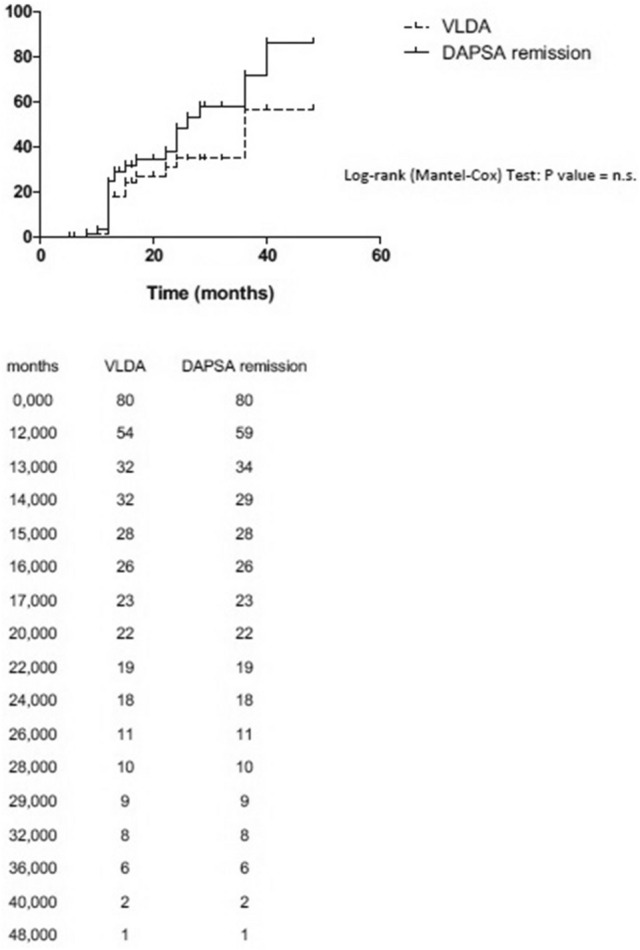
All PsA patients satisfying CASPAR criteria were followed prospectively every 3-6 months, in a context of clinical practice by January 2013. Sustained remission was defined when patients achieved a DAPSA score ≤ 4 and/or VLDA for at least 12 months. The exclusion criterion was the presence of a condition of VLDA or DAPSA ≤ 4 at the baseline assessment. Kaplan-Meier survival curve was used to evaluate the survival of patients.
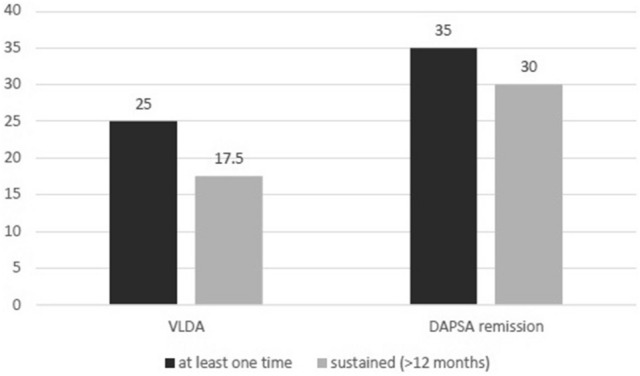
A total of 147 PsA patients were evaluated for the study. Of these, 80 performed at least 12 consecutive months of follow-up. The average duration of follow-up was 24 months (range, 12-60 months). At the last follow-up, 22 patients were on csDMARDs treatment while 58 patients were on bDMARDs. Of the 80 patients, 14 (17.5%) achieved a sustained VLDA while 24 (30%) achieved sustained remission according to the DAPSA criteria. The mean duration of remission in patients achieving VLDA and DAPSA ≤ 4 was 17 months for both criteria. High baseline levels of CRP, shorter disease duration, and less pain at baseline were found to be predictors of sustained VLDA and DAPSA remission.
In our study, based on clinical practice, a sustained VLDA was achieved in 17.5% and a sustained remission according to the DAPSA criteria in 30% of patients with PsA.
持续缓解应被视为银屑病关节炎(PsA)的主要治疗目标。极低疾病活动度(VLDA)和疾病活动度评分(DAPSA)≤4是最常用的标准。本研究的目的是评估在现实生活环境中随访的一组PsA患者的持续缓解率。
2013年1月前,在临床实践中,对所有符合CASPAR标准的PsA患者每3 - 6个月进行前瞻性随访。当患者的DAPSA评分≤4和/或VLDA持续至少12个月时,定义为持续缓解。排除标准为基线评估时存在VLDA或DAPSA≤4的情况。采用Kaplan-Meier生存曲线评估患者的缓解情况。
共有147例PsA患者纳入本研究评估。其中,80例患者进行了至少连续12个月的随访。平均随访时间为24个月(范围12 - 60个月)。在最后一次随访时,22例患者接受传统合成改善病情抗风湿药(csDMARDs)治疗,58例患者接受生物制剂改善病情抗风湿药(bDMARDs)治疗。在这80例患者中,14例(17.5%)达到持续VLDA,24例(30%)根据DAPSA标准达到持续缓解。达到VLDA和DAPSA≤4的患者,两种标准下的平均缓解持续时间均为17个月。发现基线时较高的CRP水平、较短的病程和较低的基线疼痛是持续VLDA和DAPSA缓解的预测因素。
在我们基于临床实践的研究中,17.5%的PsA患者实现了持续VLDA,30%的患者根据DAPSA标准实现了持续缓解。