Singapore Bioimaging Consortium, Agency for Science Technology and Research, Singapore.
Pohang University of Science and Technology, Department of Creative IT Engineering, Pohang, Republic of Korea.
J Biomed Opt. 2019 Aug;24(8):1-7. doi: 10.1117/1.JBO.24.8.086001.
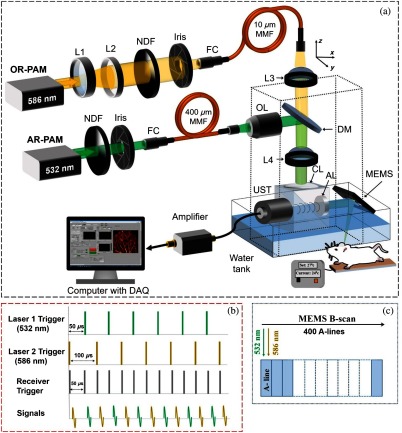
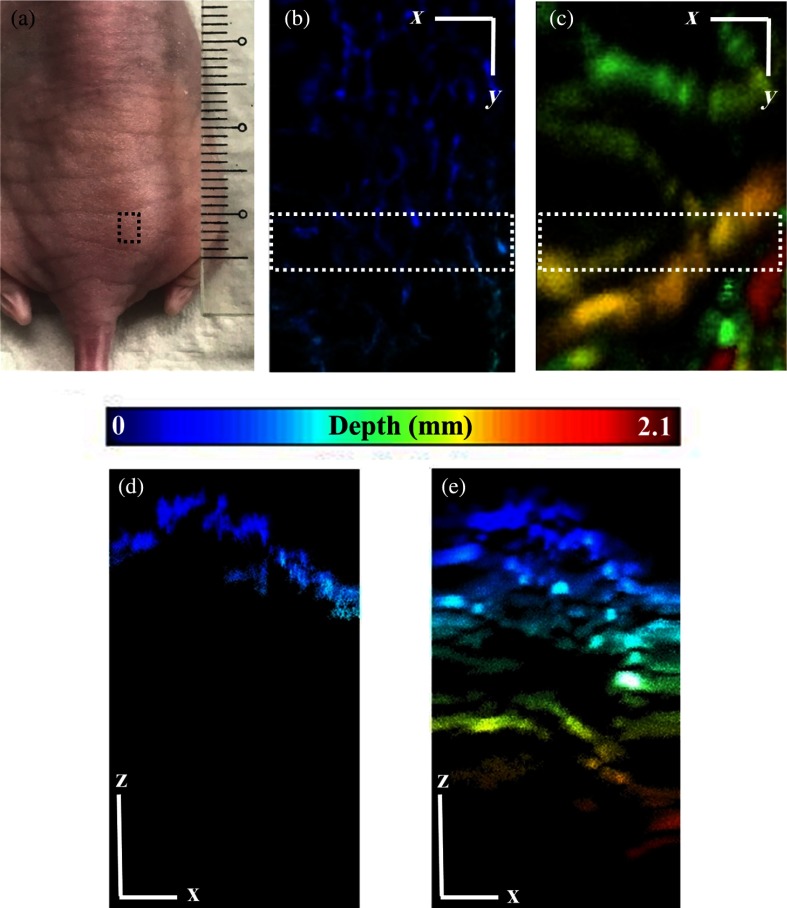
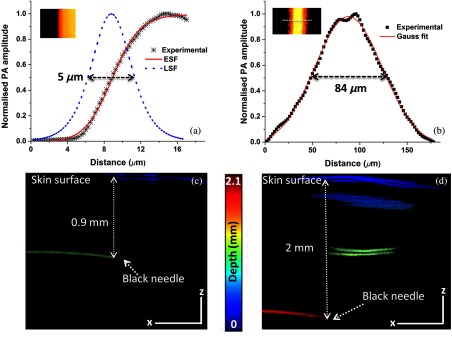
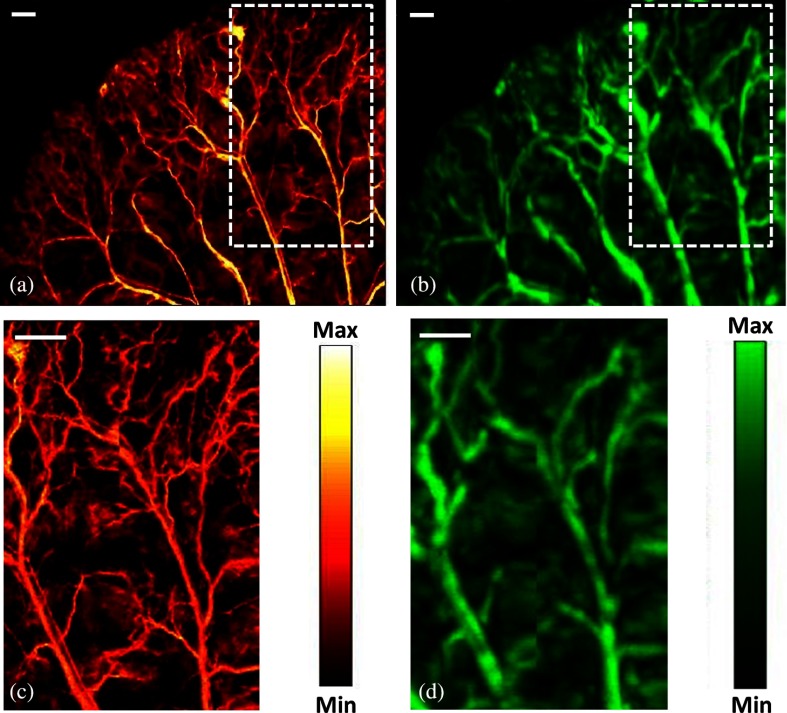
Photoacoustic microscopy (PAM) is a fast-growing biomedical imaging technique that provides high-resolution in vivo imaging beyond the optical diffusion limit. Depending on the scalable lateral resolution and achievable penetration depth, PAM can be classified into optical resolution PAM (OR-PAM) and acoustic resolution PAM (AR-PAM). The use of a microelectromechanical systems (MEMS) scanner has improved OR-PAM imaging speed significantly and is highly beneficial in the development of miniaturized handheld devices. The shallow penetration depth of OR-PAM limits the use of such devices for a wide range of clinical applications. We report the use of a high-speed MEMS scanner for both OR-PAM and AR-PAM. A high-speed, wide-area scanning integrated OR-AR-PAM system combining MEMS scanner and raster mechanical movement was developed. A lateral resolution of 5 μm and penetration depth ∼0.9-mm in vivo was achieved using OR-PAM at 586 nm, whereas a lateral resolution of 84 μm and penetration depth of ∼2-mm in vivo was achieved using AR-PAM at 532 nm.
光声显微镜(PAM)是一种快速发展的生物医学成像技术,可提供超越光扩散极限的高分辨率体内成像。根据可扩展的横向分辨率和可实现的穿透深度,PAM 可分为光学分辨率 PAM(OR-PAM)和声学分辨率 PAM(AR-PAM)。微机电系统(MEMS)扫描仪的使用极大地提高了 OR-PAM 成像速度,这对于开发小型手持式设备非常有益。OR-PAM 的浅层穿透深度限制了此类设备在广泛临床应用中的使用。我们报告了使用高速 MEMS 扫描仪进行 OR-PAM 和 AR-PAM。开发了一种高速、大面积扫描集成 OR-AR-PAM 系统,结合了 MEMS 扫描仪和光栅机械运动。在 586nm 处使用 OR-PAM 实现了 5μm 的横向分辨率和约 0.9mm 的体内穿透深度,而在 532nm 处使用 AR-PAM 实现了 84μm 的横向分辨率和约 2mm 的体内穿透深度。