Yin Andrew Lukas, Hachuel David, Pollak John P, Scherl Ellen J, Estrin Deborah
Medical College, Weill Cornell Medicine, New York, NY, United States.
Cornell Tech, New York, NY, United States.
J Med Internet Res. 2019 Aug 19;21(8):e14630. doi: 10.2196/14630.
Digital health is poised to transform health care and redefine personalized health. As Internet and mobile phone usage increases, as technology develops new ways to collect data, and as clinical guidelines change, all areas of medicine face new challenges and opportunities. Inflammatory bowel disease (IBD) is one of many chronic diseases that may benefit from these advances in digital health. This review intends to lay a foundation for clinicians and technologists to understand future directions and opportunities together.
This review covers mobile health apps that have been used in IBD, how they have fit into a clinical care framework, and the challenges that clinicians and technologists face in approaching future opportunities.
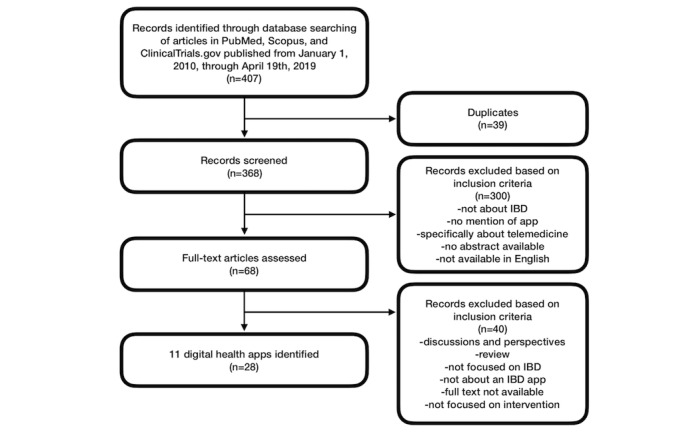
We searched PubMed, Scopus, and ClinicalTrials.gov to identify mobile apps that have been studied and were published in the literature from January 1, 2010, to April 19, 2019. The search terms were ("mobile health" OR "eHealth" OR "digital health" OR "smart phone" OR "mobile app" OR "mobile applications" OR "mHealth" OR "smartphones") AND ("IBD" OR "Inflammatory bowel disease" OR "Crohn's Disease" (CD) OR "Ulcerative Colitis" (UC) OR "UC" OR "CD"), followed by further analysis of citations from the results. We searched the Apple iTunes app store to identify a limited selection of commercial apps to include for discussion.
A total of 68 articles met the inclusion criteria. A total of 11 digital health apps were identified in the literature and 4 commercial apps were selected to be described in this review. While most apps have some educational component, the majority of apps focus on eliciting patient-reported outcomes related to disease activity, and a few are for treatment management. Significant benefits have been seen in trials relating to education, quality of life, quality of care, treatment adherence, and medication management. No studies have reported a negative impact on any of the above. There are mixed results in terms of effects on office visits and follow-up.
While studies have shown that digital health can fit into, complement, and improve the standard clinical care of patients with IBD, there is a need for further validation and improvement, from both a clinical and patient perspective. Exploring new research methods, like microrandomized trials, may allow for more implementation of technology and rapid advancement of knowledge. New technologies that can objectively and seamlessly capture remote data, as well as complement the clinical shift from symptom-based to inflammation-based care, will help the clinical and health technology communities to understand the full potential of digital health in the care of IBD and other chronic illnesses.
数字健康有望变革医疗保健并重新定义个性化健康。随着互联网和手机使用的增加、技术开发出收集数据的新方法以及临床指南的变化,医学的各个领域都面临着新的挑战和机遇。炎症性肠病(IBD)是众多可能受益于数字健康这些进展的慢性病之一。本综述旨在为临床医生和技术专家共同理解未来方向和机遇奠定基础。
本综述涵盖了已用于IBD的移动健康应用程序、它们如何融入临床护理框架以及临床医生和技术专家在把握未来机遇时所面临的挑战。
我们检索了PubMed、Scopus和ClinicalTrials.gov,以识别2010年1月1日至2019年4月19日期间在文献中被研究并发表的移动应用程序。检索词为(“移动健康”或“电子健康”或“数字健康”或“智能手机”或“移动应用”或“移动应用程序”或“移动医疗”或“智能手机”)以及(“IBD”或“炎症性肠病”或“克罗恩病”(CD)或“溃疡性结肠炎”(UC)或“UC”或“CD”),随后对结果中的参考文献进行进一步分析。我们在苹果iTunes应用商店中进行搜索,以识别出有限的一些商业应用程序纳入讨论。
共有68篇文章符合纳入标准。在文献中识别出了总共11个数字健康应用程序,本综述选择了4个商业应用程序进行描述。虽然大多数应用程序都有一些教育成分,但大多数应用程序侧重于获取与疾病活动相关的患者报告结局,少数应用程序用于治疗管理。在与教育、生活质量、护理质量、治疗依从性和药物管理相关的试验中已观察到显著益处。没有研究报告对上述任何一项有负面影响。在对门诊就诊和随访的影响方面结果不一。
虽然研究表明数字健康可以融入、补充并改善IBD患者的标准临床护理,但从临床和患者角度来看,仍需要进一步验证和改进。探索新的研究方法,如微随机试验,可能会使技术得到更多应用并推动知识快速进步。能够客观且无缝地获取远程数据以及补充从基于症状的护理向基于炎症的护理的临床转变的新技术,将有助于临床和健康技术领域了解数字健康在IBD和其他慢性病护理中的全部潜力。
