Cloete Karen J, Šmit Žiga, Minnis-Ndimba Roya, Vavpetič Primož, du Plessis Anton, le Roux Stephan G, Pelicon Primož
iThemba Laboratory for Accelerator Based Sciences, National Research Foundation, PO Box 722, Somerset West 7129, South Africa.
Jožef Stefan Institute, Jamova cesta 39, SI-1001 Ljubljana, Slovenia.
Food Chem X. 2019 May 21;2:100032. doi: 10.1016/j.fochx.2019.100032. eCollection 2019 Jun 30.
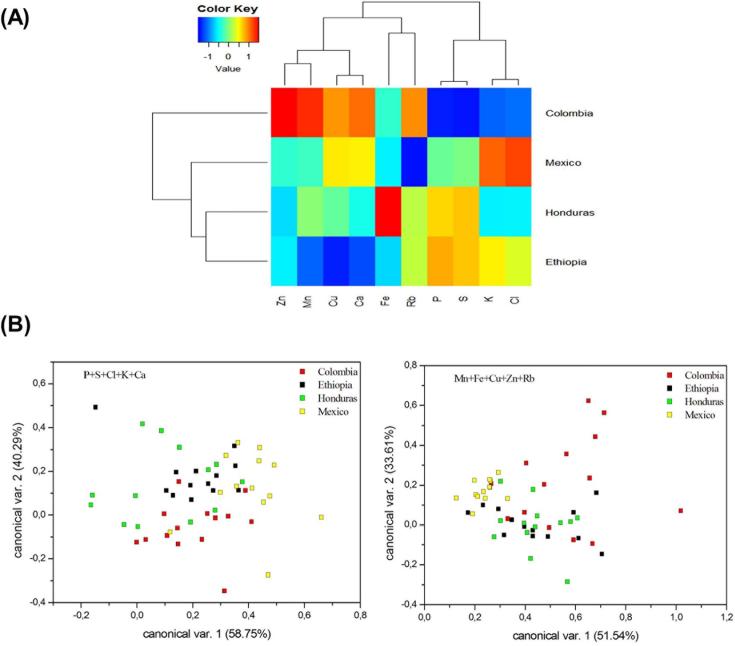
The physico-elemental profiles of commercially attained and roasted organic coffee beans from Ethiopia, Colombia, Honduras, and Mexico were compared using light microscopy, X-ray micro-computed tomography, and external beam particle induced X-ray emission. External beam PIXE analysis detected P, S, Cl, K, Ca, Ti, Mn, Fe, Cu, Zn, Br, Rb, and Sr in samples. Linear discriminant analysis showed that there was no strong association between elemental data and production region, whilst a heatmap combined with hierarchical clustering showed that soil-plant physico-chemical properties may influence regional elemental signatures. Physical trait data showed that Mexican coffee beans weighed significantly more than beans from other regions, whilst Honduras beans had the highest width. X-ray micro-computed tomography qualitative data showed heterogeneous microstructural features within and between beans representing different regions. In conclusion, such multi-dimensional analysis may present a promising tool in assessing the nutritional content and qualitative characteristics of food products such as coffee.
使用光学显微镜、X射线显微计算机断层扫描和外束粒子激发X射线发射,对来自埃塞俄比亚、哥伦比亚、洪都拉斯和墨西哥的商业采购及烘焙的有机咖啡豆的物理元素特征进行了比较。外束PIXE分析在样品中检测到了磷、硫、氯、钾、钙、钛、锰、铁、铜、锌、溴、铷和锶。线性判别分析表明,元素数据与产地之间没有很强的关联,而结合层次聚类的热图表明,土壤-植物物理化学性质可能会影响区域元素特征。物理性状数据表明,墨西哥咖啡豆的重量明显高于其他地区的咖啡豆,而洪都拉斯咖啡豆的宽度最大。X射线显微计算机断层扫描定性数据显示,代表不同地区的咖啡豆内部和之间存在异质微观结构特征。总之,这种多维度分析可能是评估咖啡等食品营养成分和质量特征的一种有前景的工具。