Ojha Probir Kumar, Roy Kunal
Drug Theoretics and Cheminformatics Laboratory, Department of Pharmaceutical Technology, Jadavpur University Kolkata 700 032 India
RSC Adv. 2018 Jan 9;8(5):2293-2304. doi: 10.1039/c7ra12914a.
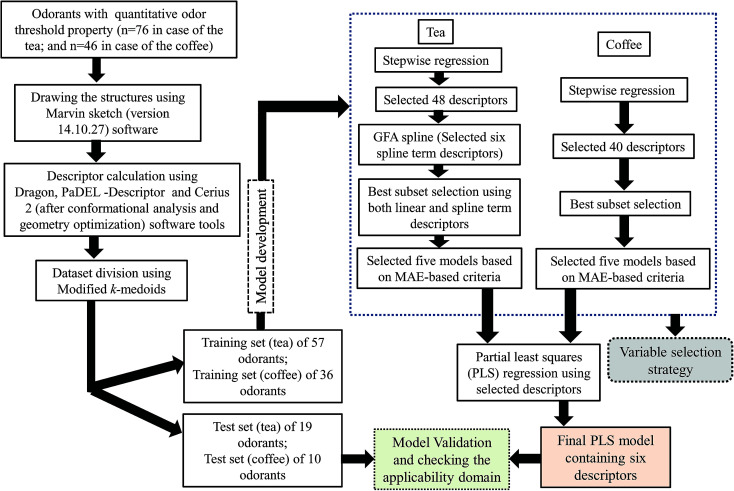
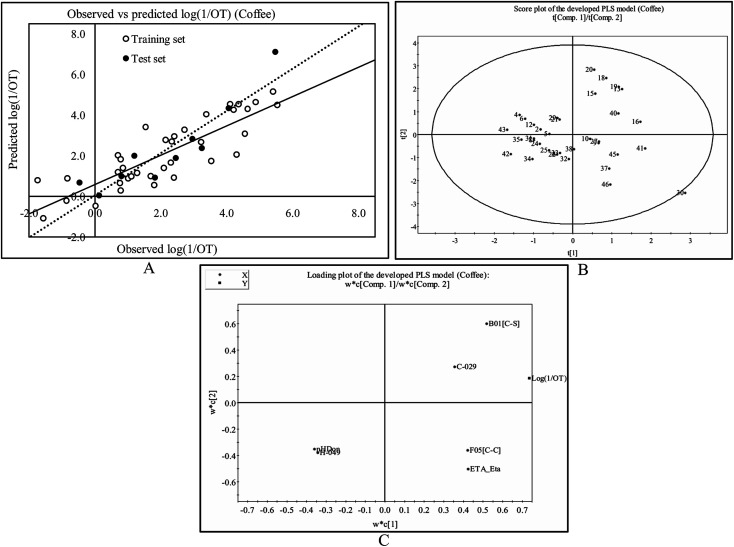
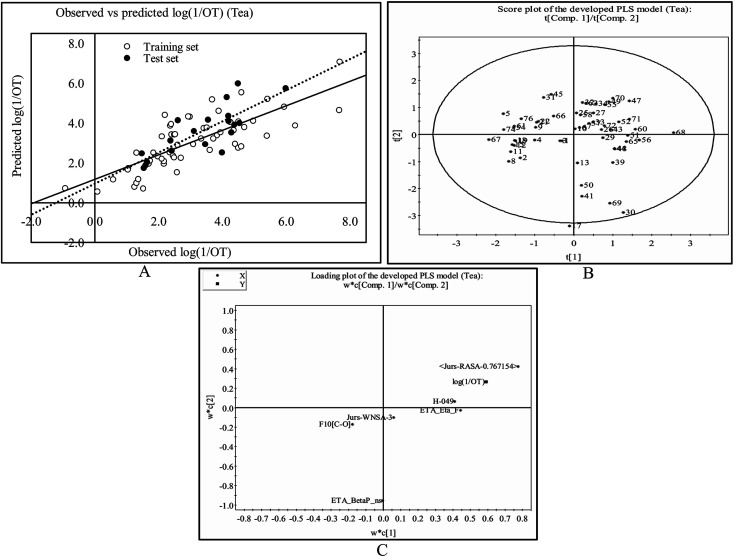
Tea and coffee are the most attractive non-alcoholic beverages used worldwide due to the odorant properties of diverse components present in these beverages. The aim of this work is to investigate the key structural features which regulate the odorant properties of constituents present in black tea and coffee using regression-based chemometric models. We have also investigated the key structural properties which create the odor difference between tea and coffee. We have employed different variable selection strategies to extract the most relevant variables prior to development of final partial least squares (PLS) models. The models were extensively validated using different validation metrics, and the results justify the reliability and usefulness of the developed predictive PLS models. The best PLS model captured the necessary structural information on relative hydrophobic surface area, heteroatoms with higher number of multiple bonds, hydrogen atoms connected to C(sp)/C(sp)/C(sp)/C(sp) fragments, electron-richness, C-O atom pairs at the topological distance 10 and surface weighted charged partial negative surface areas for explaining the odorant properties of the constituents present in black tea. On the other hand, C-S atom pairs at the topological distance 1, C-C atom pairs at the topological distance 5, donor atoms like N and O for hydrogen bonds, hydrogen atoms connected to C(sp)/C(sp)/C(sp)/C(sp) fragments and R-CX-X fragments (where, R represents any group linked through carbon and X represents any heteroatom (O, N, S, P, Se, and halogens)) are the key structural components captured by the PLS model developed from the constituents present in coffee. The developed models can thus be successfully utilized for prediction of odorant properties of diverse classes of compounds and exploration of the structural information which creates the odor difference between black tea and coffee.
茶和咖啡是全球范围内最具吸引力的非酒精饮料,这归因于这些饮料中多种成分的气味特性。本研究的目的是使用基于回归的化学计量模型,研究调节红茶和咖啡中成分气味特性的关键结构特征。我们还研究了造成茶和咖啡气味差异的关键结构特性。在开发最终的偏最小二乘法(PLS)模型之前,我们采用了不同的变量选择策略来提取最相关的变量。使用不同的验证指标对模型进行了广泛验证,结果证明了所开发的预测PLS模型的可靠性和实用性。最佳PLS模型捕捉到了关于相对疏水表面积、具有较高多重键数的杂原子、连接到C(sp)/C(sp)/C(sp)/C(sp)片段的氢原子、富电子性、拓扑距离为10的C-O原子对以及表面加权带电部分负表面积的必要结构信息,用于解释红茶中成分的气味特性。另一方面,拓扑距离为1的C-S原子对、拓扑距离为5的C-C原子对、氢键供体原子如N和O、连接到C(sp)/C(sp)/C(sp)/C(sp)片段的氢原子以及R-CX-X片段(其中,R代表通过碳连接的任何基团,X代表任何杂原子(O、N、S、P、Se和卤素))是从咖啡成分开发的PLS模型捕捉到的关键结构成分。因此,所开发的模型可以成功用于预测各类化合物的气味特性,并探索造成红茶和咖啡气味差异的结构信息。