Division of Cardiology, Department of Internal Medicine, Myongji Hospital, Hanyang University College of Medicine, Goyang, Korea.
Division of Cardiology, Department of Internal Medicine, Severance Cardiovascular Hospital, Yonsei University College of Medicine, Seoul, Korea.
Yonsei Med J. 2019 Sep;60(9):816-823. doi: 10.3349/ymj.2019.60.9.816.
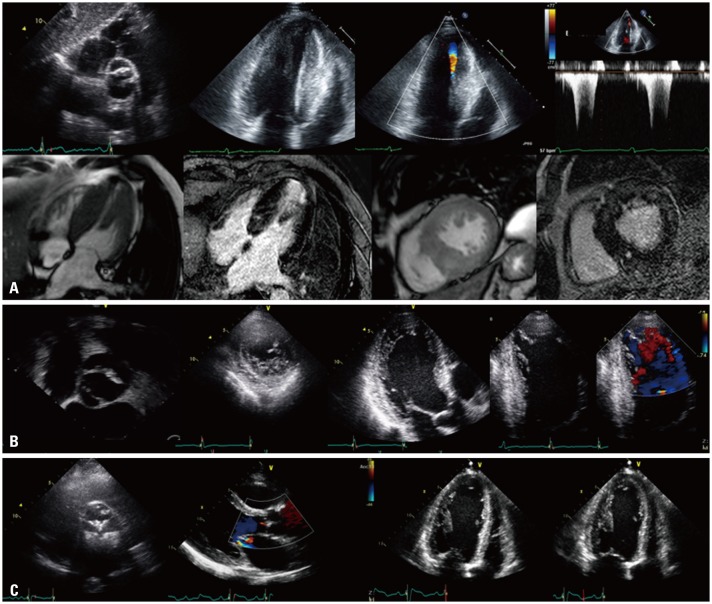
The present study aimed to investigate the prevalence, characteristics, and clinical significance of concomitant specific cardiomyopathies in subjects with bicuspid aortic valves (BAVs).
A total of 1186 adults with BAV (850 males, mean age 56±14 years) at a single tertiary center were comprehensively reviewed. Left ventricular non-compaction, hypertrophic cardiomyopathy, and idiopathic dilated cardiomyopathy were confirmed when patients fulfilled current clinical and echocardiographic criteria. Clinical and echocardiographic characteristics, including comorbidities, heart failure presentation, BAV morphology, function, and aorta phenotypes, in BAV subjects with or without specific cardiomyopathies were compared.
Overall, 67 subjects (5.6%) had concomitant cardiomyopathies: 40 (3.4%) patients with left ventricular non-compaction, 17 (1.4%) with hypertrophic cardiomyopathy, and 10 (0.8%) with dilated cardiomyopathy. BAV subjects with hypertrophic cardiomyopathy had higher prevalences of diabetes mellitus and heart failure with preserved ejection fraction, and tended to have type 0 phenotype, while BAV subjects with dilated cardiomyopathy showed higher prevalences of chronic kidney disease and heart failure with reduced ejection fraction. BAV subjects with left ventricular non-compaction were significantly younger and predominantly male, and had greater BAV dysfunction and a higher prevalence of normal aorta shape. In multiple regression analysis, cardiomyopathy was independently associated with heart failure (odds ratio 2.795, 95% confidential interval 1.603-4.873, <0.001) after controlling for confounding factors.
Concomitant cardiomyopathies were observed in 5.6% of subjects with BAV. A few different clinical and echocardiographic characteristics were found. The presence of cardiomyopathy was independently associated with heart failure.
本研究旨在探讨二叶式主动脉瓣(BAV)患者中同时存在特定心肌病的患病率、特征和临床意义。
在单一的三级中心共回顾了 1186 名患有 BAV 的成年人(850 名男性,平均年龄 56±14 岁)。当患者符合当前临床和超声心动图标准时,确认存在左心室心肌致密化不全、肥厚型心肌病和特发性扩张型心肌病。比较了 BAV 患者中存在或不存在特定心肌病时的临床和超声心动图特征,包括合并症、心力衰竭表现、BAV 形态、功能和主动脉表型。
共有 67 例(5.6%)患者同时患有心肌病:40 例(3.4%)患者患有左心室心肌致密化不全,17 例(1.4%)患者患有肥厚型心肌病,10 例(0.8%)患者患有扩张型心肌病。患有肥厚型心肌病的 BAV 患者中糖尿病和射血分数保留性心力衰竭的患病率较高,且倾向于具有 0 型表型,而患有扩张型心肌病的 BAV 患者中慢性肾脏病和射血分数降低性心力衰竭的患病率较高。患有左心室心肌致密化不全的 BAV 患者明显更年轻且主要为男性,且 BAV 功能障碍更严重,正常主动脉形态的患病率更高。在多因素回归分析中,在校正混杂因素后,心肌病与心力衰竭独立相关(比值比 2.795,95%置信区间 1.603-4.873,<0.001)。
在 5.6%的 BAV 患者中观察到同时存在心肌病。发现了一些不同的临床和超声心动图特征。存在心肌病与心力衰竭独立相关。