Moores Cancer Center.
Biomedical Sciences Graduate Program.
Blood. 2019 Nov 14;134(20):1730-1744. doi: 10.1182/blood.2019000170.
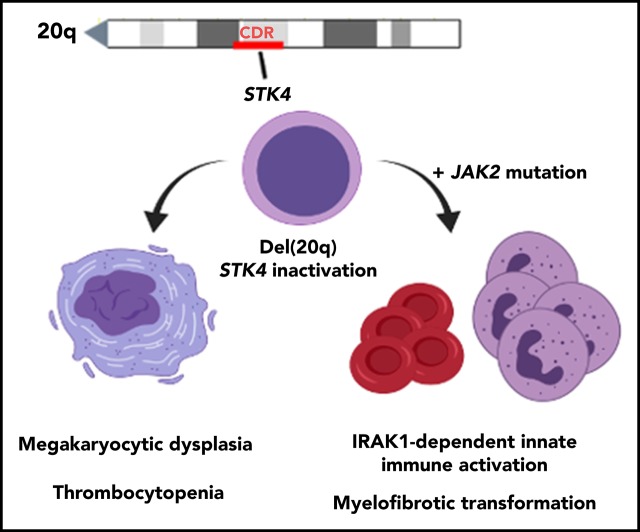
Heterozygous deletions within chromosome 20q, or del(20q), are frequent cytogenetic abnormalities detected in hematologic malignancies. To date, identification of genes in the del(20q) common deleted region that contribute to disease development have remained elusive. Through assessment of patient gene expression, we have identified STK4 (encoding Hippo kinase MST1) as a 20q gene that is downregulated below haploinsufficient amounts in myelodysplastic syndrome (MDS) and myeloproliferative neoplasm (MPN). Hematopoietic-specific gene inactivation in mice revealed Hippo kinase loss to induce splenomegaly, thrombocytopenia, megakaryocytic dysplasia, and a propensity for chronic granulocytosis; phenotypes that closely resemble those observed in patients harboring del(20q). In a JAK2-V617F model, heterozygous Hippo kinase inactivation led to accelerated development of lethal myelofibrosis, recapitulating adverse MPN disease progression and revealing a novel genetic interaction between these 2 molecular events. Quantitative serum protein profiling showed that myelofibrotic transformation in mice was associated with cooperative effects of JAK2-V617F and Hippo kinase inactivation on innate immune-associated proinflammatory cytokine production, including IL-1β and IL-6. Mechanistically, MST1 interacted with IRAK1, and shRNA-mediated knockdown was sufficient to increase IRAK1-dependent innate immune activation of NF-κB in human myeloid cells. Consistent with this, treatment with a small molecule IRAK1/4 inhibitor rescued the aberrantly elevated IL-1β production in the JAK2-V617F MPN model. This study identified Hippo kinase MST1 (STK4) as having a central role in the biology of del(20q)-associated hematologic malignancies and revealed a novel molecular basis of adverse MPN progression that may be therapeutically exploitable via IRAK1 inhibition.
20q 染色体杂合性缺失(del(20q))是血液恶性肿瘤中常见的细胞遗传学异常。迄今为止,在 del(20q) 共同缺失区域中,识别出导致疾病发展的基因仍然难以捉摸。通过评估患者的基因表达,我们发现 STK4(编码 Hippo 激酶 MST1)是一种在骨髓增生异常综合征(MDS)和骨髓增殖性肿瘤(MPN)中下调至单倍不足量的 20q 基因。在小鼠中进行的造血特异性基因失活研究表明,Hippo 激酶缺失会导致脾肿大、血小板减少、巨核细胞发育不良和慢性粒细胞增多倾向;这些表型与携带 del(20q)的患者观察到的表型非常相似。在 JAK2-V617F 模型中,杂合性 Hippo 激酶失活导致致命骨髓纤维化的加速发展,重现了不良的 MPN 疾病进展,并揭示了这两种分子事件之间的一种新的遗传相互作用。定量血清蛋白谱分析显示,小鼠的骨髓纤维化转化与 JAK2-V617F 和 Hippo 激酶失活对先天免疫相关促炎细胞因子产生的协同作用有关,包括 IL-1β 和 IL-6。从机制上讲,MST1 与 IRAK1 相互作用,shRNA 介导的敲低足以增加人髓样细胞中 IRAK1 依赖性先天免疫激活 NF-κB。与此一致,用小分子 IRAK1/4 抑制剂治疗可挽救 JAK2-V617F MPN 模型中异常升高的 IL-1β 产生。这项研究确定 Hippo 激酶 MST1(STK4)在与 del(20q)相关的血液恶性肿瘤的生物学中具有核心作用,并揭示了不良 MPN 进展的新分子基础,通过 IRAK1 抑制可能具有治疗潜力。