Key Laboratory of Liver Disease of Guangdong Province, The Third Affiliated Hospital, Sun Yat-sen University, Guangzhou, China.
Department of Biochemistry, Zhongshan school of medicine, Sun Yat-sen University, Guangzhou, China.
Nat Commun. 2019 Aug 21;10(1):3761. doi: 10.1038/s41467-019-11696-7.
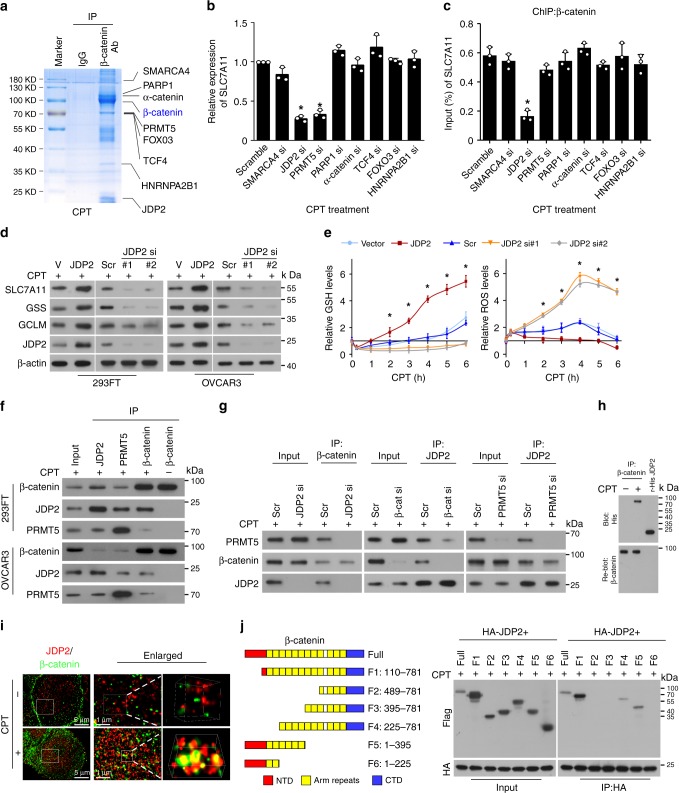
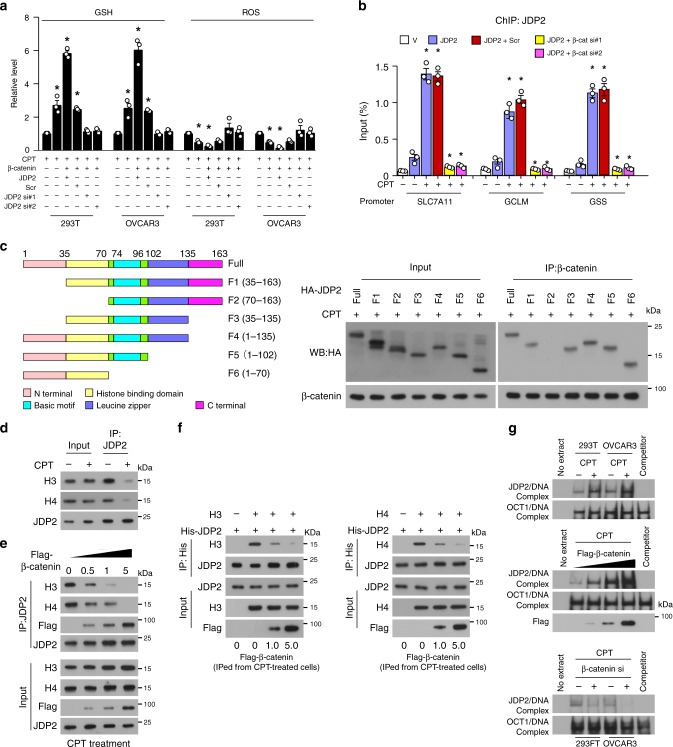
The mechanisms underlying how cells subjected to genotoxic stress reestablish reduction-oxidation (redox) homeostasis to scavenge genotoxic stress-induced reactive oxygen species (ROS), which maintains the physiological function of cellular processes and cell survival, remain unclear. Herein, we report that, via a TCF-independent mechanism, genotoxic stress induces the enrichment of β-catenin in chromatin, where it forms a complex with ATM phosphorylated-JDP2 and PRMT5. This elicits histone H3R2me1/H3R2me2s-induced transcriptional activation by the recruitment of the WDR5/MLL methyltransferase complexes and concomitant H3K4 methylation at the promoters of multiple genes in GSH-metabolic cascade. Treatment with OICR-9429, a small-molecule antagonist of the WDR5-MLL interaction, inhibits the β-catenin/JDP2/PRMT5 complex-reestablished GSH metabolism, leading to a lethal increase in the already-elevated levels of ROS in the genotoxic-agent treated cancer cells. Therefore, our results unveil a plausible role for β-catenin in reestablishing redox homeostasis upon genotoxic stress and shed light on the mechanisms of inducible chemotherapy resistance in cancer.
细胞在遭受遗传毒性应激后如何重新建立氧化还原(redox)稳态以清除遗传毒性应激诱导的活性氧(ROS)的机制尚不清楚,ROS 会破坏细胞过程的生理功能并导致细胞死亡。在此,我们报告称,遗传毒性应激通过非 TCF 依赖的机制诱导β-catenin 在染色质中富集,在染色质中,它与 ATM 磷酸化-JDP2 和 PRMT5 形成复合物。这通过募集 WDR5/MLL 甲基转移酶复合物并伴随 H3K4 甲基化来引发组氨酸 H3R2me1/H3R2me2s 诱导的转录激活,在多个基因的启动子处,这些基因都参与 GSH 代谢级联反应。用 OICR-9429(WDR5-MLL 相互作用的小分子拮抗剂)处理会抑制β-catenin/JDP2/PRMT5 复合物重新建立的 GSH 代谢,导致在已经升高的遗传毒性药物处理的癌细胞中 ROS 水平致命性增加。因此,我们的研究结果揭示了β-catenin 在遗传毒性应激后重新建立氧化还原稳态中的作用,并阐明了癌症中诱导性化疗耐药的机制。