Mahran Howayda N, Saber Lobna M, Alghaithy Abdullaziz A, Elareefy Azza A
Department of Medical Laboratory Technology, Faculty of Applied Medical Sciences, Taibah University, Almadinah Almunawwarah, KSA.
Department of Clinical Nutrition, Faculty of Applied Medical Sciences, Taibah University, Almadinah Almunawwarah, KSA.
J Taibah Univ Med Sci. 2016 Nov 14;12(1):8-13. doi: 10.1016/j.jtumed.2016.10.002. eCollection 2017 Feb.
Many cross-sectional and prospective studies have shown that type 2 diabetes mellitus is a probable cause of non-alcoholic fatty liver disease (NAFLD) with fibrosis and cirrhosis. This research aimed to examine the plasma amino transaminase levels as biomarkers of NAFLD and their association with apoptosis markers (Fas and FasL) as well as the lipid profile in type II diabetic patients.
This cross-sectional comparative study included 120 type II diabetic and 100 non-diabetic patients, and their defined biomarkers were studied.
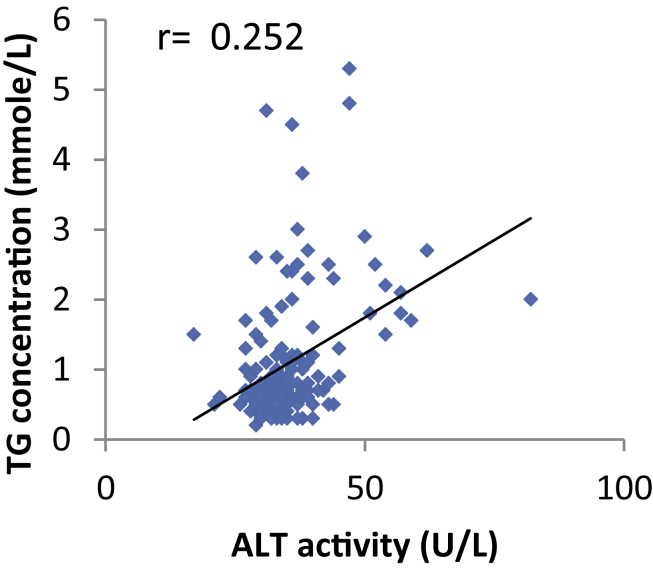
The results showed that the mean ALT levels, FasL and triglyceride/high density lipoprotein (TG/HDL) ratio were significantly higher in patients with type II diabetics. According to the Atherogenic Index of Plasma (Log TG/HDL), approximately 45% of diabetic patients had a high risk and 11% had an intermediate risk of developing cardiovascular disease. Alanine aminotransferase (ALT) was significantly and positively correlated with FasL, TG, glucose levels and body mass index (BMI) in diabetic patients. Moreover, TG was positively correlated with blood glucose levels and BMI, whereas HDL was negatively correlated with FasL and ALT.
The results of this study showed that in diabetic patients, elevated ALT levels and FasL may play a role in the risk of developing liver disease and could be used as a distinct marker of NAFLD, indicating liver injury. Moreover, atherogenic dyslipidaemia is a prominent feature in type II diabetes mellitus. Low HDL-c is closely associated with hypertriglyceridemia with an increased risk of cardiovascular disease and NAFLD in diabetics.
许多横断面研究和前瞻性研究表明,2型糖尿病是导致非酒精性脂肪性肝病(NAFLD)伴纤维化和肝硬化的可能原因。本研究旨在检测血浆氨基转氨酶水平作为NAFLD的生物标志物,及其与凋亡标志物(Fas和FasL)以及II型糖尿病患者血脂谱的关联。
这项横断面比较研究纳入了120例II型糖尿病患者和100例非糖尿病患者,并对他们确定的生物标志物进行了研究。
结果显示,II型糖尿病患者的平均谷丙转氨酶(ALT)水平、FasL以及甘油三酯/高密度脂蛋白(TG/HDL)比值显著更高。根据血浆致动脉粥样硬化指数(Log TG/HDL),约45%的糖尿病患者发生心血管疾病的风险高,11%的患者风险中等。在糖尿病患者中,谷丙转氨酶(ALT)与FasL、TG、血糖水平和体重指数(BMI)显著正相关。此外,TG与血糖水平和BMI正相关,而HDL与FasL和ALT负相关。
本研究结果表明,在糖尿病患者中,ALT水平升高和FasL可能在肝病发生风险中起作用,并且可作为NAFLD的一个明显标志物,提示肝损伤。此外,致动脉粥样硬化血脂异常是II型糖尿病的一个突出特征。低HDL-c与高甘油三酯血症密切相关,增加糖尿病患者心血管疾病和NAFLD的风险。