Sakai Toshinori, Goto Tsuyoshi, Sugiura Kosuke, Manabe Hiroaki, Tezuka Fumitake, Yamashita Kazuta, Takata Yoichiro, Chikawa Takashi, Sairyo Koichi
Department of Orthopedics, Institute of Biomedical Sciences, Tokushima University Graduate School, Tokushima, Japan.
Department of Rehabilitation, Tokushima University Hospital, Tokushima, Japan.
Spine Surg Relat Res. 2018 Jul 25;3(1):67-70. doi: 10.22603/ssrr.2018-0012. eCollection 2019 Jan 25.
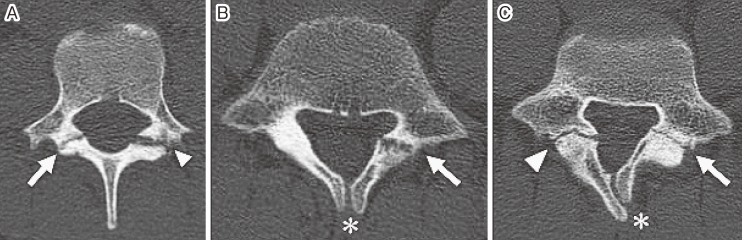
Although there has been a dramatic improvement in the outcomes of conservative treatment to achieve bony healing due to advances in diagnostic and therapeutic tools, in some patients, the results continue to be unfavorable. The purpose of this study was to investigate the outcomes of conservative treatment in pediatric patients with stress fractures occurring in the lamina that are discontinuous due to a contralateral pars defect or spina bifida occulta (SBO).
The medical records at our outpatient clinic for 103 consecutive patients (83 boys, 20 girls) with lumbar spondylolysis (LS) were reviewed to identify those who had presented with a stress fracture and a contralateral pars defect or with SBO at the affected lamina level.
Twelve patients (11 boys, 1 girl) of mean age 12.3 (range 8-16) years were identified. Except for 1 stress structure that occurred at L4, all the stress fractures occurred at L5. Six patients had a pars defect, 5 had SBO, and 1 had both. Two of the 6 patients with a contralateral pars defect had early LS, 3 had progressive LS, and 1 had a pedicle fracture. The fracture healed in 1 (50%) of the 2 patients with early LS and in the patient with the pedicle fracture, but did not heal in any of the patients with progressive LS. Two of the 5 patients with SBO at the affected lamina level had early LS and 3 had progressive LS. The bony healing rate was 100% in the 2 patients with early LS and 66.7% in the 3 patients with progressive LS. The fracture healed in the patient with progressive LS and both a pars defect and SBO at the affected lamina.
Contralateral pars defect remains an unfavorable factor for bony healing discontinuous laminar stress fractures.
尽管由于诊断和治疗工具的进步,保守治疗实现骨愈合的效果有了显著改善,但在一些患者中,结果仍然不理想。本研究的目的是调查因对侧椎弓峡部缺损或隐性脊柱裂(SBO)导致椎板连续性中断的小儿应力性骨折患者的保守治疗结果。
回顾了我们门诊连续103例腰椎椎弓峡部裂(LS)患者(83例男孩,20例女孩)的病历,以确定那些在受影响椎板水平出现应力性骨折且伴有对侧椎弓峡部缺损或SBO的患者。
确定了12例患者(11例男孩,1例女孩),平均年龄12.3岁(范围8 - 16岁)。除1例应力性骨折发生在L4外,所有应力性骨折均发生在L5。6例患者有椎弓峡部缺损,5例有SBO,1例两者都有。6例对侧椎弓峡部缺损患者中,2例有早期LS,3例有进展性LS,1例有椎弓根骨折。2例早期LS患者中的1例以及椎弓根骨折患者的骨折愈合,但进展性LS患者均未愈合。5例受影响椎板水平有SBO的患者中,2例有早期LS,3例有进展性LS。2例早期LS患者的骨愈合率为100%,3例进展性LS患者的骨愈合率为66.7%。进展性LS且受影响椎板既有椎弓峡部缺损又有SBO的患者骨折愈合。
对侧椎弓峡部缺损仍然是椎板连续性中断的应力性骨折骨愈合的不利因素。