Selemon Lynn D, Young Keith A, Cruz Dianne A, Williamson Douglas E
Department of Neuroscience, Yale School of Medicine, Yale University, New Haven, CT, USA.
Baylor Scott & White Psychiatry, Central Texas Veterans Health Care System, Temple, TX, USA.
Chronic Stress (Thousand Oaks). 2019 May 23;3. doi: 10.1177/2470547019850166. Print 2019.
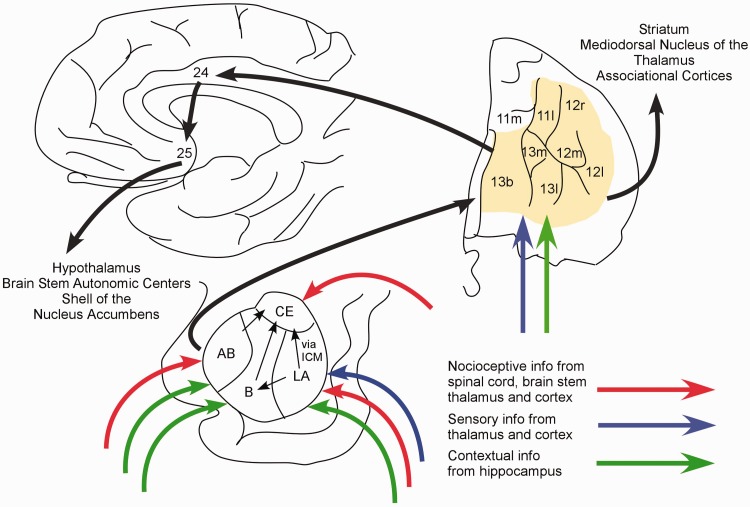
Symptoms of posttraumatic stress disorder include hyperarousal, avoidance of trauma-related stimuli, re-experiencing of trauma, and mood changes. This review focuses on the frontal cortical areas that form crucial links in circuitry pertinent to posttraumatic stress disorder symptomatology: (1) the conditioned fear extinction circuit, (2) the salience circuit, and (3) the mood circuit. These frontal areas include the ventromedial prefrontal cortex (conditioned fear extinction), the dorsal anterior cingulate and insular cortices (salience), and the lateral orbitofrontal and subgenual cingulate cortices (mood). Frontal lobe structural abnormalities in posttraumatic stress disorder, including volumetric reductions in the cingulate cortices, impact all three circuits. Functional analyses of frontal cortices in posttraumatic stress disorder show abnormal activation in all three according to task demand and emotional valence. Network analyses reveal altered amygdalo-frontal connectivity and failure to suppress the default mode network during cognitive engagement. Spine shape alterations also have been detected in the medial orbito-frontal cortex in posttraumatic stress disorder postmortem brains, suggesting reduced synaptic plasticity. Importantly, frontal lobe abnormalities in posttraumatic stress disorder extend beyond emotion-related circuits to include the lateral prefrontal cortices that mediate executive functions. In conclusion, widespread frontal lobe dysfunction in posttraumatic stress disorder provides a neurobiologic basis for the core symptomatology of the disorder, as well as for executive function impairment.
创伤后应激障碍的症状包括过度觉醒、回避与创伤相关的刺激、再次体验创伤以及情绪变化。本综述聚焦于额叶皮质区域,这些区域在与创伤后应激障碍症状学相关的神经回路中形成关键连接:(1)条件性恐惧消退回路,(2)显著性回路,以及(3)情绪回路。这些额叶区域包括腹内侧前额叶皮质(条件性恐惧消退)、背侧前扣带回和岛叶皮质(显著性),以及外侧眶额叶和膝下扣带回皮质(情绪)。创伤后应激障碍中的额叶结构异常,包括扣带回皮质体积减小,会影响所有这三个回路。对创伤后应激障碍中额叶皮质的功能分析表明,根据任务需求和情绪效价,所有这三个区域都会出现异常激活。网络分析揭示杏仁核 - 额叶连接改变,以及在认知参与期间无法抑制默认模式网络。在创伤后应激障碍的尸检大脑中,内侧眶额叶皮质也检测到了棘突形状改变,这表明突触可塑性降低。重要的是,创伤后应激障碍中的额叶异常不仅限于与情绪相关的回路,还包括介导执行功能的外侧前额叶皮质。总之,创伤后应激障碍中广泛存在的额叶功能障碍为该障碍的核心症状学以及执行功能损害提供了神经生物学基础。