Faculty of Nursing, Edmonton Clinic Health Academy (ECHA), University of Alberta, 11405-87th Ave, Edmonton, AB T6G 1C9, Canada.
Department of Music, Faculty of Arts, University of Alberta, 3-98 Fine Arts Building, Edmonton, AB T6G 2C9, Canada.
Int J Environ Res Public Health. 2022 Mar 6;19(5):3113. doi: 10.3390/ijerph19053113.
Post traumatic stress disorder (PTSD) has emerged as a severely debilitating psychiatric disorder associated with critical illness. Little progress has been made in the treatment of post-intensive care unit (ICU) PTSD.
To synthesize neurobiological evidence on the pathophysiology of PTSD and the brain areas involved, and to highlight the potential of music to treat post-ICU PTSD.
Critical narrative review to elucidate an evidence-based neurobiological framework to inform the study of music interventions for PTSD post-ICU. Literature searches were performed in PubMed and CINAHL. The Scale for the Assessment of Narrative Review Articles (SANRA) guided reporting.
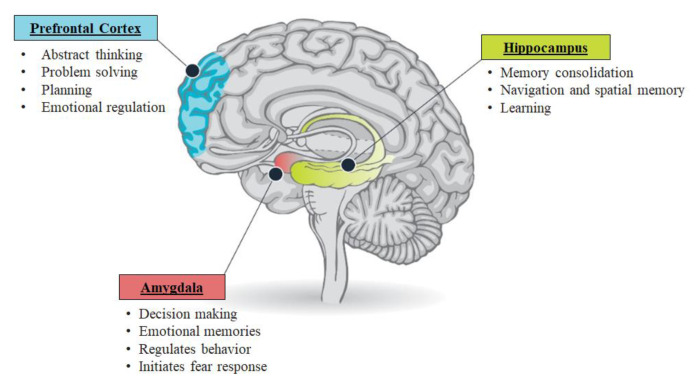
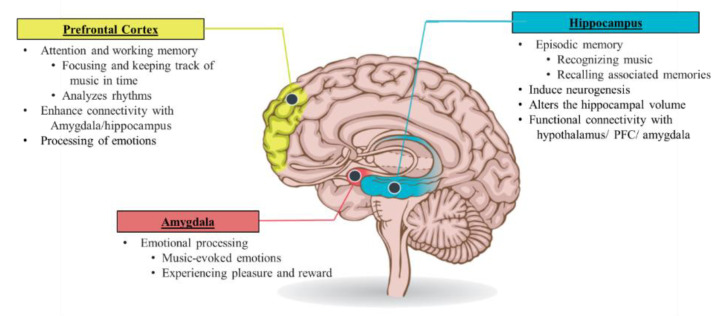
A dysfunctional HPA axis feedback loop, an increased amygdalic response, hippocampal atrophy, and a hypoactive prefrontal cortex contribute to PTSD symptoms. Playing or listening to music can stimulate neurogenesis and neuroplasticity, enhance brain recovery, and normalize stress response. Additionally, evidence supports effectiveness of music to improve coping and emotional regulation, decrease dissociation symptoms, reduce depression and anxiety levels, and overall reduce severity of PTSD symptoms.
Despite the lack of music interventions for ICU survivors, music has the potential to help people suffering from PTSD by decreasing amygdala activity, improving hippocampal and prefrontal brain function, and balancing the HPA-axis.
创伤后应激障碍(PTSD)已成为与重症相关的严重致残性精神障碍。在重症监护病房(ICU)后 PTSD 的治疗方面几乎没有取得进展。
综合 PTSD 的神经生物学证据及其涉及的大脑区域,并强调音乐治疗 ICU 后 PTSD 的潜力。
批判性叙述性综述,阐明基于证据的神经生物学框架,为 ICU 后 PTSD 的音乐干预研究提供信息。在 PubMed 和 CINAHL 中进行文献检索。使用 Scale for the Assessment of Narrative Review Articles(SANRA)进行报告。
HPA 轴反馈回路功能障碍、杏仁核反应增加、海马萎缩和前额叶皮质活动低下导致 PTSD 症状。演奏或听音乐可以刺激神经发生和神经可塑性,促进大脑恢复,使应激反应正常化。此外,有证据表明音乐有助于改善应对和情绪调节、减少分离症状、降低抑郁和焦虑水平,并总体减轻 PTSD 症状的严重程度。
尽管缺乏针对 ICU 幸存者的音乐干预措施,但音乐通过降低杏仁核活动、改善海马和前额叶脑功能以及平衡 HPA 轴,有可能帮助 PTSD 患者。