Medical College of Georgia, Augusta, GA, USA.
Teva Pharmaceuticals Frazer, 41 Moores Rd, Malvern, PA, 19355, USA.
Qual Life Res. 2019 Dec;28(12):3303-3312. doi: 10.1007/s11136-019-02269-8. Epub 2019 Aug 21.
Tardive dyskinesia (TD) is a common but serious hyperkinetic movement disorder and side effect of antipsychotic medications used to treat bipolar disorder (BD), major depressive disorder (MDD), and schizophrenia (SZ). The purpose of this study was to evaluate health-related quality of life (HRQoL) in a population with diagnoses for BD, MDD, or SZ by comparing patients with TD (n = 197) with those without TD (n = 219). HRQoL in each group was also compared with HRQoL of the general population.
This study employed a cross-sectional web-based survey. HRQoL was assessed by four instruments: the SF-12 Health Survey, Version 2 (SF-12v2), the Quality of Life Enjoyment and Satisfaction Questionnaire, Short Form (Q-LES-Q-SF), the Social Withdrawal subscale of the Internalized Stigma of Mental Illness Scale (SW-ISMI); and two questions on movement disorders.
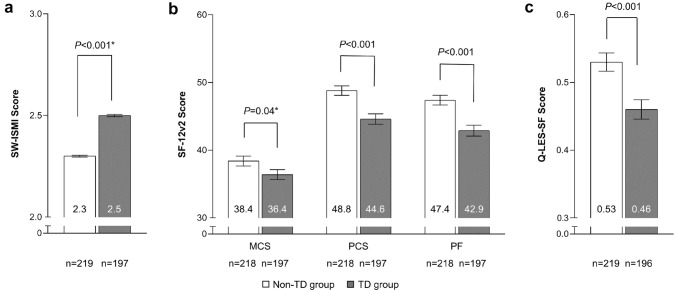
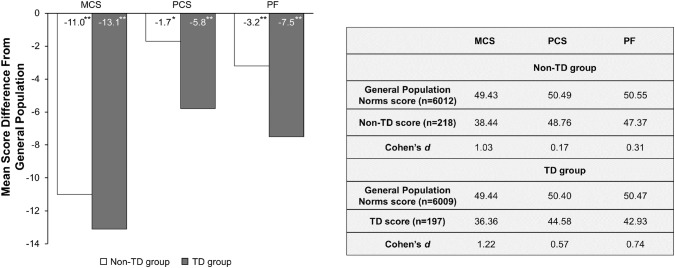
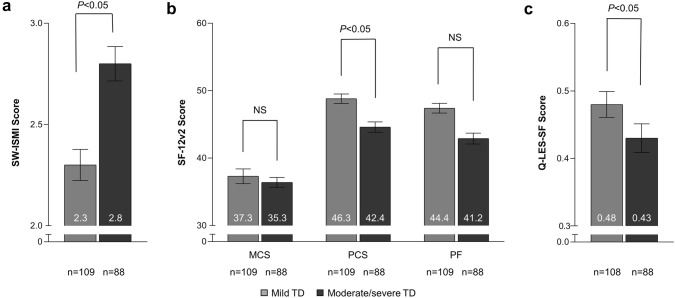
Patients with TD had significantly worse HRQoL and social withdrawal than those without. The differences were more pronounced for physical HRQoL domains than for mental health domains. Patients with more-severe TD, assessed through either self-rating or clinician rating, experienced significantly worse HRQoL than did those with less-severe TD. The impact of TD was substantially greater in patients with SZ than in those with BD or MDD. Compared with the general population, patients with BD, MDD, or SZ experienced significantly worse HRQoL regardless of TD status, although this deficit in HRQoL was greater among those with TD.
The presence of TD is associated with worse HRQoL and social withdrawal. The most severe impact of TD is on physical aspects of patients' HRQoL.
迟发性运动障碍(TD)是一种常见但严重的运动障碍,是用于治疗双相情感障碍(BD)、重度抑郁症(MDD)和精神分裂症(SZ)的抗精神病药物的副作用。本研究的目的是通过比较患有 TD(n=197)和无 TD(n=219)的患者,评估 BD、MDD 或 SZ 诊断患者的健康相关生活质量(HRQoL)。还将每组的 HRQoL 与一般人群的 HRQoL 进行比较。
本研究采用横断面网络调查。使用四种工具评估 HRQoL:SF-12 健康调查,第 2 版(SF-12v2)、生活质量享受和满意度问卷、简短版(Q-LES-Q-SF)、内化精神疾病耻辱感量表的社会退缩子量表(SW-ISMI);以及两个关于运动障碍的问题。
患有 TD 的患者的 HRQoL 和社会退缩明显差于无 TD 的患者。与心理健康领域相比,物理 HRQoL 领域的差异更为明显。通过自我评估或临床医生评估评估的 TD 严重程度较高的患者的 HRQoL 明显差于 TD 严重程度较低的患者。与 BD 或 MDD 患者相比,TD 对 SZ 患者的影响更大。无论 TD 状态如何,与一般人群相比,BD、MDD 或 SZ 患者的 HRQoL 明显较差,尽管 TD 患者的 HRQoL 缺陷更大。
TD 的存在与较差的 HRQoL 和社会退缩有关。TD 的最严重影响是对患者 HRQoL 的生理方面。