Scientific Research Department, Centre for Psycho-Oncology, Helen Dowling Institute, Professor Bronkhorstlaan 20, Postbus 80, 3720 AB, Bilthoven, The Netherlands.
Department of Methodology and Statistics, School of Social and Behavioral Sciences, Tilburg University, Tilburg, The Netherlands.
J Behav Med. 2020 Aug;43(4):553-563. doi: 10.1007/s10865-019-00084-7. Epub 2019 Aug 22.
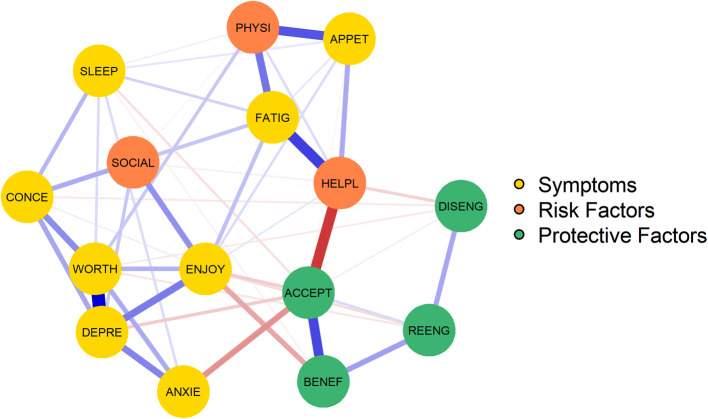
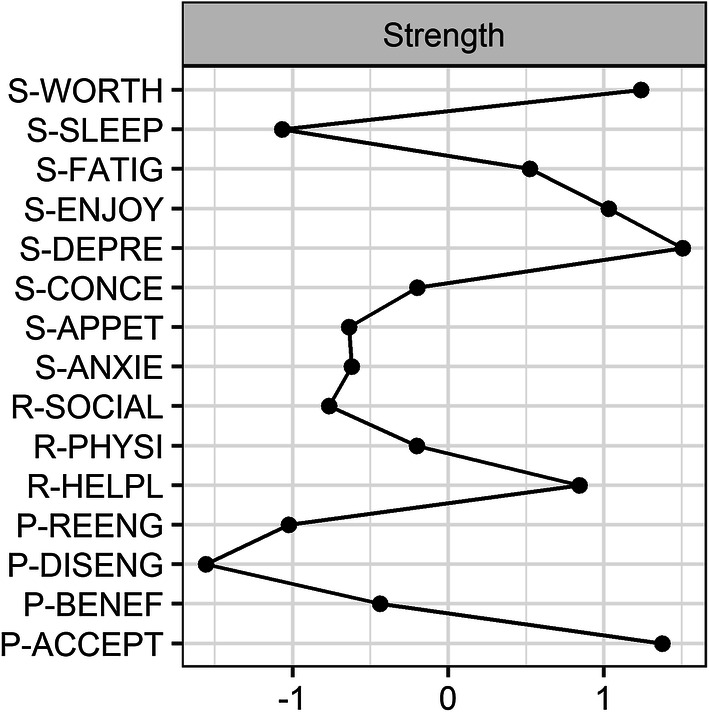
Researchers have extensively studied fatigue, depression and anxiety in cancer patients. Several risk and protective factors have been identified for these symptoms. As most studies address these constructs, independently from other symptoms and potential risk and protective factors, more insight into the complex relationships among these constructs is needed. This study used the multivariate network approach to gain a better understanding of how patients' symptoms and risk and protective factors (i.e. physical symptoms, social withdrawal, illness cognitions, goal adjustment and partner support) are interconnected. We used cross-sectional data from a sample of cancer patients seeking psychological care (n = 342). Using network modelling, the relationships among symptoms of fatigue, depression and anxiety, and potential risk and protective factors were explored. Additionally, centrality (i.e. the number and strength of connections of a construct) and stability of the network were explored. Among risk factors, the relationship of helplessness and physical symptoms with fatigue stood out as they were stronger than most other connections in the network. Among protective factors, illness acceptance was most centrally embedded within the network, indicating it had more and stronger connections than most other variables in the network. The network identified key connections with risk factors (helplessness, physical symptoms) and a key protective factor (acceptance) at the group level. Longitudinal studies should explore these risk and protective factors in individual dynamic networks to further investigate their causal role and the extent to which such networks can inform us on what treatment would be most suitable for the individual cancer patient.
研究人员已经广泛研究了癌症患者的疲劳、抑郁和焦虑。已经确定了这些症状的几个风险和保护因素。由于大多数研究都在独立于其他症状和潜在风险和保护因素的情况下研究这些结构,因此需要更多地了解这些结构之间的复杂关系。本研究使用多元网络方法来更好地理解患者的症状和风险及保护因素(即身体症状、社交退缩、疾病认知、目标调整和伴侣支持)之间是如何相互关联的。我们使用了正在寻求心理护理的癌症患者样本的横断面数据(n=342)。使用网络建模,探讨了疲劳、抑郁和焦虑症状与潜在风险和保护因素之间的关系。此外,还探讨了网络的中心性(即一个结构的连接数量和强度)和稳定性。在风险因素中,无助感和身体症状与疲劳的关系尤为突出,因为它们比网络中的大多数其他连接都要强。在保护因素中,疾病接受度在网络中处于中心位置,这表明它比网络中的大多数其他变量具有更多和更强的连接。网络确定了与风险因素(无助感、身体症状)和关键保护因素(接受度)相关的关键连接,这在群体水平上得到了体现。纵向研究应该在个体动态网络中探讨这些风险和保护因素,以进一步研究它们的因果作用,以及这些网络在多大程度上可以为我们提供关于哪种治疗方法最适合个体癌症患者的信息。