Department of Plant Breeding, Justus Liebig University, IFZ Research Centre for Biosystems, Land Use and Nutrition, Heinrich-Buff-Ring 26-32, 35392 Giessen, Giessen, Germany.
RNA Biology and Molecular Physiology, Faculty for Biology, Bielefeld University, Universitaetsstrasse 25, 33615, Bielefeld, Germany.
BMC Plant Biol. 2019 Aug 22;19(1):372. doi: 10.1186/s12870-019-1973-x.
Correct timing of flowering is critical for plants to produce enough viable offspring. In Arabidopsis thaliana (Arabidopsis), flowering time is regulated by an intricate network of molecular signaling pathways. Arabidopsis srr1-1 mutants lacking SENSITIVITY TO RED LIGHT REDUCED 1 (SRR1) expression flower early, particularly under short day (SD) conditions (1). SRR1 ensures that plants do not flower prematurely in such non-inductive conditions by controlling repression of the key florigen FT. Here, we have examined the role of SRR1 in the closely related crop species Brassica napus.
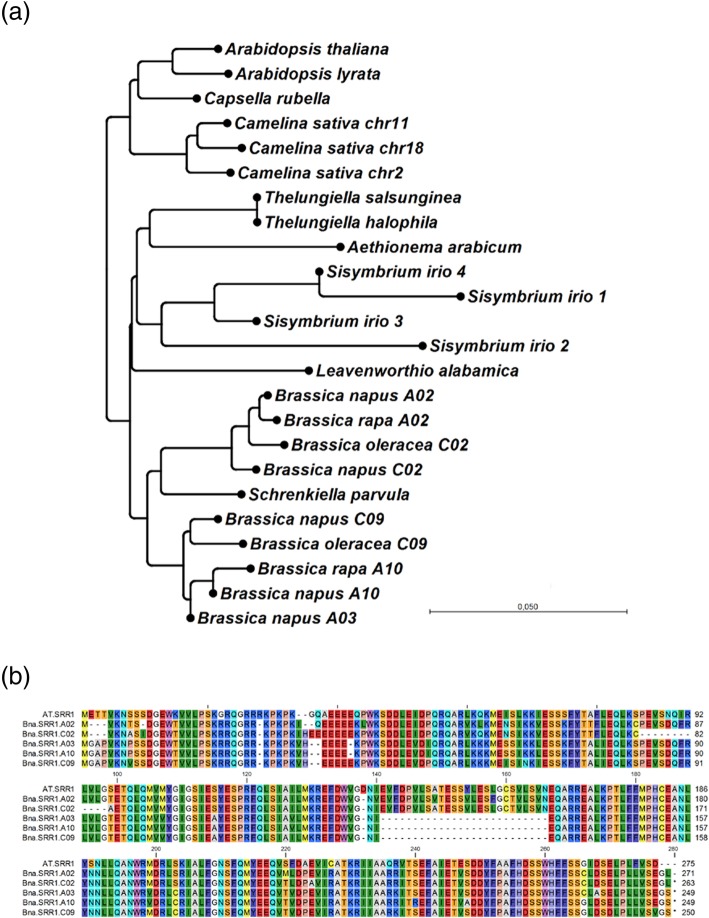
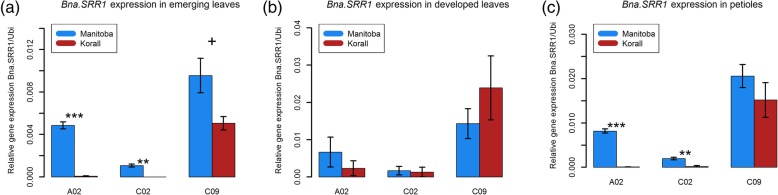
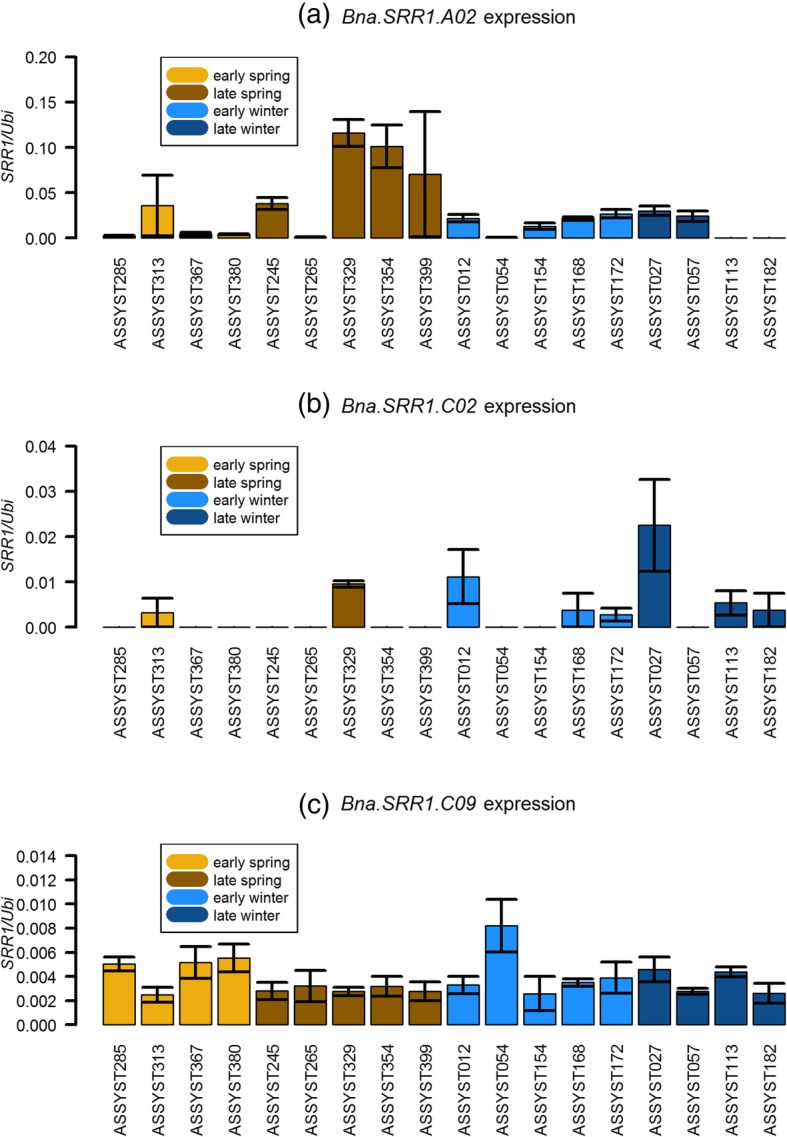
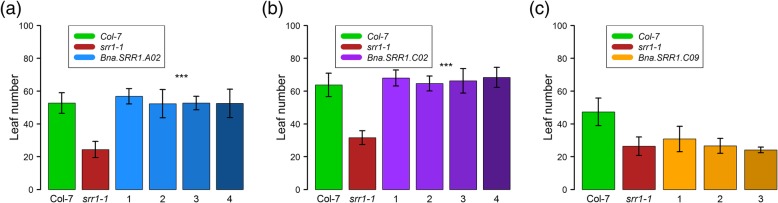
Arabidopsis SRR1 has five homologs in Brassica napus. They can be divided into two groups, where the A02 and C02 copies show high similarity to AtSRR1 on the protein level. The other group, including the A03, A10 and C09 copies all carry a larger deletion in the amino acid sequence. Three of the homologs are expressed at detectable levels: A02, C02 and C09. Notably, the gene copies show a differential expression pattern between spring and winter type accessions of B. napus. When the three expressed gene copies were introduced into the srr1-1 background, only A02 and C02 were able to complement the srr1-1 early flowering phenotype, while C09 could not. Transcriptional analysis of known SRR1 targets in Bna.SRR1-transformed lines showed that CYCLING DOF FACTOR 1 (CDF1) expression is key for flowering time control via SRR1.
We observed subfunctionalization of the B. napus SRR1 gene copies, with differential expression between early and late flowering accessions of some Bna.SRR1 copies. This suggests involvement of Bna.SRR1 in regulation of seasonal flowering in B. napus. The C09 gene copy was unable to complement srr1-1 plants, but is highly expressed in B. napus, suggesting specialization of a particular function. Furthermore, the C09 protein carries a deletion which may pinpoint a key region of the SRR1 protein potentially important for its molecular function. This is important evidence of functional domain annotation in the highly conserved but unique SRR1 amino acid sequence.
开花时间的准确性对于植物产生足够数量的可育后代至关重要。在拟南芥(Arabidopsis thaliana)中,开花时间由一个复杂的分子信号通路网络调控。拟南芥 srr1-1 突变体缺乏 SENSITIVITY TO RED LIGHT REDUCED 1(SRR1)表达,会在短日照(SD)条件下早期开花(1)。SRR1 通过控制关键成花素 FT 的抑制,确保植物在非诱导条件下不会过早开花。在这里,我们研究了 SRR1 在亲缘关系密切的作物物种油菜(Brassica napus)中的作用。
拟南芥 SRR1 在油菜中有五个同源物。它们可以分为两组,其中 A02 和 C02 拷贝在蛋白质水平上与 AtSRR1 高度相似。另一组,包括 A03、A10 和 C09 拷贝,在氨基酸序列中都有较大的缺失。三个同源物以可检测的水平表达:A02、C02 和 C09。值得注意的是,这些基因拷贝在油菜春性和冬性品种之间表现出不同的表达模式。当三个表达的基因拷贝被引入 srr1-1 背景时,只有 A02 和 C02 能够互补 srr1-1 早期开花表型,而 C09 则不能。对 Bna.SRR1 转化系中已知 SRR1 靶基因的转录分析表明,CYCLING DOF FACTOR 1(CDF1)的表达是通过 SRR1 控制开花时间的关键。
我们观察到油菜 SRR1 基因拷贝的亚功能化,一些 Bna.SRR1 拷贝在早期和晚期开花品种之间表现出不同的表达。这表明 Bna.SRR1 参与了油菜季节性开花的调控。C09 基因拷贝不能互补 srr1-1 植物,但在油菜中高度表达,表明其具有特定功能的专业化。此外,C09 蛋白携带缺失,这可能指出了 SRR1 蛋白的一个关键区域,该区域可能对其分子功能很重要。这是对高度保守但独特的 SRR1 氨基酸序列进行功能域注释的重要证据。