Schiessl Sarah, Iniguez-Luy Federico, Qian Wei, Snowdon Rod J
Department of Plant Breeding, Justus Liebig University, IFZ Research Centre for Biosystems, Land Use and Nutrition, Heinrich-Buff-Ring 26-32, 35392, Giessen, Germany.
Agriaquaculture Nutritional Genomic Center (CGNA), Genomics and Bioinformatics Unit, Km 10 Camino Cajón-Vilcún, INIA, Temuco, Chile.
BMC Genomics. 2015 Sep 29;16:737. doi: 10.1186/s12864-015-1950-1.
Flowering time, plant height and seed yield are strongly influenced by climatic and day-length adaptation in crop plants. To investigate these traits under highly diverse field conditions in the important oilseed crop Brassica napus, we performed a genome-wide association study using data from diverse agroecological environments spanning three continents.
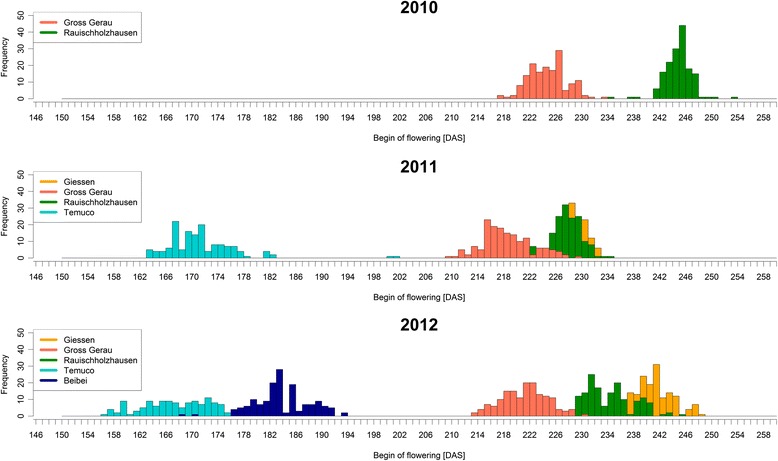
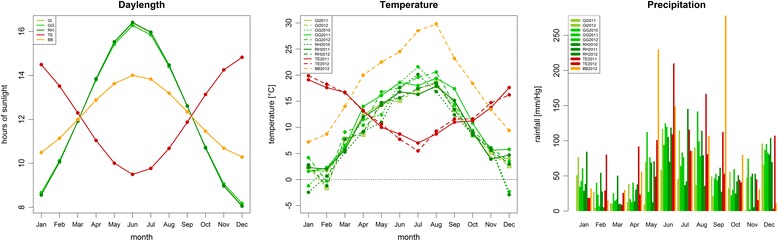
A total of 158 European winter-type B.napus inbred lines were genotyped with 21,623 unique, single-locus single-nucleotide polymorphism (SNP) markers using the Brassica 60 K-SNP Illumina® Infinium consortium array. Phenotypic associations were calculated in the panel over the years 2010-2012 for flowering time, plant height and seed yield in 5 highly diverse locations in Germany, China and Chile, adding up to 11 diverse environments in total.
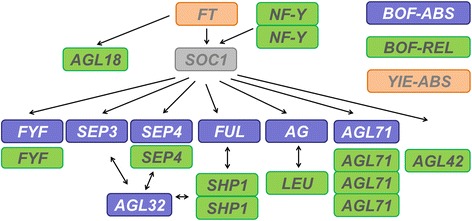
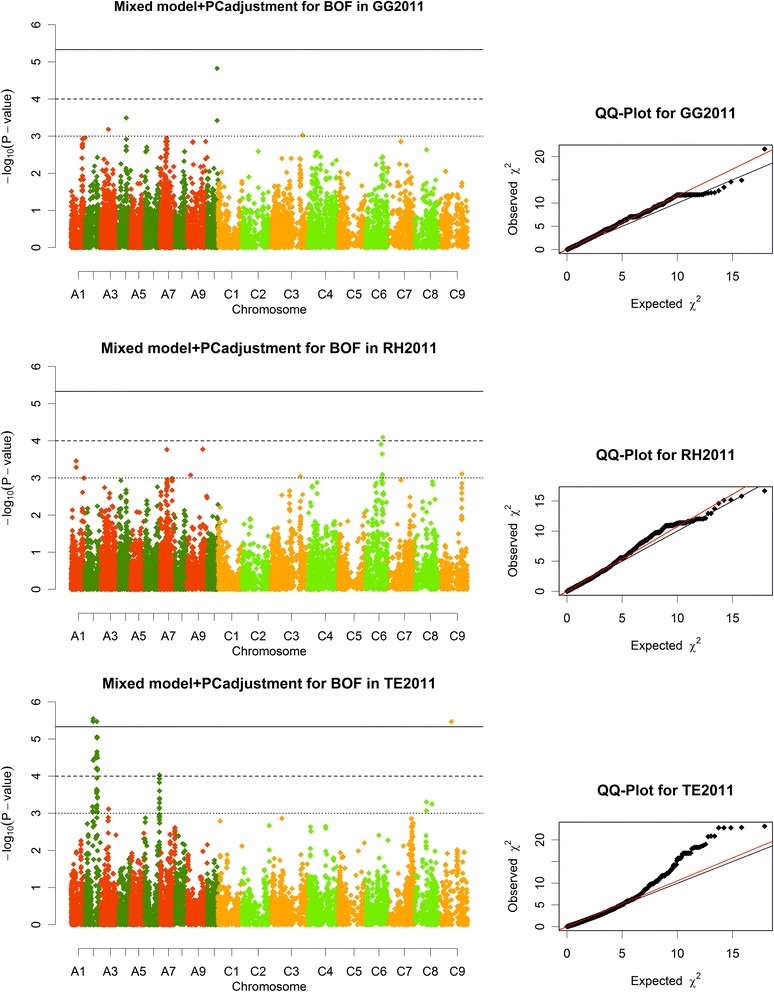
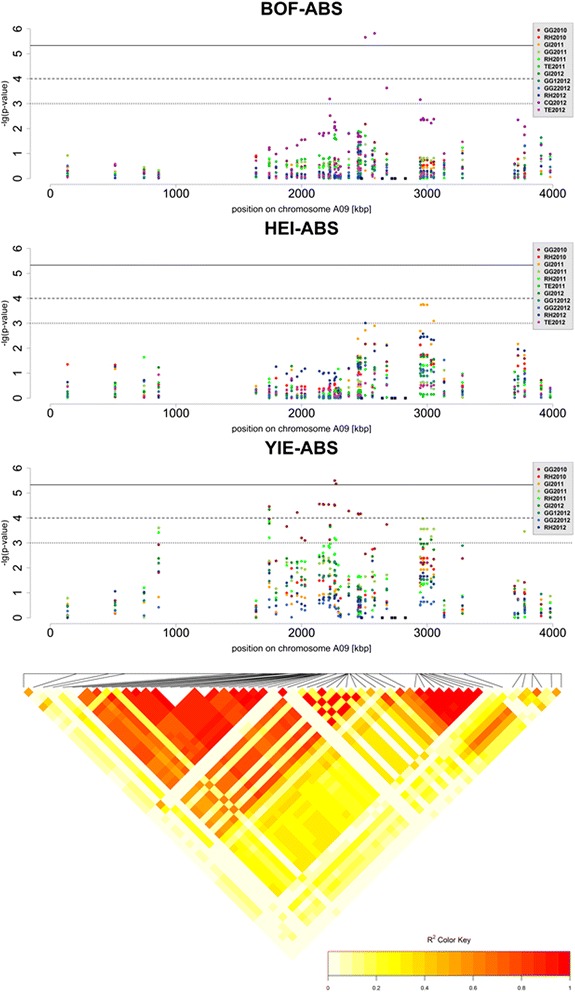
We identified 101 genome regions associating with the onset of flowering, 69 with plant height, 36 with seed yield and 68 cross-trait regions with potential adaptive value. Within these regions, B.napus orthologs for a number of candidate adaptation genes were detected, including central circadian clock components like CIRCADIAN CLOCK- ASSOCIATED 1 (Bna.CCA1) and the important flowering-time regulators FLOWERING LOCUS T (Bna.FT) and FRUITFUL (Bna.FUL).
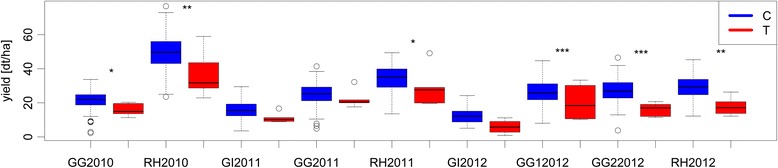
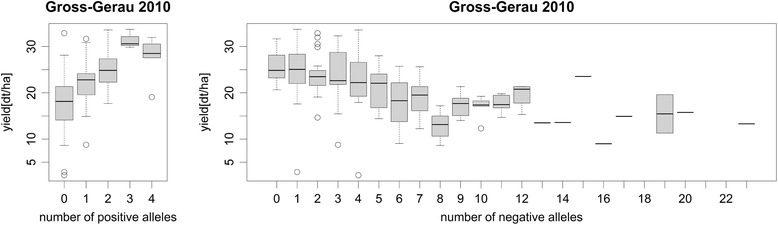
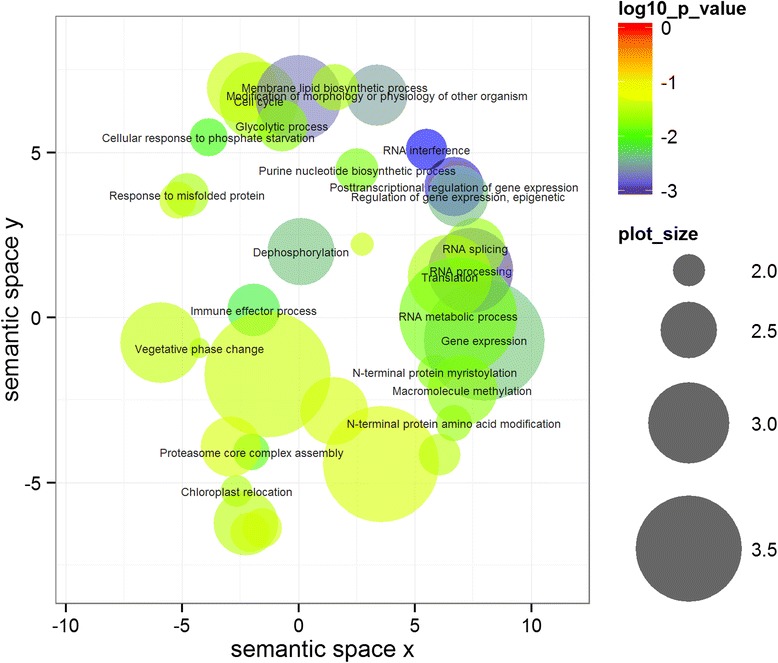
Gene ontology (GO) enrichment analysis of candidate regions suggested that selection of genes involved in post-transcriptional and epigenetic regulation of flowering time may play a potential role in adaptation of B. napus to highly divergent environments. The classical flowering time regulators Bna.FLC and Bna.CO were not found among the candidate regions, although both show functional variation. Allelic effects were additive for plant height and yield, but not for flowering time. The scarcity of positive minor alleles for yield in this breeding pool points to a lack of diversity for adaptation that could restrict yield gain in the face of environmental change.
Our study provides a valuable framework to further improve the adaptability and yield stability of this recent allopolyploid crop under changing environments. The results suggest that flowering time regulation within an adapted B. napus breeding pool is driven by a high number of small modulating processes rather than major transcription factors like Bna.CO. In contrast, yield regulation appears highly parallel, therefore yield could be increased by pyramiding positively associated haplotypes.
作物的开花时间、株高和种子产量受气候和日照长度适应性的强烈影响。为了在重要的油料作物甘蓝型油菜高度多样的田间条件下研究这些性状,我们利用来自三大洲不同农业生态环境的数据进行了全基因组关联研究。
使用甘蓝型油菜60K-SNP Illumina® Infinium芯片,对158个欧洲冬性甘蓝型油菜自交系用21,623个独特的单基因座单核苷酸多态性(SNP)标记进行基因分型。在2010 - 2012年期间,在德国、中国和智利的5个高度多样的地点计算该群体中开花时间、株高和种子产量的表型关联,总共11个不同环境。
我们鉴定出101个与开花起始相关的基因组区域,69个与株高相关,36个与种子产量相关,以及68个具有潜在适应性价值的跨性状区域。在这些区域内,检测到许多候选适应基因的甘蓝型油菜直系同源基因,包括核心生物钟组分如生物钟相关1(Bna.CCA1)以及重要的开花时间调节因子成花素(Bna.FT)和FUL(Bna.FUL)。
候选区域的基因本体(GO)富集分析表明,选择参与开花时间转录后和表观遗传调控的基因可能在甘蓝型油菜适应高度不同环境中发挥潜在作用。尽管经典的开花时间调节因子Bna.FLC和Bna.CO都表现出功能变异,但在候选区域中未发现它们。株高和产量的等位基因效应是累加的,但开花时间不是。该育种群体中产量正向小等位基因的稀缺表明缺乏适应多样性,这可能限制面对环境变化时的产量增益。
我们的研究提供了一个有价值的框架,以在变化的环境下进一步提高这种新近的异源多倍体作物的适应性和产量稳定性。结果表明,在适应的甘蓝型油菜育种群体中,开花时间调控由大量小的调节过程驱动,而非像Bna.CO这样的主要转录因子。相比之下,产量调控似乎高度平行,因此可以通过聚合正相关单倍型来提高产量。