Ghoma Linguissi Laure Stella, Sagna Tani, Soubeiga Serge Théophile, Gwom Luc Christian, Nkenfou Céline Nguefeu, Obiri-Yeboah Dorcas, Ouattara Abdoul Karim, Pietra Virginio, Simpore Jacques
Laboratoire de Biologie Moléculaire et de Génétique, Université Ouaga I Pr Joseph Ki-Zerbo, Ouagadougou, Burkina Faso.
Institut National de Recherche en Sciences de la Santé (IRSSA), Brazzaville, Republic of Congo.
HIV AIDS (Auckl). 2019 Jul 24;11:165-177. doi: 10.2147/HIV.S204661. eCollection 2019.
Burkina-Faso's HIV/AIDS program is one of the most successful in Africa, with a declining HIV prevalence and treatment outcomes that rival those of developed countries. Prevention of mother-to-child transmission (PMTCT) guidelines in Burkina-Faso, initiated in the year 2000, were revised in 2004, 2006 and 2010. The guideline document has since undergone several stages of improvement, largely based on recommendations from WHO, with adaptations by local experts in the field. Option B+ adopted since August 2014 in Burkina-Faso has enabled maintenance of mothers on longer treatment and increasing their survival and that of their children. Through this review, we describe the achievements and challenges of HIV PMTCT programs in Burkina-Faso.
This study had the following objectives: 1) describing the historical perspective of PMTCT implementation in Burkina-Faso; 2) presenting the effectiveness of interventions at improving PMTCT service delivery and promoting retention of mothers and babies in care; and 3) determining the impact of male partner involvement on PMTCT in Burkina-Faso.
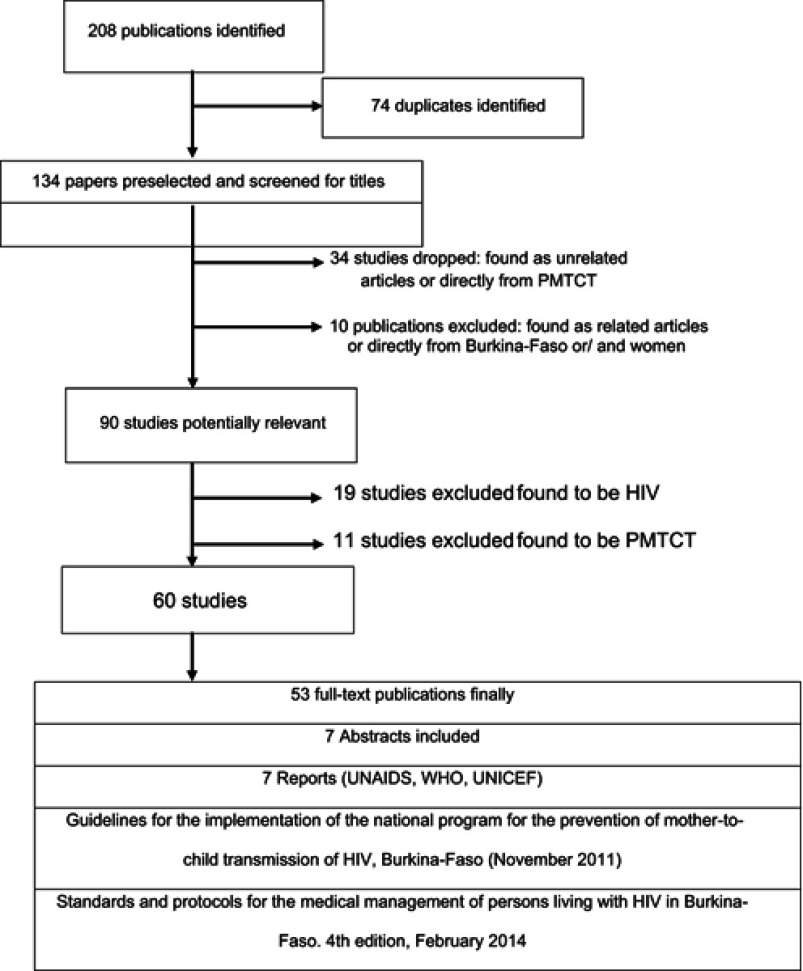
A literature search was conducted in PubMed and Google. Search terms included the following keywords: "HIV testing"; "prevention"; "mother"; "child"; "male partner"; "counseling"; "involvement"; "participation"; and the grouped terms "PMTCT and partners"; "VCT"; "barriers and/or factors"; "Male involvement in PMTCT"; and "Burkina-Faso". Data collection took place from May to October 2015. The search was limited to articles published between January 2002 and December 2015. UNICEF and UNAIDS web sites were also used to find relevant abstracts and documents.
Studies have revealed that with PMTCT, HIV transmission rate moved from 10.4% in 2006 to 0% in 2015. The PMTCT program remains the best way to care for HIV-infected pregnant women and their babies. The current PMTCT policy is based on evidence that male partner involvement is associated with women's completion of PMTCT.
This study shows that the reduction in mother to child transmission of HIV in Burkina-Faso over the years is mainly due to the improvement of PMTCT programs. Efforts still need to be made about the involvement of male partners.
布基纳法索的艾滋病毒/艾滋病项目是非洲最成功的项目之一,艾滋病毒感染率呈下降趋势,治疗效果可与发达国家相媲美。布基纳法索于2000年启动的预防母婴传播(PMTCT)指南在2004年、2006年和2010年进行了修订。此后,该指南文件经历了几个改进阶段,主要基于世界卫生组织的建议,并由该领域的当地专家进行调整。布基纳法索自2014年8月起采用的“选项B+”使母亲能够接受更长时间的治疗,并提高了她们及其子女的存活率。通过本次综述,我们描述了布基纳法索艾滋病毒预防母婴传播项目的成就和挑战。
本研究有以下目标:1)描述布基纳法索预防母婴传播实施情况的历史视角;2)介绍干预措施在改善预防母婴传播服务提供以及促进母亲和婴儿持续接受护理方面的有效性;3)确定男性伴侣参与对布基纳法索预防母婴传播的影响。
在PubMed和谷歌上进行文献检索。检索词包括以下关键词:“艾滋病毒检测”;“预防”;“母亲”;“儿童”;“男性伴侣”;“咨询”;“参与”;以及分组术语“预防母婴传播与伴侣”;“自愿咨询检测”;“障碍和/或因素”;“男性参与预防母婴传播”;以及“布基纳法索”。数据收集于2015年5月至10月进行。检索限于2002年1月至2015年12月发表的文章。联合国儿童基金会和联合国艾滋病规划署的网站也被用于查找相关摘要和文件。
研究表明,通过预防母婴传播,艾滋病毒传播率从2006年的10.4%降至2015年的0%。预防母婴传播项目仍然是照顾感染艾滋病毒的孕妇及其婴儿的最佳方式。当前的预防母婴传播政策基于这样的证据,即男性伴侣的参与与女性完成预防母婴传播相关。
本研究表明,多年来布基纳法索艾滋病毒母婴传播率的降低主要归功于预防母婴传播项目的改进。在男性伴侣参与方面仍需做出努力。