Plastic and Reconstructive Surgery Research, Centre for Dermatology Research, NIHR Manchester Biomedical Research Centre, University of Manchester, Manchester, United Kingdom.
Hair and Skin Research Laboratory, Department of Dermatology, Groote Schuur Hospital, University of Cape Town, Cape Town, South Africa.
Front Immunol. 2019 Aug 7;10:1810. doi: 10.3389/fimmu.2019.01810. eCollection 2019.
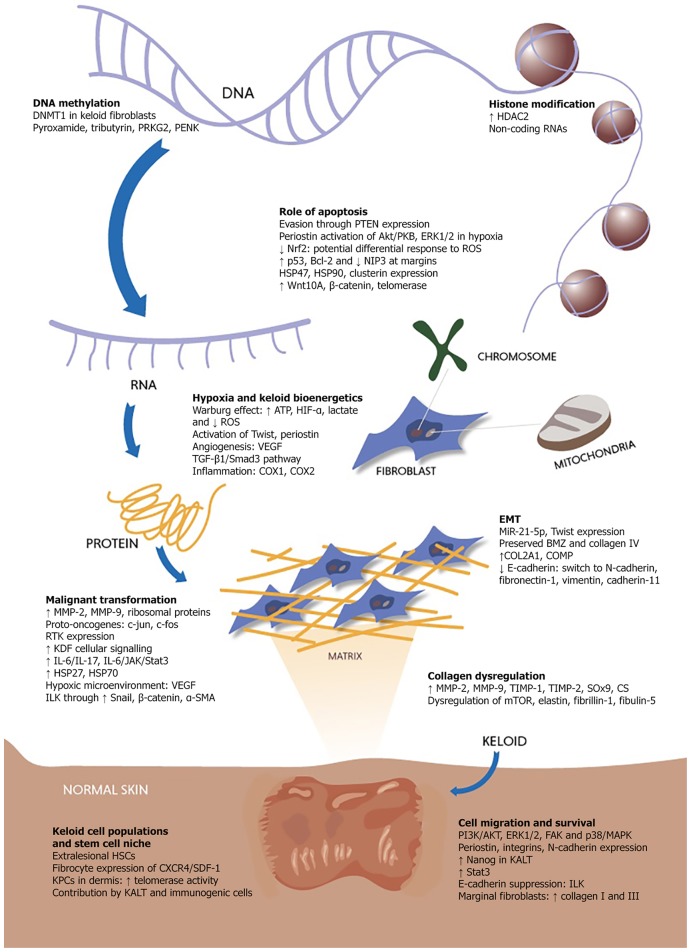
Keloids are considered as benign fibroproliferative skin tumors growing beyond the site of the original dermal injury. Although traditionally viewed as a form of skin scarring, keloids display many cancer-like characteristics such as progressive uncontrolled growth, lack of spontaneous regression and extremely high rates of recurrence. Phenotypically, keloids are consistent with non-malignant dermal tumors that are due to the excessive overproduction of collagen which never metastasize. Within the remit of keloid pathobiology, there is increasing evidence for the various interplay of neoplastic-promoting and suppressing factors, which may explain its aggressive clinical behavior. Amongst the most compelling parallels between keloids and cancer are their shared cellular bioenergetics, epigenetic methylation profiles and epithelial-to-mesenchymal transition amongst other disease biological (genotypic and phenotypic) behaviors. This review explores the quasi-neoplastic or cancer-like properties of keloids and highlights areas for future study.
瘢痕疙瘩被认为是一种良性纤维增生性皮肤肿瘤,生长超出原始皮肤损伤部位。尽管传统上被视为皮肤瘢痕的一种形式,但瘢痕疙瘩表现出许多类似癌症的特征,如进行性不受控制的生长、缺乏自发消退和极高的复发率。表型上,瘢痕疙瘩与非恶性皮肤肿瘤一致,是由于胶原过度产生所致,从不转移。在瘢痕疙瘩病理生物学范围内,越来越多的证据表明存在促进和抑制肿瘤的多种相互作用的因素,这可能解释了其侵袭性的临床行为。瘢痕疙瘩与癌症之间最引人注目的相似之处之一是它们共同的细胞生物能量学、表观遗传甲基化谱以及上皮-间充质转化等疾病生物学(基因型和表型)行为。本综述探讨了瘢痕疙瘩的类肿瘤或类似癌症的特性,并强调了未来研究的领域。