Section of Pharmacology, Department of Medicine, Medical School, University of Perugia, Perugia, Italy.
Front Immunol. 2019 Aug 7;10:1823. doi: 10.3389/fimmu.2019.01823. eCollection 2019.
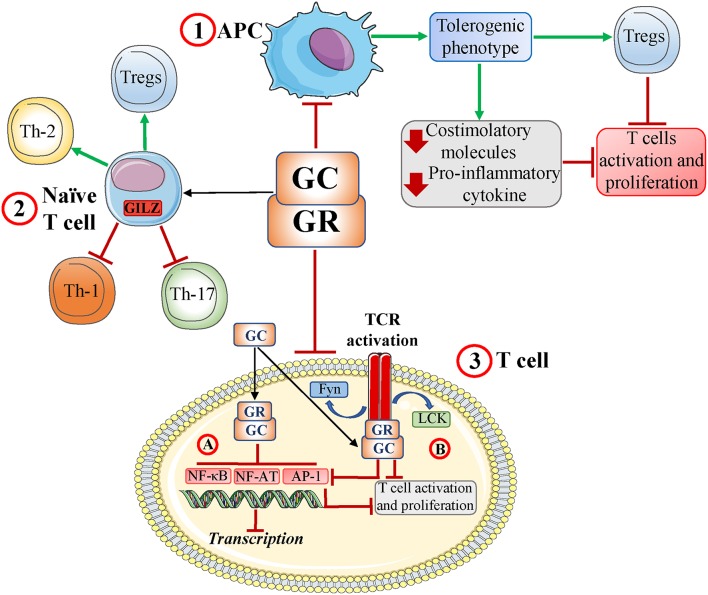
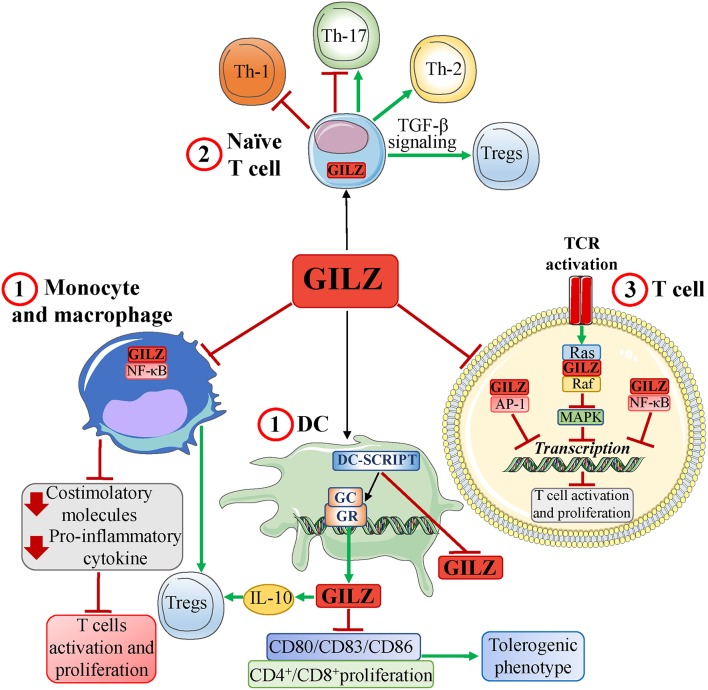
Glucocorticoid-induced leucine zipper (GILZ) is a protein with multiple biological roles that is upregulated by glucocorticoids (GCs) in both immune and non-immune cells. Importantly, GCs are immunosuppressive primarily due to their regulation of cell signaling pathways that are crucial for immune system activity. GILZ, which is transcriptionally induced by the glucocorticoid receptor (GR), mediates part of these immunosuppressive, and anti-inflammatory effects, thereby controlling immune cell proliferation, survival, and differentiation. The primary immune cells targeted by the immunosuppressive activity of GCs are T cells. Importantly, the effects of GCs on T cells are partially mediated by GILZ. In fact, GILZ regulates T-cell activation, and differentiation by binding and inhibiting factors essential for T-cell function. For example, GILZ associates with nuclear factor-κB (NF-κB), c-Fos, and c-Jun and inhibits NF-κB-, and AP-1-dependent transcription. GILZ also binds Raf and Ras, inhibits activation of Ras/Raf downstream targets, including mitogen-activated protein kinase 1 (MAPK1). In addition GILZ inhibits forkhead box O3 (FoxO3) without physical interaction. GILZ also promotes the activity of regulatory T cells (Tregs) by activating transforming growth factor-β (TGF-β) signaling. Ultimately, these actions inhibit T-cell activation and modulate the differentiation of T helper (Th)-1, Th-2, Th-17 cells, thereby mediating the immunosuppressive effects of GCs on T cells. In this mini-review, we discuss how GILZ mediates GC activity on T cells, focusing mainly on the therapeutic potential of this protein as a more targeted anti-inflammatory/immunosuppressive GC therapy.
糖皮质激素诱导亮氨酸拉链(GILZ)是一种具有多种生物学功能的蛋白质,在免疫和非免疫细胞中均可被糖皮质激素(GCs)上调。重要的是,GCs 主要通过调节对免疫系统活动至关重要的细胞信号通路而具有免疫抑制作用。GILZ 由糖皮质激素受体(GR)转录诱导,介导部分免疫抑制和抗炎作用,从而控制免疫细胞的增殖、存活和分化。GCs 的免疫抑制活性主要针对的是 T 细胞。重要的是,GCs 对 T 细胞的作用部分是通过 GILZ 介导的。事实上,GILZ 通过结合和抑制 T 细胞功能所必需的因子来调节 T 细胞的激活和分化。例如,GILZ 与核因子-κB(NF-κB)、c-Fos 和 c-Jun 结合并抑制 NF-κB 和 AP-1 依赖性转录。GILZ 还与 Raf 和 Ras 结合,抑制 Ras/Raf 下游靶标的激活,包括丝裂原激活蛋白激酶 1(MAPK1)。此外,GILZ 抑制叉头框 O3(FoxO3)而不发生物理相互作用。GILZ 通过激活转化生长因子-β(TGF-β)信号通路,还促进调节性 T 细胞(Tregs)的活性。最终,这些作用抑制了 T 细胞的激活,并调节了辅助性 T 细胞(Th)-1、Th-2、Th-17 细胞的分化,从而介导了 GCs 对 T 细胞的免疫抑制作用。在这篇综述中,我们讨论了 GILZ 如何介导 GCs 对 T 细胞的作用,主要集中在该蛋白作为更具靶向性的抗炎/免疫抑制 GC 治疗的治疗潜力上。