
骨髓来源的抑制性细胞扩增在早期 ART 后持续存在,并可能影响 CD4 T 细胞的恢复。
Myeloid Derived Suppressor Cells Expansion Persists After Early ART and May Affect CD4 T Cell Recovery.
机构信息
Cellular Immunology Laboratory, National Institute for Infectious Diseases Lazzaro Spallanzani-IRCCS, Rome, Italy.
Virology Laboratory, National Institute for Infectious Diseases Lazzaro Spallanzani-IRCCS, Rome, Italy.
出版信息
Front Immunol. 2019 Aug 8;10:1886. doi: 10.3389/fimmu.2019.01886. eCollection 2019.
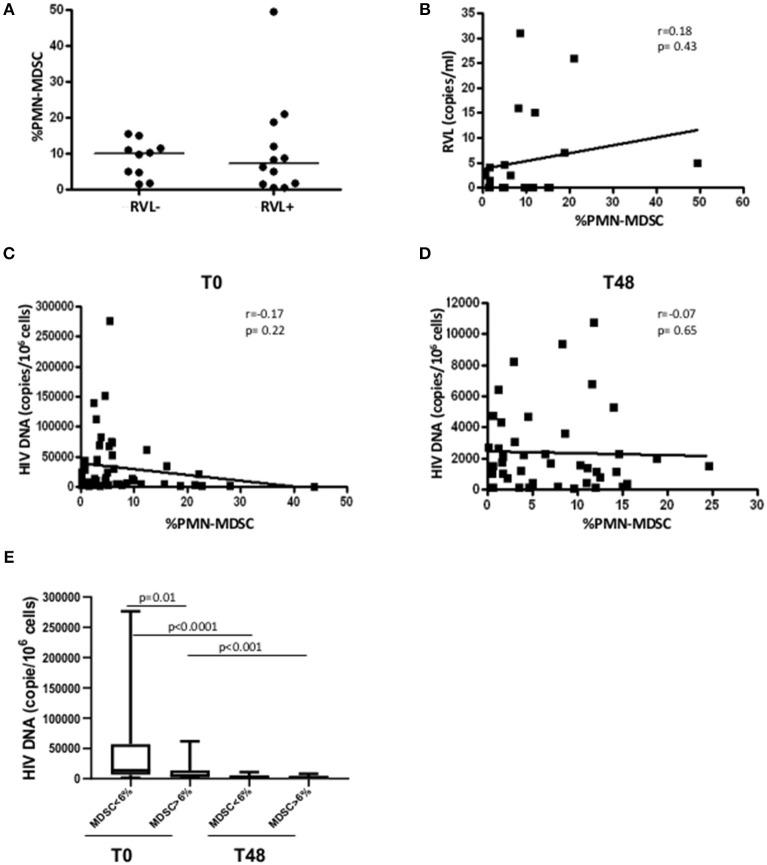
Myeloid-derived suppressor cells (MDSC) are expanded during HIV-1 infection and correlated with disease progression. MDSC expand in the early phase of primary infection depending on TRAIL level. In this study we evaluated the effect of ART on the frequency of MDSC in patients with primary HIV infection (PHI), and their impact on CD4 T cell reconstitution. MDSC frequency was evaluated by flow-cytometry in 60 PHI patients at 12, 24 and 48 weeks after ART initiation. Cytokine plasma levels were evaluated by Luminex technology at the same time points. The capacity of MDSC to modulate hematopoietic early progenitor cells' expansion was evaluated using the OP9/Dl1 system. As previously described, polymorphonuclear-MDSC (PMN-MDSC) frequency was higher in PHI compared to healthy donors. Interestingly, 48 weeks of successful ART failed to normalize the PMN-MDSC frequency. Moreover, PMN-MDSC frequency was not correlated with residual viral load, suggesting that the persistence of PMN-MDSC was not due to residual viral replication. Interestingly, patients with low PMN-MDSC frequency (<6%) at T0 had a higher HIV DNA at the same time point than individuals with high PMN-MDSC frequency (>6%). We also found an inverse correlation between PMN-MDSC frequency and CD4-T cell count at 48 weeks post-ART, which was confirmed by multivariate analysis adjusting for age and CD4 T cell number at baseline. These data suggest that the persistence of PMN-MDSC may impact CD4 T cell recovery. Indeed, PMN-MDSC impaired the expansion of CD34+CD38- hematopoietic early progenitors. Further, a balance between TRAIL and GM-CSF may be necessary to maintain a low MDSC level. In conclusion, early ART initiation was not able to normalize PMN-MDSC frequency that might impact the CD4 T cell recovery. These data open new questions regarding the clinical impact of MDSC persistence in HIV+ patients, in particular on non-AIDS related diseases.
髓源抑制性细胞(MDSC)在 HIV-1 感染期间扩增,并与疾病进展相关。MDSC 在原发性感染的早期阶段根据 TRAIL 水平扩增。在这项研究中,我们评估了抗逆转录病毒治疗(ART)对原发性 HIV 感染(PHI)患者 MDSC 频率的影响,以及它们对 CD4 T 细胞重建的影响。在 ART 开始后 12、24 和 48 周,通过流式细胞术评估 60 例 PHI 患者的 MDSC 频率。同时使用 Luminex 技术评估细胞因子的血浆水平。使用 OP9/Dl1 系统评估 MDSC 调节造血早期祖细胞扩增的能力。如前所述,PHI 患者中多形核 MDSC(PMN-MDSC)的频率高于健康供体。有趣的是,成功的 48 周 ART 未能使 PMN-MDSC 频率正常化。此外,PMN-MDSC 频率与残留病毒载量无关,表明 PMN-MDSC 的持续存在不是由于残留病毒复制所致。有趣的是,T0 时PMN-MDSC 频率较低(<6%)的患者在同一时间点的 HIV DNA 高于PMN-MDSC 频率较高(>6%)的个体。我们还发现,在 ART 后 48 周时,PMN-MDSC 频率与 CD4-T 细胞计数呈负相关,这通过调整基线时年龄和 CD4 T 细胞数的多变量分析得到证实。这些数据表明,PMN-MDSC 的持续存在可能会影响 CD4 T 细胞的恢复。事实上,PMN-MDSC 会损害 CD34+CD38-造血早期祖细胞的扩增。此外,维持 TRAIL 和 GM-CSF 之间的平衡可能对于维持低 MDSC 水平是必要的。总之,早期 ART 启动不能使 PMN-MDSC 频率正常化,这可能会影响 CD4 T 细胞的恢复。这些数据提出了有关 HIV+患者中 MDSC 持续存在对非 AIDS 相关疾病的临床影响的新问题。



 Zotero 插件