
通过流式细胞术分析冷冻保存样本中多形核髓系来源抑制细胞的新方法。
A new procedure to analyze polymorphonuclear myeloid derived suppressor cells in cryopreserved samples cells by flow cytometry.
机构信息
Cellular Immunology and Pharmacology Laboratory, "Lazzaro Spallanzani" National Institute for Infectious Diseases, IRCCS, Rome, Italy.
Clinical Department, "Lazzaro Spallanzani" National Institute for Infectious Diseases, IRCCS, Rome, Italy.
出版信息
PLoS One. 2018 Aug 30;13(8):e0202920. doi: 10.1371/journal.pone.0202920. eCollection 2018.
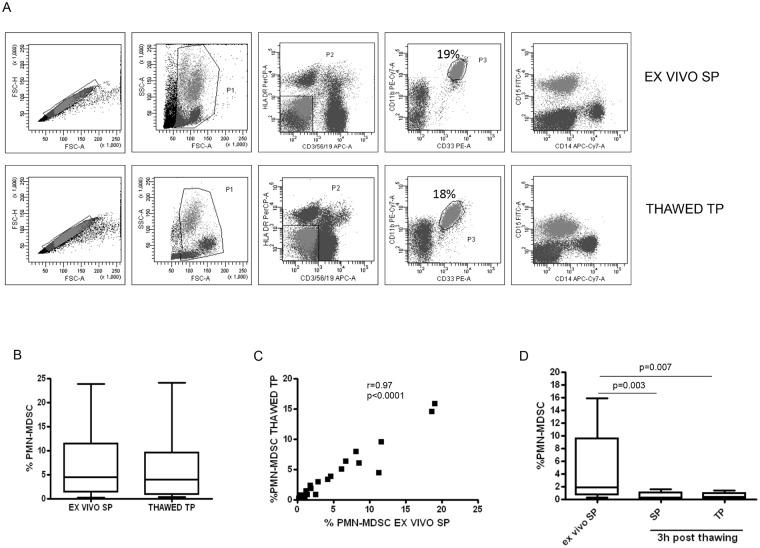
Myeloid derived suppressor cells (MDSC) is a heterogeneous subset of immature and mature cells of the myeloid lineage, undergoing expansion during pathologic conditions, and able to perform strong immune suppressive functions. It has been shown that cryopreservation selectively impacts the polimorphonuclear (PMN) MDSC viability and recovery, and alters the correct analysis of MDSC subsets. In laboratory practice, cryopreservation is often inevitable, in particular in multicenter studies where samples have to be shipped to a centralized laboratory. Aim of the present work was to set out a new protocol to evaluate the frequency of PMN-MDSC in thawed cells by flow-cytometry. PBMC were isolated from HIV+ patients and healthy donors, and were cryopreserved for at least ten days. After thawing, two different protocols were used: 1. standard protocol (SP) consisting of staining with the antibodies mix and then fixing with formalin 1%; 2. thawed protocol (TP) in which fixation foregoes the staining with the antibodies mix. Results showed that PMN-MDSC frequency in ex vivo PBMC evaluated by means TP was comparable to that analysed by SP, indicating that the protocol did not alter PMN-MDSC quantification in ex vivo cells. We then demonstrated that PMN-MDSC frequency in thawed PBMC tested by TP was almost identical to the frequency obtained in ex vivo cells evaluated by using SP. However, we observed that after three hours of culture post-thawing, PMN-MDSC were not assessable anymore with both SP and TP. In conclusion, we herein demonstrated that fixing PBMC soon after thawing and before antibody staining allows preservation of PMN-MDSC integrity and a reliable cells quantification. Thus, it is possible to phenotipically identify PMN-MDSC in cryopreserved PBMC, consenting adequate test precision and accuracy as well as making multicentre research more feasible.
髓系来源的抑制细胞(MDSC)是骨髓谱系中未成熟和成熟细胞的异质性亚群,在病理条件下扩增,并能够发挥强大的免疫抑制功能。已经表明,冷冻保存会选择性地影响多形核(PMN)MDSC 的活力和恢复,并改变 MDSC 亚群的正确分析。在实验室实践中,冷冻保存通常是不可避免的,特别是在需要将样本运送到集中实验室的多中心研究中。本研究的目的是制定一种新的方案,通过流式细胞术评估解冻细胞中 PMN-MDSC 的频率。从 HIV+患者和健康供体中分离 PBMC,并至少冷冻保存十天。解冻后,使用两种不同的方案:1. 标准方案(SP),包括用抗体混合物染色,然后用 1%甲醛固定;2. 解冻方案(TP),其中省略了用抗体混合物染色的固定步骤。结果表明,通过 TP 评估的 ex vivo PBMC 中 PMN-MDSC 的频率与通过 SP 分析的频率相当,表明该方案不会改变 ex vivo 细胞中 PMN-MDSC 的定量。然后我们证明,通过 TP 测试的解冻 PBMC 中的 PMN-MDSC 频率与使用 SP 评估的 ex vivo 细胞中获得的频率几乎相同。然而,我们观察到解冻后三小时的培养后,PMN-MDSC 无法再用 SP 和 TP 进行评估。总之,我们证明了在解冻后不久且在抗体染色之前固定 PBMC 可以保留 PMN-MDSC 的完整性,并实现可靠的细胞定量。因此,可以在冷冻保存的 PBMC 中表型鉴定 PMN-MDSC,从而确保适当的测试精度和准确性,并使多中心研究更加可行。


 Zotero 插件