Xu Ning, Liu Shixun, Xin Fengxue, Zhou Jie, Jia Honghua, Xu Jiming, Jiang Min, Dong Weiliang
State Key Laboratory of Materials-Oriented Chemical Engineering, College of Biotechnology and Pharmaceutical Engineering, Nanjing Tech University, Nanjing, China.
Jiangsu Key Laboratory for Biomass-Based Energy and Enzyme Technology, Huaiyin Normal University, Huai'an, China.
Front Bioeng Biotechnol. 2019 Aug 8;7:191. doi: 10.3389/fbioe.2019.00191. eCollection 2019.
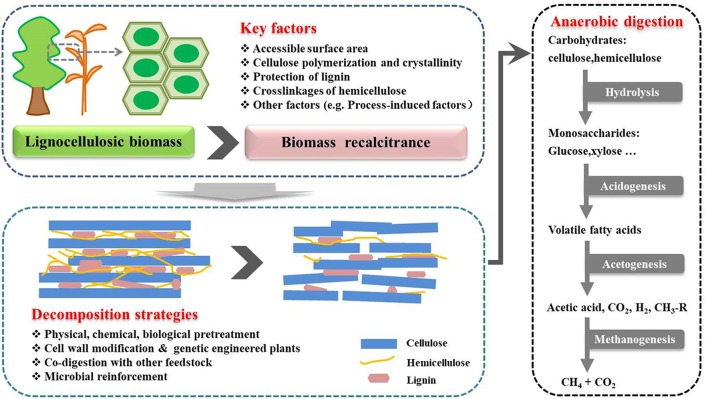
Anaerobic digestion using lignocellulosic material as the substrate is a cost-effective strategy for biomethane production, which provides great potential to convert biomass into renewable energy. However, the recalcitrance of native lignocellulosic biomass makes it resistant to microbial hydrolysis, which reduces the bioconversion efficiency of organic matter into biogas. Therefore, it is necessary to critically investigate the correlation between lignocellulose characteristics and bioconversion efficiency. Accordingly, this review comprehensively summarizes the anaerobic digestion process and rate-limiting step, structural and compositional properties of lignocellulosic biomass, recalcitrance and inhibitors of lignocellulose and their major effects on anaerobic digestion for biomethane production. Moreover, various type of pretreatment strategies applied to lignocellulosic biomass was discussed in detail, which would contribution to cell wall degradation and improvement of biomethane yields. In the view of current knowledge, high energy input and cost requirements are the main limitations of these pretreatment methods. In addition to optimization of fermentation process, further studies should focus much more on key structural influence factors of biomass recalcitrance and anaerobic digestion efficiency, which will contribute to improvement of biomethane production from lignocellulose.
以木质纤维素材料为底物的厌氧消化是一种具有成本效益的生物甲烷生产策略,它为将生物质转化为可再生能源提供了巨大潜力。然而,天然木质纤维素生物质的顽固性使其对微生物水解具有抗性,这降低了有机物转化为沼气的生物转化效率。因此,有必要深入研究木质纤维素特性与生物转化效率之间的相关性。据此,本综述全面总结了厌氧消化过程及限速步骤、木质纤维素生物质的结构和组成特性、木质纤维素的顽固性和抑制剂及其对生物甲烷生产厌氧消化的主要影响。此外,还详细讨论了应用于木质纤维素生物质的各种预处理策略,这些策略将有助于细胞壁降解和提高生物甲烷产量。从目前的知识来看,高能量输入和成本需求是这些预处理方法的主要局限性。除了优化发酵过程外,进一步的研究应更多地关注生物质顽固性和厌氧消化效率的关键结构影响因素,这将有助于提高木质纤维素生物甲烷的产量。