Ware Tyson L, Huskins Shannon R, Grinton Bronwyn E, Liu Yu-Chi, Bennett Mark F, Harvey Michael, McMahon Jacinta, Andreopoulos-Malikotsinas Danae, Bahlo Melanie, Howell Katherine B, Hildebrand Michael S, Damiano John A, Rosenfeld Alexander, Mackay Mark T, Mandelstam Simone, Leventer Richard J, Harvey A Simon, Freeman Jeremy L, Scheffer Ingrid E, Jones Dean L, Berkovic Samuel F
Department of Paediatrics Royal Hobart Hospital Hobart Tasmania Australia.
School of Medicine University of Tasmania Hobart Tasmania Australia.
Epilepsia Open. 2019 Jul 22;4(3):504-510. doi: 10.1002/epi4.12350. eCollection 2019 Sep.
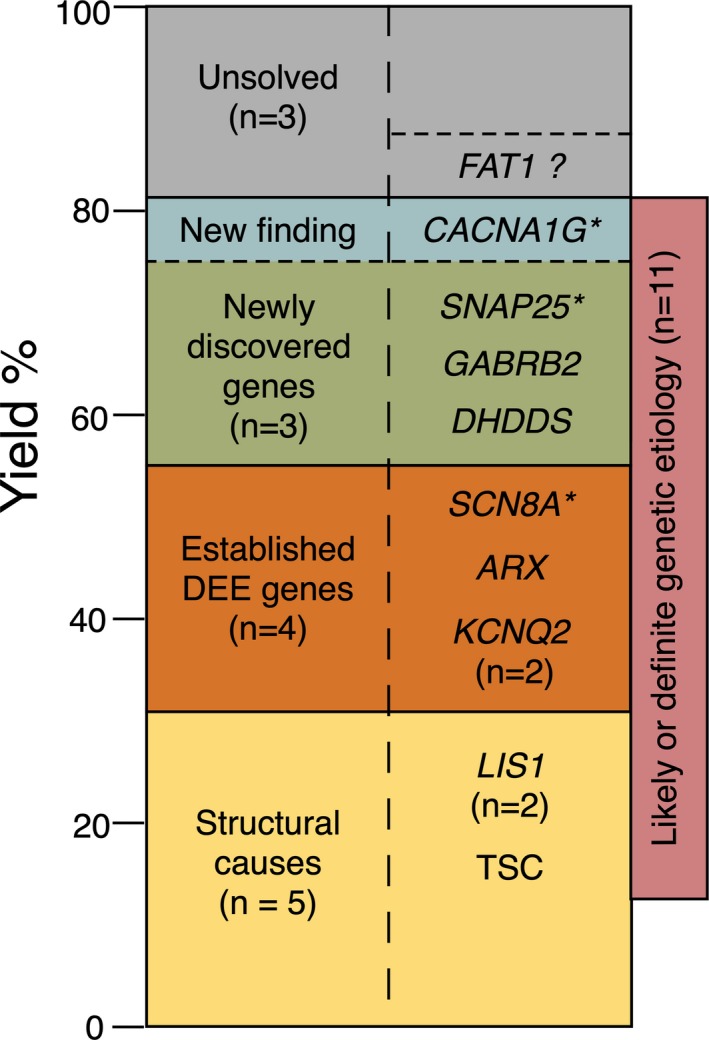
We sought to determine incidence, etiologies, and yield of genetic testing in infantile onset developmental and epileptic encephalopathies (DEEs) in a population isolate, with an intensive multistage approach. Infants born in Tasmania between 2011 and 2016, with seizure onset <2 years of age, epileptiform EEG, frequent seizures, and developmental impairment, were included. Following review of EEG databases, medical records, brain MRIs, and other investigations, clinical genetic testing was undertaken with subsequent research interrogation of whole exome sequencing (WES) in unsolved cases. The incidence of infantile DEEs was 0.44/1000 per year (95% confidence interval 0.25 to 0.71), with 16 cases ascertained. The etiology was structural in 5/16 cases. A genetic basis was identified in 6 of the remaining 11 cases (3 gene panel, 3 WES). In two further cases, WES identified novel variants with strong in silico data; however, paternal DNA was not available to support pathogenicity. The etiology was not determined in 3/16 (19%) cases, with a candidate gene identified in one of these. Pursuing clinical imaging and genetic testing followed by WES at an intensive research level can give a high diagnostic yield in the infantile DEEs, providing a solid base for prognostic and genetic counseling.
我们采用强化多阶段方法,试图确定人群隔离中婴儿期起病的发育性和癫痫性脑病(DEEs)的基因检测发病率、病因及检测结果。纳入2011年至2016年在塔斯马尼亚出生、癫痫发作起始年龄<2岁、脑电图有癫痫样放电、癫痫发作频繁且有发育障碍的婴儿。在查阅脑电图数据库、病历、脑部磁共振成像及其他检查后,进行临床基因检测,对未确诊病例随后进行全外显子测序(WES)的研究性分析。婴儿期DEEs的发病率为每年0.44/1000(95%置信区间0.25至0.71),共确诊16例。16例中有5例病因是结构性的。其余11例中有6例确定了遗传基础(3例通过基因panel,3例通过WES)。另有2例中,WES鉴定出具有强大计算机模拟数据的新变异;然而,无法获得父系DNA来支持其致病性。16例中有3例(19%)病因未确定,其中1例鉴定出一个候选基因。在强化研究层面进行临床影像学和基因检测,随后进行WES,在婴儿期DEEs中可获得较高的诊断率,为预后和遗传咨询提供坚实基础。