Institute for Medical Informatics, Biometry and Epidemiology, University of Duisburg-Essen, Essen, Germany.
Institute of Medical Sociology, Centre for Health and Society, University Hospital Düsseldorf, Düsseldorf, Germany.
PLoS One. 2019 Aug 23;14(8):e0221252. doi: 10.1371/journal.pone.0221252. eCollection 2019.
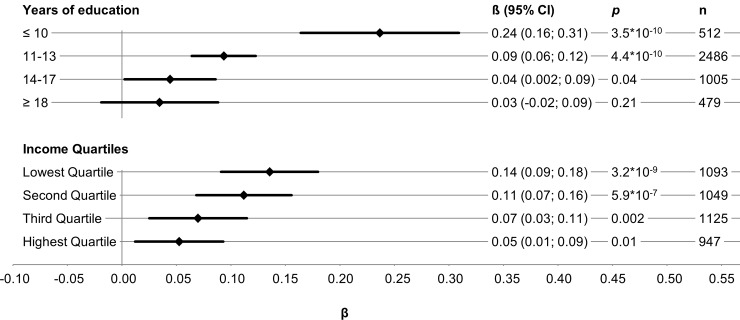
Body mass index (BMI) is influenced by genetic, behavioral and environmental factors, while interactions between genetic and socioeconomic factors have been suggested. Aim of the study was to investigate whether socioeconomic position (SEP) interacts with a BMI-related genetic sum score (GRSBMI) to affect BMI in a population-based cohort. SEP-related health behaviors and a GRS associated with educational attainment (GRSEdu) were included in the analysis to explore potential interactions underlying the GRSBMIxSEP effect. Baseline information on SEP indicators (education, income), BMI, smoking, physical activity, alcohol consumption and genetic risk factors were available for 4,493 participants of the Heinz Nixdorf Recall Study. Interaction analysis was based on linear regression as well as on stratified analyses. In SEP-stratified analyses, the highest genetic effects were observed in the lowest educational group with a 0.24 kg/m2 higher BMI (95%CI: 0.16; 0.31) and in the lowest income quartile with a 0.14 kg/m2 higher BMI (95%CI: 0.09; 0.18) per additional risk allele. Indication for a GRSBMIxSEP interaction was observed for education (ßGRSbmixeducation = -0.02 [95%CI:-0.03; -0.01]) and income (ßGRSbmixincome = -0.05 [95%CI: -0.08; -0.02]). When adjusting for interactions with the GRSEdu and SEP-related health behaviors, effect size estimates of the GRSBMIxSEP interaction remained virtually unchanged. Results gave indication for an interaction of BMI-related genetic risk factors with SEP indicators, showing substantially stronger genetic effects in low SEP groups. This supports the hypothesis that expression of genetic risks is higher in socioeconomically disadvantaged environments. No indication was observed that the GRSBMIxSEP interaction was affected by other SEP-related factors included in the analysis.
体重指数(BMI)受遗传、行为和环境因素的影响,而遗传和社会经济因素之间的相互作用也已被提出。本研究的目的是调查社会经济地位(SEP)是否与 BMI 相关的遗传总和评分(GRSBMI)相互作用,从而影响基于人群的队列中的 BMI。在分析中纳入了与 SEP 相关的健康行为和与教育程度相关的 GRS(GRSEdu),以探索 GRSBMIxSEP 效应背后潜在的相互作用。Heinz Nixdorf 回顾研究的 4493 名参与者的基线信息包括 SEP 指标(教育、收入)、BMI、吸烟、身体活动、饮酒和遗传风险因素。交互分析基于线性回归和分层分析。在 SEP 分层分析中,在最低教育组中观察到最高的遗传效应,其 BMI 高出 0.24kg/m2(95%CI:0.16;0.31),在最低收入四分位数中,BMI 高出 0.14kg/m2(95%CI:0.09;0.18),每增加一个风险等位基因。观察到 GRSBMIxSEP 相互作用的迹象,表明教育(ßGRSbmixeducation = -0.02 [95%CI:-0.03;-0.01])和收入(ßGRSbmixincome = -0.05 [95%CI:-0.08;-0.02])。当调整与 GRSEdu 和与 SEP 相关的健康行为的相互作用时,GRSBMIxSEP 相互作用的效应大小估计值几乎没有变化。结果表明,BMI 相关遗传风险因素与 SEP 指标之间存在相互作用,在低 SEP 组中表现出更强的遗传效应。这支持了遗传风险表达在社会经济不利环境中更高的假设。没有迹象表明分析中纳入的其他与 SEP 相关的因素会影响 GRSBMIxSEP 相互作用。