Lawrence Berkeley National Laboratory, Molecular Biophysics & Integrated Bioimaging Division, 1 Cyclotron Rd, Berkeley, CA, 94720, USA.
Int J Obes (Lond). 2020 Oct;44(10):2101-2112. doi: 10.1038/s41366-020-0636-1. Epub 2020 Jul 14.
BACKGROUND/OBJECTIVES: Quantile-dependent expressivity occurs when a gene's phenotypic expression depends upon whether the trait (e.g., BMI) is high or low relative to its distribution. We have previously shown that the obesity effects of a genetic risk score (GRS) increased significantly with increasing quantiles of BMI. However, BMI is an inexact adiposity measure and GRS explains <3% of the BMI variance. The purpose of this paper is to test BMI for quantile-dependent expressivity using a more inclusive genetic measure (h, heritability in the narrow sense), extend the result to other adiposity measures, and demonstrate its consistency with purported gene-environment interactions.
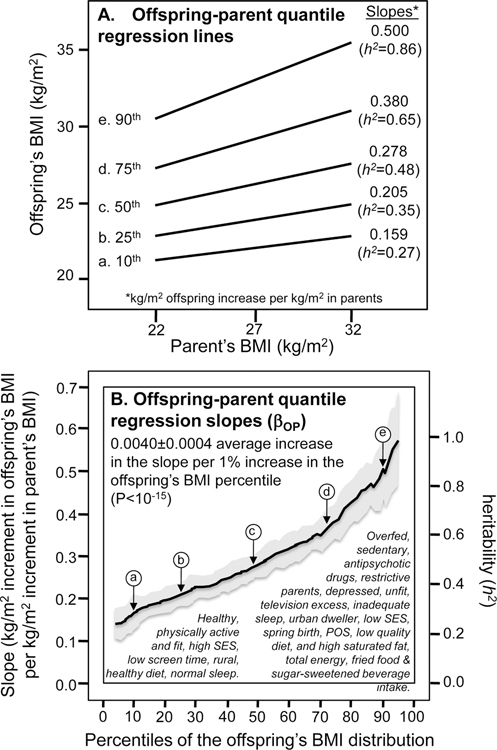
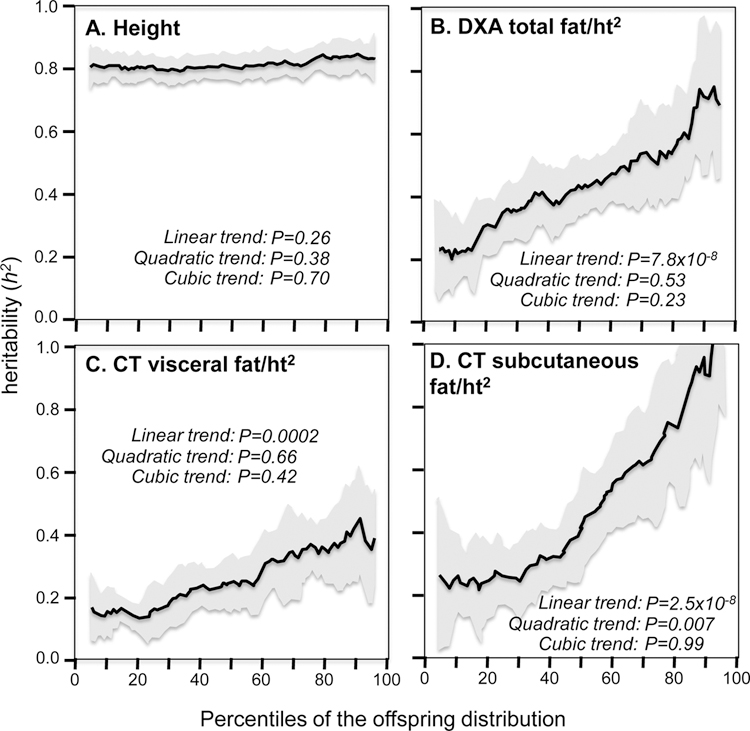
SUBJECTS/METHODS: Quantile-specific offspring-parent regression slopes (β) were obtained from quantile regression for height (ht) and computed tomography (CT), dual-energy x-ray absorptiometry (DXA), anthropometric, and bioelectrical impedance (BIA) adiposity measures. Heritability was estimated by 2β/(1 + r) in 6227 offspring-parent pairs from the Framingham Heart Study, where r is the spouse correlation.
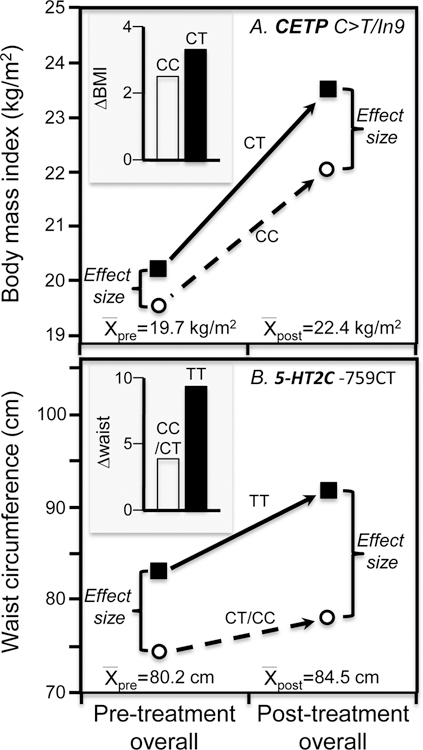
Compared to h at the 10th percentile, genetic heritability was significantly greater at the 90th population percentile for BMI (3.14-fold greater, P < 10), waist girth/ht (3.27-fold, P < 10), hip girth/ht (3.12-fold, P = 6.3 × 10), waist-to-hip ratio (1.75-fold, P = 0.01), sagittal diameter/ht (3.89-fold, P = 3.7 × 10), DXA total fat/ht (3.62-fold, P = 0.0002), DXA leg fat/ht (3.29-fold, P = 2.0 × 10), DXA arm fat/ht (4.02-fold, P = 0.001), CT-visceral fat/ht (3.03-fold, P = 0.002), and CT-subcutaneous fat/ht (3.54-fold, P = 0.0004). External validity was suggested by the phenomenon's consistency with numerous published reports. Quantile-dependent expressivity potentially explains precision medicine markers for weight gain from overfeeding or antipsychotic medications, and the modifying effects of physical activity, sleep, diet, polycystic ovary syndrome, socioeconomic status, and depression on gene-BMI relationships.
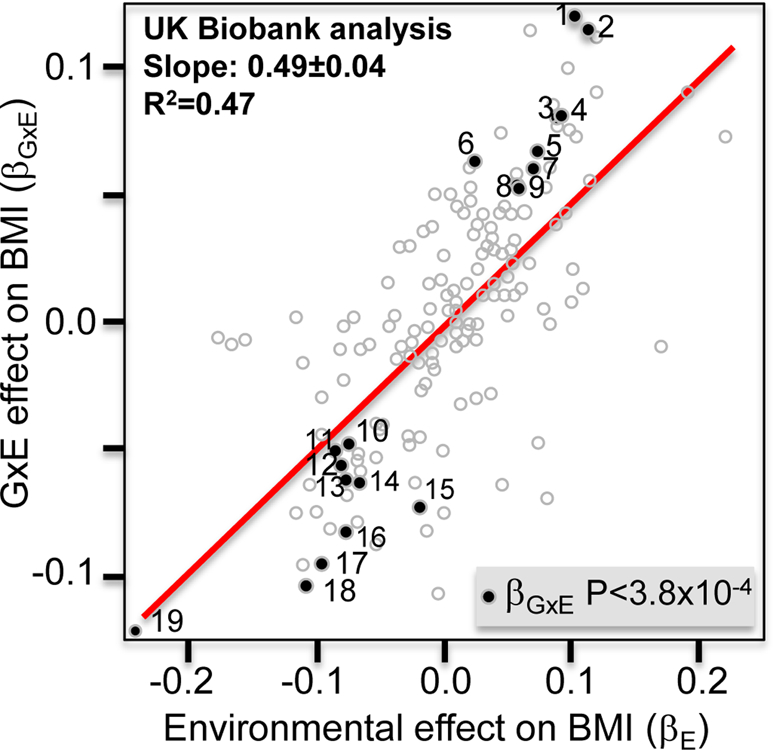
Genetic heritabilities of anthropometric, CT, and DXA adiposity measures increase with increasing adiposity. Some gene-environment interactions may arise from analyzing subjects by characteristics that distinguish high vs. low adiposity rather than the effects of environmental stimuli on transcriptional and epigenetic processes.
背景/目的:当一个基因的表型表达取决于性状(例如 BMI)相对于其分布是高还是低时,就会出现分位数依赖性表达。我们之前已经表明,遗传风险评分(GRS)对肥胖的影响随着 BMI 分位数的增加而显著增加。然而,BMI 是一种不精确的肥胖测量指标,并且 GRS 仅解释了 BMI 变异的<3%。本文的目的是使用更具包容性的遗传指标(狭义遗传率 h)来测试 BMI 的分位数依赖性表达,将结果扩展到其他肥胖指标,并证明其与假定的基因-环境相互作用一致。
通过身高(ht)和计算机断层扫描(CT)、双能 X 射线吸收法(DXA)、人体测量学和生物电阻抗(BIA)肥胖测量的分位数回归,获得了特定于分位数的后代-父母回归斜率(β)。在弗雷明汉心脏研究的 6227 对后代-父母中,通过 2β/(1+r)估计遗传率,其中 r 是配偶相关系数。
与第 10 个百分位数的 h 相比,BMI(高 3.14 倍,P<10)、腰围/ht(高 3.27 倍,P<10)、臀围/ht(高 3.12 倍,P=6.3×10)、腰臀比(高 1.75 倍,P=0.01)、矢状径/ht(高 3.89 倍,P=3.7×10)、DXA 总脂肪/ht(高 3.62 倍,P=0.0002)、DXA 腿部脂肪/ht(高 3.29 倍,P=2.0×10)、DXA 手臂脂肪/ht(高 4.02 倍,P=0.001)、CT 内脏脂肪/ht(高 3.03 倍,P=0.002)和 CT 皮下脂肪/ht(高 3.54 倍,P=0.0004)的遗传率显著更高。外部有效性表明,这种现象与众多已发表的报告一致。分位数依赖性表达可能解释了体重增加的精准医学标志物,如过量喂养或抗精神病药物引起的体重增加,以及体力活动、睡眠、饮食、多囊卵巢综合征、社会经济地位和抑郁对基因-BMI 关系的调节作用。
人体测量学、CT 和 DXA 肥胖指标的遗传力随着肥胖程度的增加而增加。一些基因-环境相互作用可能是由于根据区分高肥胖和低肥胖的特征分析受试者而不是由于环境刺激对转录和表观遗传过程的影响而产生的。