College of Sport Science, Sungkyunkwan University, Suwon 16419, Korea.
Department of Civil Engineering, Sangmyung University, Cheonan 31066, Korea.
Int J Environ Res Public Health. 2019 Aug 22;16(17):3040. doi: 10.3390/ijerph16173040.
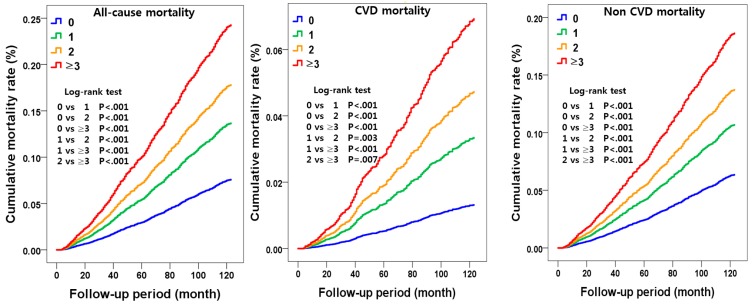
This study examined the association between lifestyle risk factors and all-cause and cardiovascular disease (CVD) mortality in 9945 Korea adults (56% women) aged 45 years and older. Smoking, heavy alcohol intake, underweight or obesity, physical inactivity, and unintentional weight loss (UWL) were included as risk factors. During 9.6 ± 2.0 years of follow-up, there were a total of 1530 cases of death from all causes, of which 365 cases were from CVD. Compared to a zero risk factor (hazard ratio, HR = 1), the crude HR of all-cause mortality was 1.864 (95% CI, 1.509-2.303) for one risk factor, 2.487 (95% confidence interval, CI, 2.013-3.072) for two risk factors, and 3.524 (95% CI, 2.803-4.432) for three or more risk factors. Compared to a zero risk factor (HR = 1), the crude HR of CVD mortality was 2.566 (95% CI, 1.550-4.250) for one risk factor, 3.655 (95% CI, 2.211-6.043) for two risk factor, and 5.416 (95% CI, 3.185-9.208) for three or more risk factors. The HRs for all-cause and CVD mortality remained significant even after adjustments for measured covariates. The current findings showed that five lifestyle risk factors, including smoking, at-risk alcohol consumption, underweight/obesity, physical inactivity, and UWL, were significantly associated with an increased risk of all-cause and CVD mortality in Korean adults.
本研究调查了 9945 名韩国成年人(56%为女性)的生活方式风险因素与全因和心血管疾病(CVD)死亡率之间的关系,这些成年人年龄均在 45 岁及以上。研究将吸烟、大量饮酒、体重过轻或肥胖、身体活动不足和非故意体重减轻(UWL)等因素纳入风险因素。在 9.6±2.0 年的随访期间,共有 1530 例全因死亡,其中 365 例死于 CVD。与零风险因素(危险比,HR=1)相比,存在一个风险因素时,全因死亡率的粗 HR 为 1.864(95%CI,1.509-2.303);存在两个风险因素时,粗 HR 为 2.487(95%CI,2.013-3.072);存在三个或更多风险因素时,粗 HR 为 3.524(95%CI,2.803-4.432)。与零风险因素(HR=1)相比,存在一个风险因素时,CVD 死亡率的粗 HR 为 2.566(95%CI,1.550-4.250);存在两个风险因素时,粗 HR 为 3.655(95%CI,2.211-6.043);存在三个或更多风险因素时,粗 HR 为 5.416(95%CI,3.185-9.208)。即使在校正了测量协变量后,全因和 CVD 死亡率的 HR 仍具有统计学意义。当前的研究结果表明,吸烟、有风险的饮酒、体重过轻/肥胖、身体活动不足和 UWL 这五种生活方式风险因素与韩国成年人全因和 CVD 死亡率的增加显著相关。