Borrelli Enrico, Zuccaro Biancamaria, Zucchiatti Ilaria, Parravano Mariacristina, Querques Lea, Costanzo Eliana, Sacconi Riccardo, Prascina Francesco, Scarinci Fabio, Bandello Francesco, Querques Giuseppe
Department of Ophthalmology, University Vita-Salute, IRCCS Ospedale San Raffaele, Milan 20132, Italy.
IRCCS-Fondazione Bietti, Rome 00198, Italy.
J Clin Med. 2019 Aug 22;8(9):1271. doi: 10.3390/jcm8091271.
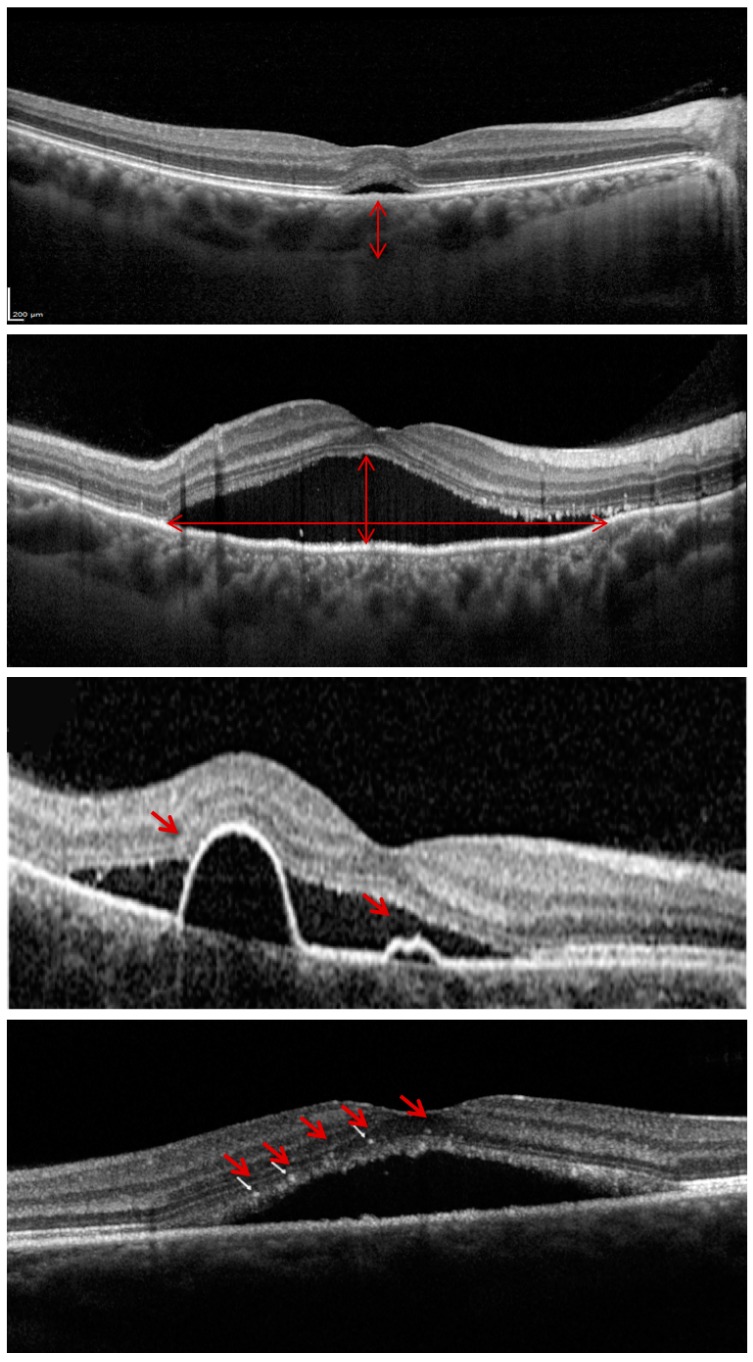
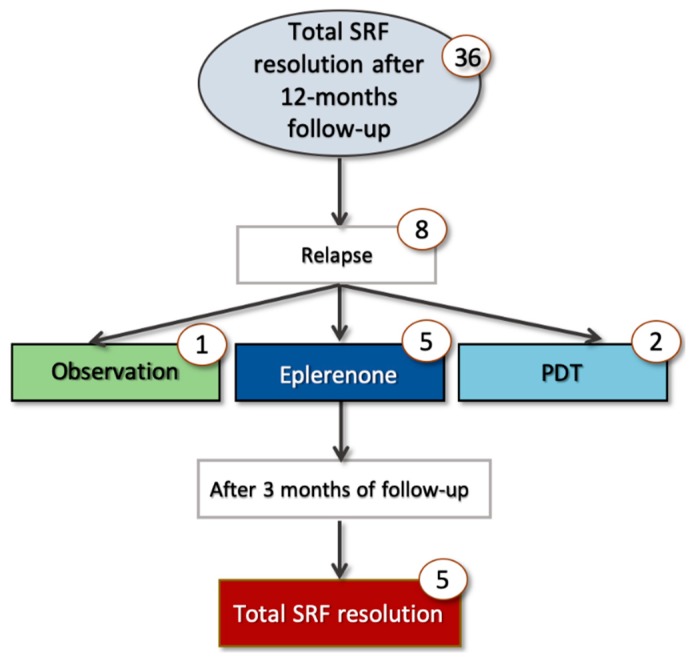
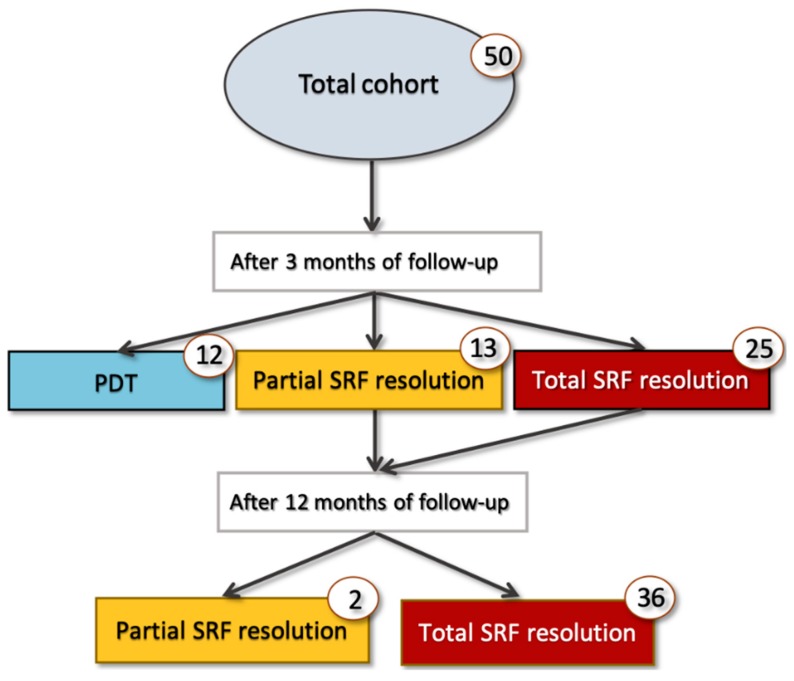
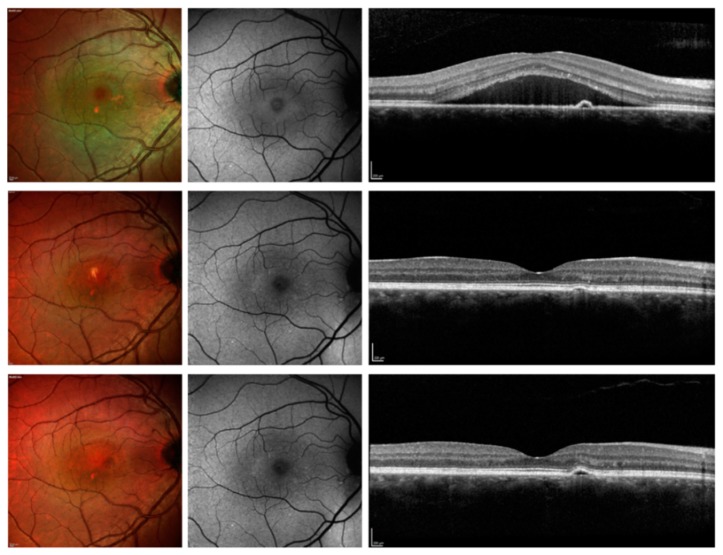
: To present data on clinical response to eplerenone over a 1-year period in patients with central serous chorioretinopathy (CSC), and to evaluate optical coherence tomography (OCT) variables as predictors of treatment response at 3- and 12-month follow-up visits. : Patients with acute or chronic CSC treated with eplerenone were retrospectively included. Clinical and imaging characteristics were recorded at baseline and at the 3-month and 12-month follow-up visits. Changes from baseline in quantitative measurements were calculated at each follow-up. Logistic regression analysis was computed to correlate clinical and OCT parameters at baseline with response to treatment at 3 and 12 months of follow-up. : A total of 50 eyes of 50 patients were included in the study. Mean ± SD best corrected visual acuity (BCVA) was 0.20 ± 0.14 Logarithm of the Minimum Angle of Resolution (LogMAR) at baseline and significantly improved at both the 3-month (0.12 ± 0.13 LogMAR, < 0.0001) and 12-month (0.10 ± 0.12 LogMAR, < 0.0001) follow-up visits. At the 3-month follow-up visit, 25 out of 50 eyes (50.0%) demonstrated macular complete subretinal fluid (SRF) resolution, while 13 eyes (26.0%) showed macular partial SRF resolution, and 12 eyes (24%) had neither partial nor complete macular SRF resolution. Among those patients with macular partial or complete SRF resolution at 3 months and thus not shifted to photodynamic therapy, 36 out of 38 cases had macular complete SRF resolution at the 12-month follow-up visit. There was a significant change from baseline at both follow-up visits in all anatomical OCT parameters (except for reduction in choroidal thickness that did not reach the statistical significance at the 12-month follow-up visit). Several OCT parameters at baseline were independently significant predictors for macular subretinal fluid complete resolution at 3 months, including (i) a thicker subfoveal choroidal thickness; (ii) a smaller subretinal fluid maximum diameter; (iii) a lower number of serous pigment epithelium detachments; and (iv) a lower number of intraretinal hyperreflective foci. : Treatment with eplerenone in CSC patients is confirmed to be beneficial for both anatomical and functional outcomes. We identified attractive OCT metrics that could potentially be used as a tool to select patients who might mainly benefit from this treatment.
呈现依普利酮治疗中心性浆液性脉络膜视网膜病变(CSC)患者1年期间的临床反应数据,并评估光学相干断层扫描(OCT)变量作为3个月和12个月随访时治疗反应的预测指标。
回顾性纳入接受依普利酮治疗的急性或慢性CSC患者。在基线以及3个月和12个月随访时记录临床和影像学特征。每次随访时计算定量测量相对于基线的变化。进行逻辑回归分析,以关联基线时的临床和OCT参数与随访3个月和12个月时的治疗反应。
本研究共纳入50例患者的50只眼。基线时平均最佳矫正视力(BCVA)±标准差为0.20±0.14最小分辨角对数(LogMAR),在3个月(0.12±0.13 LogMAR,P<0.0001)和12个月(0.10±0.12 LogMAR,P<0.0001)随访时均显著改善。在3个月随访时,50只眼中有25只(50.0%)黄斑区视网膜下液(SRF)完全吸收,13只眼(26.0%)黄斑区SRF部分吸收,12只眼(24%)黄斑区SRF既无部分吸收也无完全吸收。在3个月时黄斑区SRF部分或完全吸收且未转向光动力治疗的患者中,38例中有36例在12个月随访时黄斑区SRF完全吸收。在两次随访时,所有解剖学OCT参数相对于基线均有显著变化(12个月随访时脉络膜厚度减小未达到统计学显著性除外)。基线时的几个OCT参数是3个月时黄斑区视网膜下液完全吸收的独立显著预测指标,包括:(i)黄斑中心凹下脉络膜厚度较厚;(ii)视网膜下液最大直径较小;(iii)浆液性色素上皮脱离数量较少;(iv)视网膜内高反射灶数量较少。
依普利酮治疗CSC患者对解剖和功能结局均有益。我们确定了有吸引力的OCT指标,这些指标可能用作选择可能主要从该治疗中获益的患者的工具。