van den Bogert Bartholomeus, Boekhorst Jos, Pirovano Walter, May Ali
Research and Development Dept., BaseClear, Leiden, Netherlands.
NIZO Food Research, Ede, Netherlands.
Front Genet. 2019 Aug 9;10:721. doi: 10.3389/fgene.2019.00721. eCollection 2019.
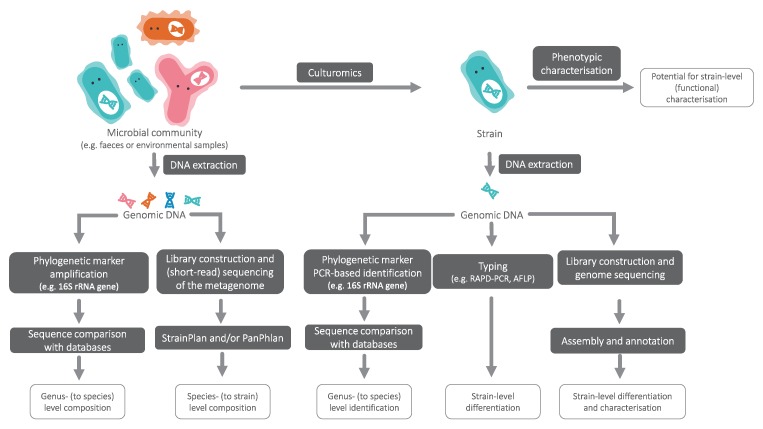
Advances in sequencing and computational biology have drastically increased our capability to explore the taxonomic and functional compositions of microbial communities that play crucial roles in industrial processes. Correspondingly, commercial interest has risen for applications where microbial communities make important contributions. These include food production, probiotics, cosmetics, and enzyme discovery. Other commercial applications include software that takes the user's gut microbiome data as one of its inputs and outputs evidence-based, automated, and personalized diet recommendations for balanced blood sugar levels. These applications pose several bioinformatic and data science challenges that range from requiring strain-level resolution in community profiles to the integration of large datasets for predictive machine learning purposes. In this perspective, we provide our insights on such challenges by touching upon several industrial areas, and briefly discuss advances and future directions of bioinformatics and data science in microbiome research.
测序技术和计算生物学的进步极大地提高了我们探索微生物群落分类和功能组成的能力,这些微生物群落在工业过程中起着关键作用。相应地,对于微生物群落做出重要贡献的应用,商业兴趣也在增加。这些应用包括食品生产、益生菌、化妆品和酶的发现。其他商业应用还包括一些软件,这些软件将用户的肠道微生物组数据作为输入之一,并输出基于证据的、自动化的和个性化的饮食建议,以平衡血糖水平。这些应用带来了若干生物信息学和数据科学挑战,从群落概况中需要菌株水平的分辨率到为预测性机器学习目的整合大型数据集不等。从这个角度出发,我们通过涉及几个工业领域来阐述我们对这些挑战的见解,并简要讨论微生物组研究中生物信息学和数据科学的进展及未来方向。