Clinical Pharmacology and Pharmacometrics, AbbVie Inc., North Chicago, Illinois, USA.
Clinical Pharmacology and Pharmacometrics, AbbVie Deutschland GmbH & Co. KG, Ludwigshafen am Rhein, Germany.
J Clin Pharmacol. 2020 Feb;60(2):188-197. doi: 10.1002/jcph.1513. Epub 2019 Aug 25.
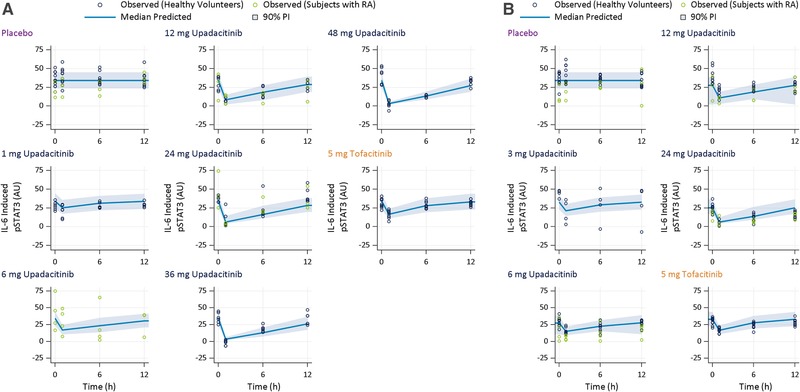
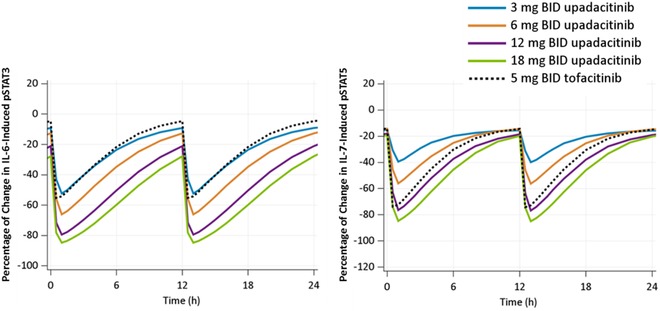
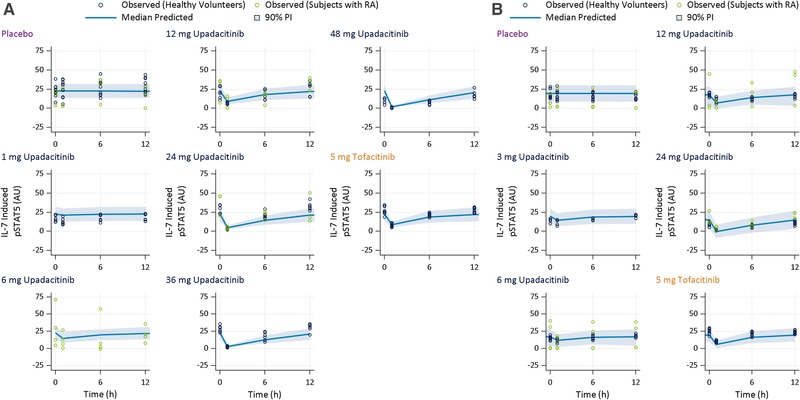
Upadacitinib is a selective Janus kinase (JAK) 1 inhibitor being developed for treatment of rheumatoid arthritis. This study characterizes the relationships between upadacitinib exposure and interleukin (IL)-6-induced signal transducer and activator of transcription proteins 3 (STAT3) phosphorylation (pSTAT3) and IL-7-induced STAT5 phosphorylation (pSTAT5) in the ex vivo setting as measures for JAK1 and JAK1/JAK3 inhibition, respectively, with comparison to tofacitinib. Drug plasma concentrations and ex vivo IL-6-induced pSTAT3 and IL-7-induced pSTAT5 in blood from subjects evaluated in 2 phase 1 studies who received immediate-release 1 mg to 48 mg upadacitinib, 5 mg twice daily (BID) tofacitinib, or placebo were determined. Exposure-response models were developed, and the effects of different upadacitinib doses on ex vivo biomarker responses were simulated and compared to tofacitinib. Upadacitinib (and tofacitinib) reversibly inhibited IL-6-induced pSTAT3 and IL-7-induced pSTAT5 in a concentration-dependent manner. Model-estimated values of 50% of the maximum effect were 60.7 nM for upadacitinib and 119 nM for tofacitinib for IL-6-induced pSTAT3 inhibition, and 125 nM for upadacitinib and 79.1 nM for tofacitinib for IL-7-induced pSTAT5 inhibition. Tofacitinib 5 mg BID is estimated to have a similar magnitude of effect on IL-6-induced pSTAT3 to ∼3 mg BID of upadacitinib (immediate-release formulation), whereas a 4-fold higher dose of upadacitinib (∼12 mg BID), is estimated to show a similar magnitude of inhibition on IL-7-induced pSTAT5 as tofacitinb 5 mg BID. This study confirms that in humans, upadacitinib has greater selectivity for JAK1 vs JAK3 relative to the rheumatoid arthritis approved dose of tofacitinib, and results from these analyses informed the selection of upadacitinib IR doses evaluated in phase 2.
乌帕替尼是一种选择性 Janus 激酶(JAK)1 抑制剂,用于治疗类风湿关节炎。本研究在体外条件下,研究了乌帕替尼暴露与白细胞介素(IL)-6 诱导的信号转导和转录激活蛋白 3(STAT3)磷酸化(pSTAT3)和 IL-7 诱导的 STAT5 磷酸化(pSTAT5)之间的关系,分别作为 JAK1 和 JAK1/JAK3 抑制的指标,并与托法替尼进行了比较。对接受即时释放型 1 毫克至 48 毫克乌帕替尼、5 毫克每日两次(BID)托法替尼或安慰剂的 2 项 1 期研究中评估的受试者的药物血浆浓度和体外 IL-6 诱导的 pSTAT3 和 IL-7 诱导的 pSTAT5 进行了测定。建立了暴露-反应模型,并模拟了不同乌帕替尼剂量对体外生物标志物反应的影响,并与托法替尼进行了比较。乌帕替尼(和托法替尼)以浓度依赖性方式可逆地抑制 IL-6 诱导的 pSTAT3 和 IL-7 诱导的 pSTAT5。模型估计的最大效应的 50%分别为 60.7 nM 用于 IL-6 诱导的 pSTAT3 抑制的乌帕替尼和 119 nM 用于托法替尼,125 nM 用于 IL-7 诱导的 pSTAT5 抑制的乌帕替尼和 79.1 nM 用于托法替尼。估计托法替尼 5 毫克 BID 对 IL-6 诱导的 pSTAT3 的作用与乌帕替尼 3 毫克 BID(即时释放型制剂)相似,而乌帕替尼 4 倍高剂量(约 12 毫克 BID),估计对 IL-7 诱导的 pSTAT5 的抑制作用与托法替尼 5 毫克 BID 相似。这项研究证实,在人类中,乌帕替尼对 JAK1 的选择性大于类风湿关节炎批准剂量的托法替尼对 JAK3 的选择性,并且这些分析的结果为选择在 2 期评估的乌帕替尼 IR 剂量提供了信息。