Department of Analytical Chemistry, Medical University of Gdansk, 80-416 Gdansk, Poland.
Department of Pharmaceutical Biochemistry, Medical University of Gdansk, 80-211 Gdansk, Poland.
Molecules. 2019 Aug 25;24(17):3082. doi: 10.3390/molecules24173082.
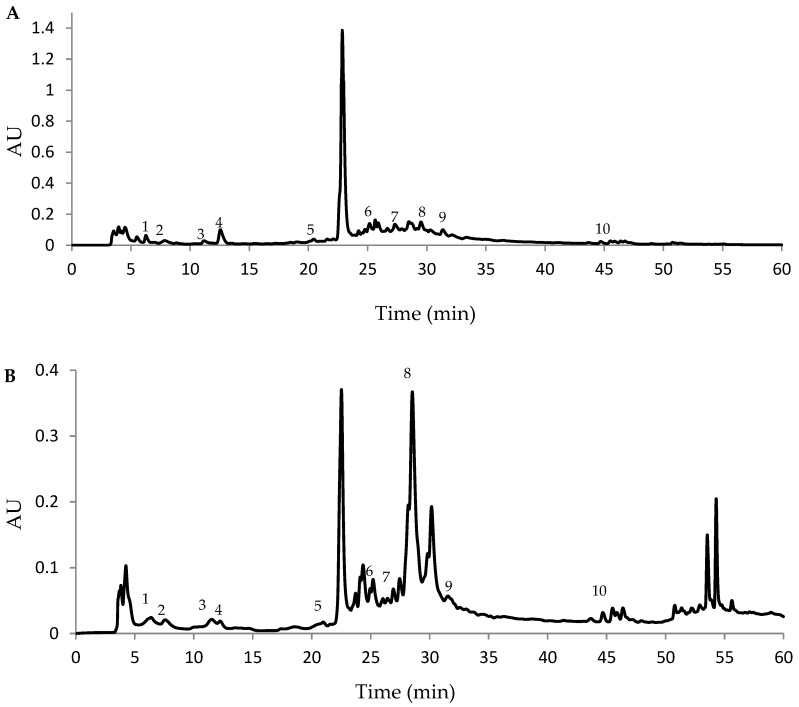
L. (white mulberry) has been commonly used as a functional food and for medicinal purposes. Hence, the aim of the study was to compare the phenolic profile of white mulberry commercial samples in relation to their antioxidant potential and acetylcholinesterase (AChE) inhibitory activity. It is of interest to determine whether herbal products originating from different commercial sources differ in their phenolic profiles. For this purpose, a simple and rapid high-performance liquid chromatography (HPLC) method was used for the separation and determination of ten major phenolic compounds. Total phenolic (TPC), total flavonoid (TFC), and total phenolic acid contents (TPAC), as well as l(+)-ascorbic acid (ASA) contents, were determined. The antioxidant potential was assessed by DPPH (2,2-diphenyl-1-picrylhydrazyl radical) scavenging activity and ferric-reducing/antioxidant power (FRAP) assay, while the AChE inhibitory activity was determined by the Ellman assay for water extracts. The study revealed that excluding two herbal products containing fruits and a sample containing leaves of white mulberry, yerba mate and lemon, the remaining samples were generally consistent in terms of phenolic composition as well as antioxidant potential and AChE inhibitory activity. This reflects the health-promoting properties of the samples under study. Moreover, the results showed that the water extracts of white mulberry were richer in phenolic compounds and presented higher antioxidant activity than the hydromethanolic extracts. However, the water extracts showed low inhibitory activity against AChE. Moreover, the correlation analysis indicated a high positive relationship between phenolic composition and antioxidant activity in extracts of white mulberry. Overall, the obtained results may be useful in the evaluation of new dietary supplements and food products. The water extracts of white mulberry could be used for antioxidant purposes, while the hydromethanolic extracts could be incorporated in antioxidant formulations.
(白桑)已被广泛用作功能性食品和药用。因此,本研究的目的是比较白桑商业样品的酚类谱与其抗氧化潜力和乙酰胆碱酯酶(AChE)抑制活性的关系。确定来自不同商业来源的草药产品在酚类谱上是否存在差异是很有意义的。为此,采用简单快速的高效液相色谱(HPLC)法分离和测定了十种主要的酚类化合物。测定总酚(TPC)、总黄酮(TFC)和总酚酸含量(TPAC)以及 l(+)-抗坏血酸(ASA)含量。通过 DPPH(2,2-二苯基-1-苦基肼自由基)清除活性和铁还原/抗氧化能力(FRAP)测定评估抗氧化潜力,通过 Ellman 法测定水提取物的 AChE 抑制活性。研究表明,除了两种含有水果的草药产品和一种含有白桑、巴拉圭茶和柠檬叶的样品外,其余样品在酚类组成、抗氧化潜力和 AChE 抑制活性方面基本一致。这反映了研究样品的促进健康的特性。此外,结果表明,白桑的水提取物比水-甲醇提取物含有更丰富的酚类化合物,具有更高的抗氧化活性。然而,水提取物对 AChE 的抑制活性较低。此外,相关分析表明,白桑提取物中酚类组成与抗氧化活性之间存在高度正相关关系。总体而言,研究结果可用于评估新的膳食补充剂和食品产品。白桑的水提取物可用于抗氧化目的,而水-甲醇提取物可用于抗氧化制剂。