Edbrooke Lara, Granger Catherine L, Clark Ross A, Denehy Linda
Department of Physiotherapy, The University of Melbourne, Melbourne VIC 3010, Australia.
Allied Health Department, Peter MacCallum Cancer Centre, Melbourne VIC 3000, Australia.
J Clin Med. 2019 Aug 23;8(9):1288. doi: 10.3390/jcm8091288.
In inoperable lung cancer, evidence is limited regarding physical activity (PA) and associations with other outcomes.
in the usual care (UC) group of an RCT to (1) explore whether baseline PA was associated with improved follow-up outcomes, (2) identify baseline variables associated with higher follow-up PA and in all RCT participants, to (3) analyse patterns of objectively measured PA, and (4) report on characteristics of those who were able to maintain or increase PA levels.
exploratory analyses of an assessor-blinded RCT. Outcomes, assessed at baseline, nine weeks and six months, included PA (seven-days of accelerometry), six-minute walk distance (6MWD), muscle strength, symptoms, mood and health-related quality of life (HRQoL).
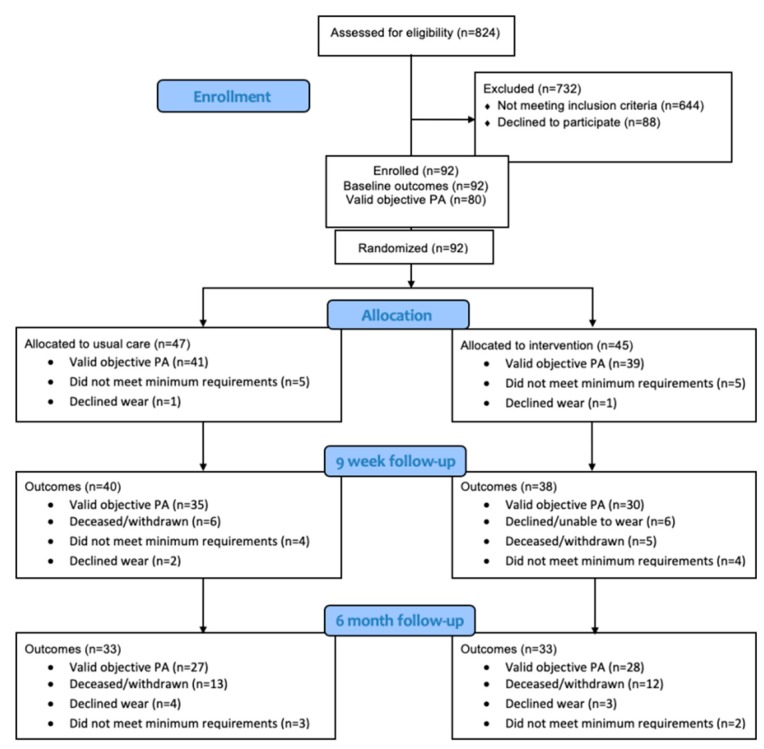
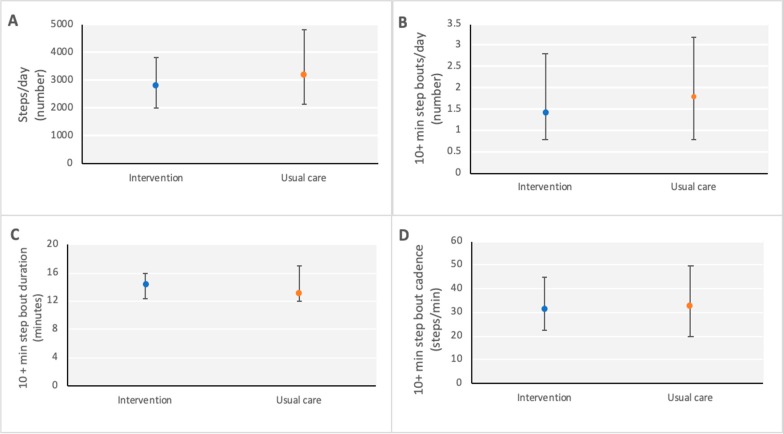
92 participants were randomised, 80 completed baseline accelerometry (39 intervention group (IG), 41 UC), characteristics: mean (SD) age 63.0 (12.3) years, 56% male, 51% stage IV disease. Baseline PA: median (IQR) steps/day 2859.6 (2034.0-3849.2) IG versus 3195.2 (2161.2-4839.0) UC. Associations between baseline PA and six-month outcomes were significant for HRQoL and 6MWD. PA at six months was significantly associated with baseline age, 6MWD and quadriceps strength. Between-group change score (steps/day) mean differences (95% CI) at nine weeks (174.5 (-1504.7 to 1853.7), = 0.84) and six months (574.0 (-1162.3 to 2310.3), = 0.52).
further research is required to determine patient subgroups deriving the greatest benefits from PA interventions.
在无法手术的肺癌患者中,关于体力活动(PA)及其与其他预后的关联的证据有限。
在一项随机对照试验(RCT)的常规护理(UC)组中,(1)探讨基线PA是否与改善的随访预后相关,(2)确定与较高随访PA相关的基线变量;在所有RCT参与者中,(3)分析客观测量的PA模式,以及(4)报告能够维持或提高PA水平者的特征。
对一项评估者设盲的RCT进行探索性分析。在基线、九周和六个月时评估的预后包括PA(七天加速度计测量)、六分钟步行距离(6MWD)、肌肉力量、症状、情绪和健康相关生活质量(HRQoL)。
92名参与者被随机分组,80名完成了基线加速度计测量(39名干预组(IG),41名UC组),特征:平均(标准差)年龄63.0(12.3)岁,56%为男性,51%为IV期疾病。基线PA:IG组每天步数中位数(四分位间距)为2859.6(2034.0 - 3849.2),UC组为3195.2(2161.2 - 4839.0)。基线PA与六个月时的HRQoL和6MWD预后之间存在显著关联。六个月时的PA与基线年龄、6MWD和股四头肌力量显著相关。九周时组间变化得分(每天步数)平均差异(95%可信区间)为174.5(-1504.7至1853.7),P = 0.84;六个月时为574.0(-1162.3至2310.3),P = 0.52。
需要进一步研究以确定从PA干预中获益最大的患者亚组。