Dohrn Ing-Mari, Hagströmer Maria, Hellénius Mai-Lis, Ståhle Agneta
1Department of Neurobiology, Care Sciences and Society (NVS), Karolinska Institutet, Sweden. 2Physiotherapy Clinic, Karolinska University Hospital, Sweden. 3Department of Medicine, Karolinska Institutet, Sweden.
J Geriatr Phys Ther. 2017 Apr/Jun;40(2):102-111. doi: 10.1519/JPT.0000000000000077.
We have developed a 12-week balance training program for older adults shown to improve fall-related concerns, gait speed, balance performance, and physical function. We hypothesized that this balance training would also contribute to higher habitual physical activity (PA) levels and improved health-related quality of life (HRQoL). The primary aim was to evaluate short- and long-term effects of the balance training program on objectively measured habitual PA in older adults with osteoporosis. Secondary aims were to assess the effects of the balance training on HRQoL, and to study whether any effects on PA were associated with changes in HRQoL, gait speed, balance performance, fall-related concerns, and physical function.
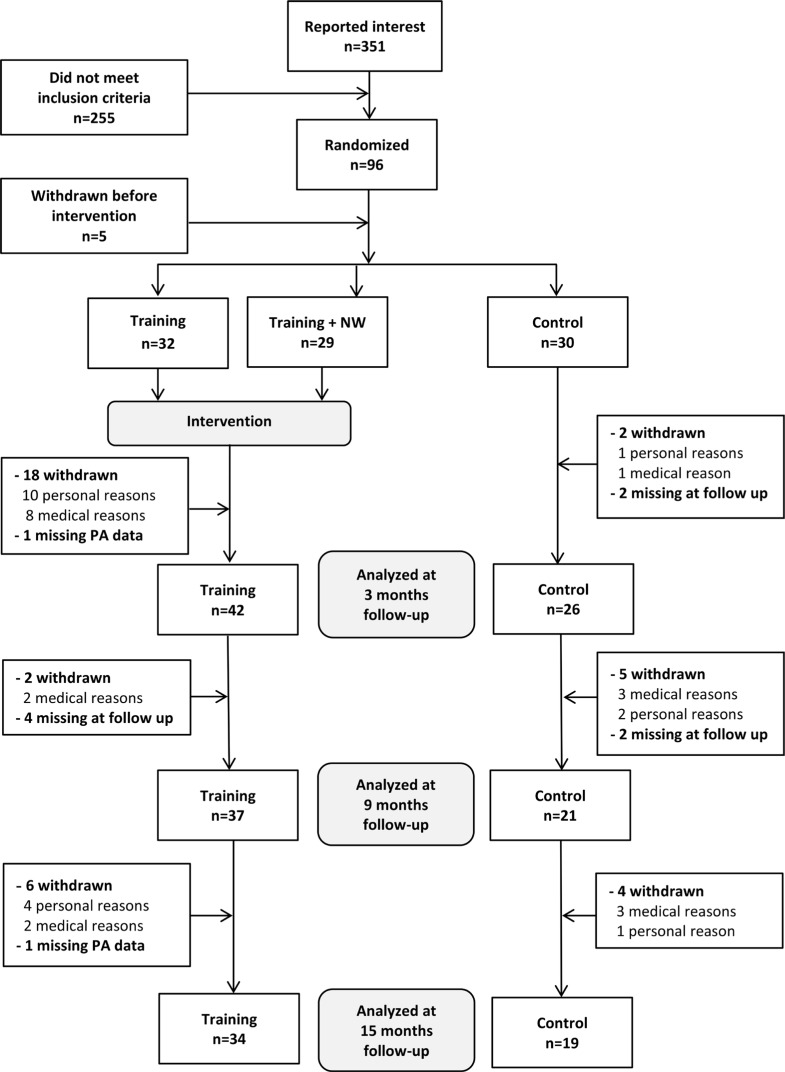
A randomized controlled trial with follow-up at 3, 9, and 15 months, including 91 participants with osteoporosis (75.6 ± 5.4 years), compared a balance training group (n = 61) with a control group (n = 30). The primary outcome was effect on habitual PA measured as steps/day, dichotomized into less than 5000 or 5000 or more steps/day. Physical activity was assessed with pedometers (Yamax) and accelerometers (Actigraph), HRQoL with the Short Form-36 (SF-36), gait with a GAITRite walkway, balance performance with Modified-Figure-Eight test and one-leg stance, fall-related concerns with Falls Efficacy Scale International, and physical function with the advanced lower extremity subscale of the questionnaire Late Life Function and Disability Instrument. Statistical methods used were multivariate logistic regression and logistic generalized estimating equation.
Sixty-eight participants completed the short-term follow-up at 3 months, and 53 participants completed the long-term follow-up at 15 months. Per-protocol analysis (n = 68) showed that the odds ratio for having a daily step count of 5000 or more at 3 months was 6.17 (95% confidence interval, 1.23-30.91), P = .027, for the intervention group compared with the control group. The longitudinal analysis (n = 91) showed that the odds ratio for having a daily step count of 5000 or more at 15 months was 2.02 (95% confidence interval, 0.88-4.64), P = .096, for the intervention group compared with the control group. The mental component sum of the SF-36 improved significantly from baseline to 3 months in the intervention group, and the physical component sum improved in both groups, but no statistically significant differences were found between groups. No associations were found between PA and changes in covariates.
The short-term evaluation showed that balance training increased habitual PA in community-dwelling older adults with osteoporosis. A significantly higher proportion of participants in the intervention group reached a level of 5000 or more steps/day, which is important for overall health. This effect was not associated with improvements in HRQoL, gait speed, balance performance, or fall-related concerns, and did not persist through the long-term follow-up. To accomplish a sustained PA change, a prolonged intervention or more support regarding habitual PA may be required, such as reinforcement with personalized behavior change counseling or PA on prescription.
我们为老年人制定了一项为期12周的平衡训练计划,该计划已被证明可改善与跌倒相关的问题、步态速度、平衡能力和身体功能。我们假设这种平衡训练也有助于提高日常身体活动(PA)水平,并改善健康相关生活质量(HRQoL)。主要目的是评估平衡训练计划对骨质疏松症老年人客观测量的日常PA的短期和长期影响。次要目的是评估平衡训练对HRQoL的影响,并研究对PA的任何影响是否与HRQoL、步态速度、平衡能力、与跌倒相关的问题和身体功能的变化有关。
一项随机对照试验,在3、9和15个月时进行随访,包括91名骨质疏松症患者(75.6±5.4岁),将平衡训练组(n = 61)与对照组(n = 30)进行比较。主要结局是对日常PA的影响,以每天步数衡量,分为每天少于5000步或5000步及以上。使用计步器(Yamax)和加速度计(Actigraph)评估身体活动,使用简短健康调查问卷36项版本(SF-36)评估HRQoL,使用GAITRite步道评估步态,使用改良数字8字测试和单腿站立评估平衡能力,使用国际跌倒效能量表评估与跌倒相关的问题,使用问卷《晚年功能与残疾量表》的高级下肢子量表评估身体功能。使用的统计方法是多变量逻辑回归和逻辑广义估计方程。
68名参与者完成了3个月的短期随访,53名参与者完成了15个月的长期随访。符合方案分析(n = 68)显示,与对照组相比,干预组在3个月时每天步数达到5000步及以上的优势比为6.17(95%置信区间,1.23 - 30.91),P = 0.027。纵向分析(n = 91)显示,与对照组相比,干预组在15个月时每天步数达到5000步及以上的优势比为2.02(95%置信区间,0.88 - 4.64),P = 0.096。干预组SF-36的心理成分总分从基线到3个月有显著改善,两组的身体成分总分均有所改善,但组间未发现统计学上的显著差异。未发现PA与协变量变化之间存在关联。
短期评估表明,平衡训练增加了社区居住的骨质疏松症老年人的日常PA。干预组中达到每天5000步及以上水平的参与者比例显著更高,这对整体健康很重要。这种效果与HRQoL、步态速度、平衡能力或与跌倒相关的问题的改善无关,并且在长期随访中未持续存在。为了实现持续的PA变化,可能需要延长干预时间或提供更多关于日常PA的支持,例如通过个性化行为改变咨询或处方PA进行强化。
