Wang Le, Xu Leixin, Peng Changliang, Teng Guoxin, Wang Yu, Xie Xiaoshuai, Wu Dongjin
Department of Spinal Surgery, Second Hospital of Shandong University, Jinan, Shandong 250033, P.R. China.
Department of Orthopedics, The Fourth People's Hospital, Heze, Shandong 274100, P.R. China.
Exp Ther Med. 2019 Sep;18(3):2021-2028. doi: 10.3892/etm.2019.7800. Epub 2019 Jul 23.
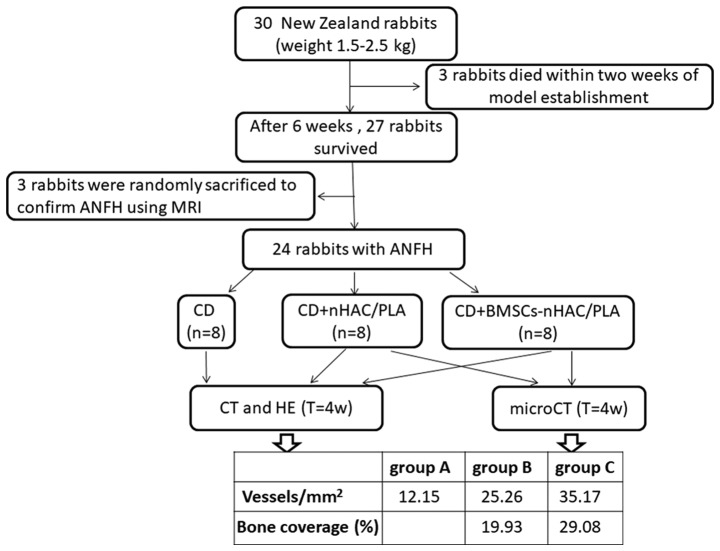
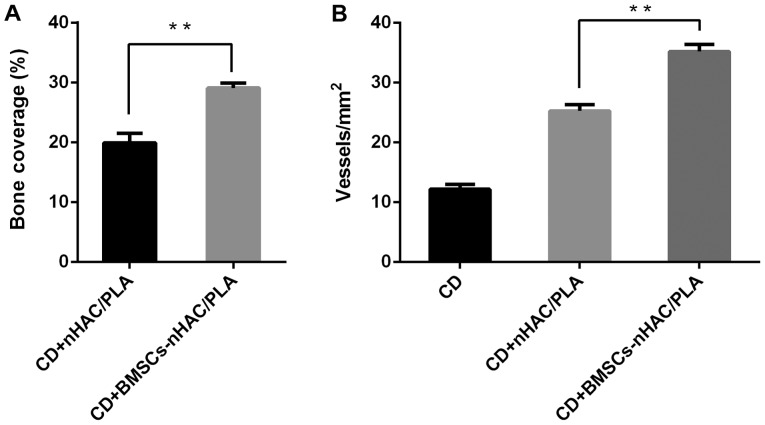
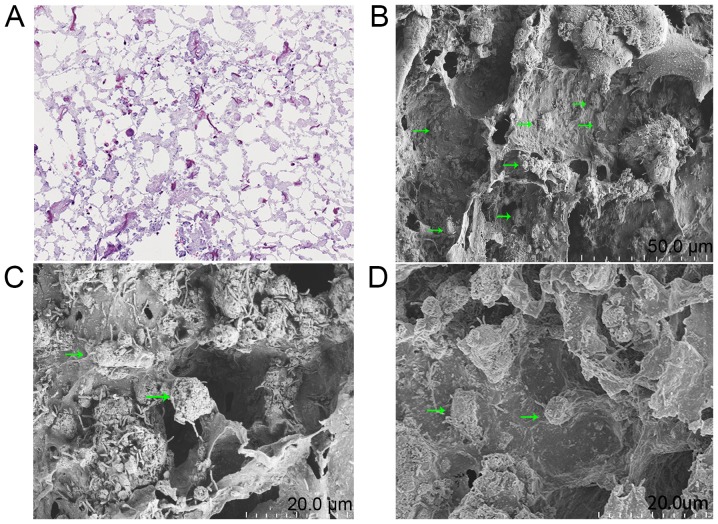
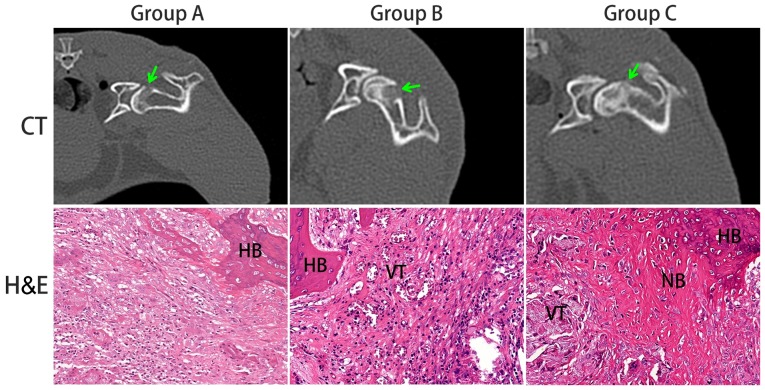
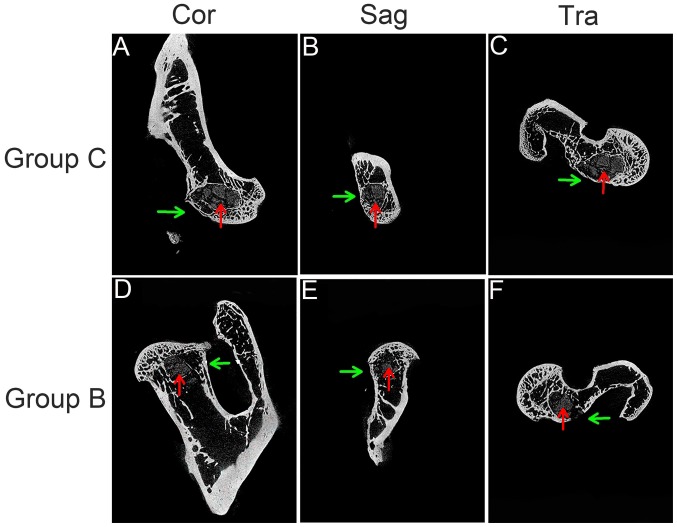
For avascular necrosis of the femoral head (ANFH), repair and regeneration are difficult because of the edema and high pressure caused by continuous ischemia and hypoxia. Core decompression (CD) is a classic method for treating early ANFH before the collapse of the femoral head; however, its effect is still controversial. To improve the therapeutic effect of CD on ANFH, a novel tissue-engineered bone (TEB) was constructed by combining bone marrow mesenchymal stem cells (BMSCs) with nano-hydroxyapatite/collagen I/poly-L-lactic acid (nHAC/PLA) scaffolds and implanting the TEB into the bone tunnel of CD. Cell attachment was observed by scanning electron microscopy and hematoxylin and eosin staining. The authors' previous studies confirmed that nHAC/PLA is an excellent scaffold material with favorable biocompatibility and no cytotoxicity. A total of 24 New Zealand rabbits with ANFH were randomly divided into three groups, as follows: Group A (n=8), pure CD; group B (n=8), CD+nHAC/PLA; and group C (n=8), CD+BMSCs-nHAC/PLA. The favorable effect of BMSCs-nHAC/PLA on angiogenesis and bone formation in necrotic areas was further evaluated via radiographic and histological analyses. Computerized tomography (CT) scanning and H&E staining showed more capillaries and new osteoid tissue in group C compared with in groups B and A. Micro-CT showed that the new bone coverage rate and implanted material degradation degree were each increased in group C compared with in group B. These results indicate that BMSCs-nHAC/PLA scaffolds may improve the curative effect of CD and provide a strategy for treating ANFH.
对于股骨头缺血性坏死(ANFH),由于持续缺血缺氧导致的水肿和高压,修复和再生十分困难。髓芯减压术(CD)是在股骨头塌陷前治疗早期ANFH的经典方法;然而,其效果仍存在争议。为提高CD治疗ANFH的疗效,通过将骨髓间充质干细胞(BMSCs)与纳米羟基磷灰石/Ⅰ型胶原/聚-L-乳酸(nHAC/PLA)支架相结合构建了一种新型组织工程骨(TEB),并将TEB植入CD的骨隧道中。通过扫描电子显微镜以及苏木精-伊红染色观察细胞黏附情况。作者之前的研究证实nHAC/PLA是一种具有良好生物相容性且无细胞毒性的优良支架材料。将24只患有ANFH的新西兰兔随机分为三组,如下:A组(n = 8),单纯髓芯减压术;B组(n = 8),髓芯减压术 + nHAC/PLA;C组(n = 8),髓芯减压术 + BMSCs-nHAC/PLA。通过影像学和组织学分析进一步评估BMSCs-nHAC/PLA对坏死区域血管生成和骨形成的良好作用。计算机断层扫描(CT)和苏木精-伊红染色显示,与B组和A组相比,C组有更多的毛细血管和新骨样组织。显微CT显示,与B组相比,C组的新骨覆盖率和植入材料降解程度均有所增加。这些结果表明,BMSCs-nHAC/PLA支架可能会提高髓芯减压术的疗效,并为治疗ANFH提供一种策略。