Feliciano Pamela, Zhou Xueya, Astrovskaya Irina, Turner Tychele N, Wang Tianyun, Brueggeman Leo, Barnard Rebecca, Hsieh Alexander, Snyder LeeAnne Green, Muzny Donna M, Sabo Aniko, Gibbs Richard A, Eichler Evan E, O'Roak Brian J, Michaelson Jacob J, Volfovsky Natalia, Shen Yufeng, Chung Wendy K
1Simons Foundation, New York, NY 10010 USA.
2Department of Systems Biology, Columbia University, New York, NY 10032 USA.
NPJ Genom Med. 2019 Aug 23;4:19. doi: 10.1038/s41525-019-0093-8. eCollection 2019.
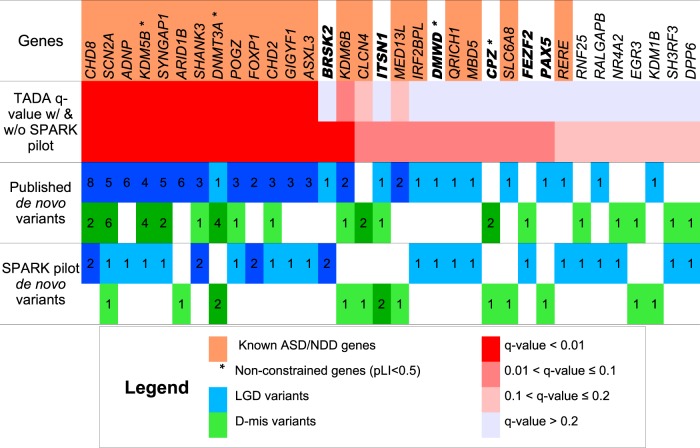
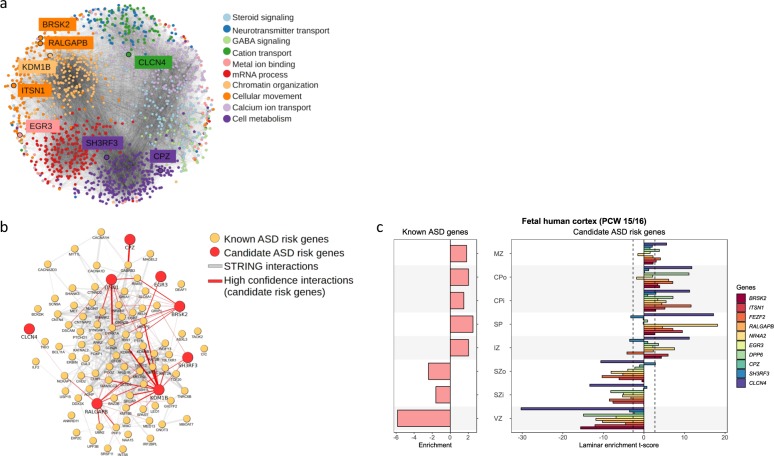
Autism spectrum disorder (ASD) is a genetically heterogeneous condition, caused by a combination of rare de novo and inherited variants as well as common variants in at least several hundred genes. However, significantly larger sample sizes are needed to identify the complete set of genetic risk factors. We conducted a pilot study for SPARK (SPARKForAutism.org) of 457 families with ASD, all consented online. Whole exome sequencing (WES) and genotyping data were generated for each family using DNA from saliva. We identified variants in genes and loci that are clinically recognized causes or significant contributors to ASD in 10.4% of families without previous genetic findings. In addition, we identified variants that are possibly associated with ASD in an additional 3.4% of families. A meta-analysis using the TADA framework at a false discovery rate (FDR) of 0.1 provides statistical support for 26 ASD risk genes. While most of these genes are already known ASD risk genes, has the strongest statistical support and reaches genome-wide significance as a risk gene for ASD (-value = 2.3e-06). Future studies leveraging the thousands of individuals with ASD who have enrolled in SPARK are likely to further clarify the genetic risk factors associated with ASD as well as allow accelerate ASD research that incorporates genetic etiology.
自闭症谱系障碍(ASD)是一种基因异质性疾病,由罕见的新生变异和遗传变异以及至少数百个基因中的常见变异共同引起。然而,需要显著更大的样本量才能确定完整的遗传风险因素集。我们对SPARK(SPARKForAutism.org)进行了一项试点研究,涉及457个患有ASD的家庭,所有家庭均在线同意参与。使用唾液中的DNA为每个家庭生成了全外显子组测序(WES)和基因分型数据。我们在10.4%以前没有遗传发现的家庭中,在临床上被认可为导致ASD或对ASD有重大影响的基因和基因座中发现了变异。此外,我们在另外3.4%的家庭中发现了可能与ASD相关的变异。使用TADA框架在错误发现率(FDR)为0.1的情况下进行的荟萃分析为26个ASD风险基因提供了统计支持。虽然这些基因中的大多数已经是已知的ASD风险基因,但 具有最强的统计支持,并作为ASD的风险基因达到全基因组显著性(-值 = 2.3e - 06)。未来利用参与SPARK的数千名患有ASD的个体进行的研究,可能会进一步阐明与ASD相关的遗传风险因素,并加速纳入遗传病因学的ASD研究。