School of Atmospheric Sciences, Guangdong Province Key Laboratory for Climate Change and Natural Disaster Studies, Zhuhai Key Laboratory of Dynamics Urban Climate and Ecology, Sun Yat-sen University, Zhuhai, Guangdong 510245, China.
Southern Marine Science and Engineering Guangdong Laboratory, Zhuhai 519082, China.
Sci Adv. 2019 Aug 14;5(8):eaax1396. doi: 10.1126/sciadv.aax1396. eCollection 2019 Aug.
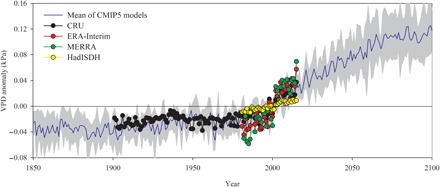
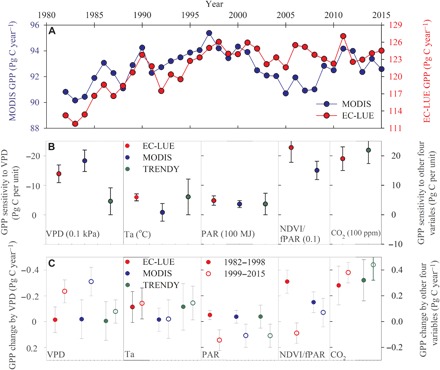
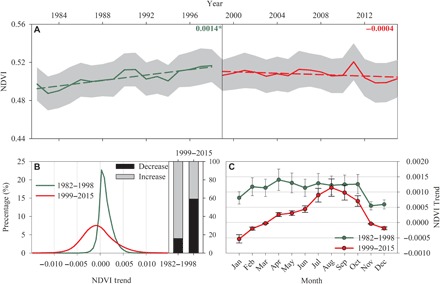
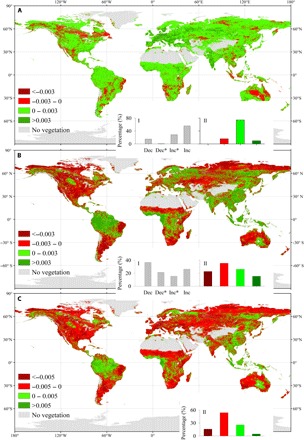
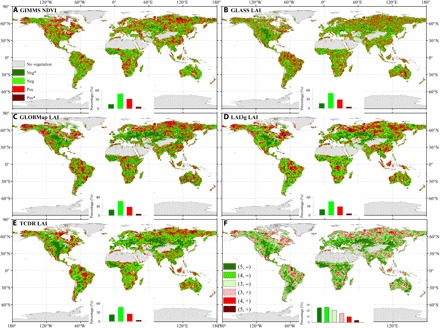
Atmospheric vapor pressure deficit (VPD) is a critical variable in determining plant photosynthesis. Synthesis of four global climate datasets reveals a sharp increase of VPD after the late 1990s. In response, the vegetation greening trend indicated by a satellite-derived vegetation index (GIMMS3g), which was evident before the late 1990s, was subsequently stalled or reversed. Terrestrial gross primary production derived from two satellite-based models (revised EC-LUE and MODIS) exhibits persistent and widespread decreases after the late 1990s due to increased VPD, which offset the positive CO fertilization effect. Six Earth system models have consistently projected continuous increases of VPD throughout the current century. Our results highlight that the impacts of VPD on vegetation growth should be adequately considered to assess ecosystem responses to future climate conditions.
大气蒸气压亏缺(VPD)是决定植物光合作用的关键变量。对四个全球气候数据集的综合分析表明,VPD 在 20 世纪 90 年代后期之后急剧增加。作为响应,卫星衍生植被指数(GIMMS3g)所指示的植被绿化趋势,在 20 世纪 90 年代后期之前是明显的,但随后停滞或逆转。来自两个基于卫星的模型(修订后的 EC-LUE 和 MODIS)的陆地总初级生产力在 20 世纪 90 年代后期之后由于 VPD 的增加而持续广泛减少,抵消了 CO2 施肥的积极效应。六个地球系统模型一致预测,在整个本世纪,VPD 将持续增加。我们的研究结果强调,应该充分考虑 VPD 对植被生长的影响,以评估生态系统对未来气候条件的响应。