Cuadrado M J, Calatayud I, Urquizu-Padilla M, Wijetilleka S, Kiani-Alikhan S, Karim M Y
Louise Coote Lupus Unit, Guy's & St Thomas' Hospitals, London, UK.
2Dept of Immunology, University Hospital Wales, Cardiff, UK.
BMC Rheumatol. 2019 Aug 21;3:30. doi: 10.1186/s41927-019-0079-2. eCollection 2019.
Hypogammaglobulinemia is a complication of B-cell targeting therapies (BCTT), used in vasculitis, rheumatoid arthritis and systemic lupus erythematosus (SLE). Since autoimmune diseases are associated with underlying and induced immune abnormalities, several societies recommend assessing immune function before and during rituximab treatment. In SLE, polyclonal hypergammaglobulinemia is the typical alteration of gammaglobulins, though hypogammaglobulinemia has also been reported.
This is a cross-sectional study describing immunoglobulin levels measured as part of routine care in patients with lupus nephritis, a group with multiple factors contributing to immunoglobulin abnormalities, including immune dysregulation, immunosuppression and nephrotic syndrome.
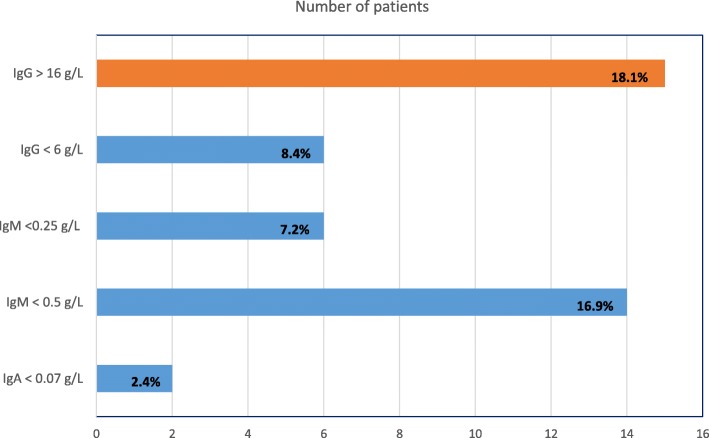
Polyclonal hypergammaglobulinemia occurred in 15/83 (18.1%) patients. In contrast, low levels of immunoglobulins were found as follows: selective IgA deficiency 2/83 (2.4%), reduced IgG levels 7/83 (8.4%), reduced IgM 14/83 (16.9%). Only 1 patient required immunoglobulin replacement.
Immunoglobulin abnormalities are frequently found in lupus nephritis, ranging from polyclonal hypergammaglobulinemia to hypogammglobulinemia. Consequently, immunoglobulin levels should be assessed prior to commencing BCTT.
低丙种球蛋白血症是用于治疗血管炎、类风湿关节炎和系统性红斑狼疮(SLE)的B细胞靶向治疗(BCTT)的一种并发症。由于自身免疫性疾病与潜在的和诱导的免疫异常相关,一些学会建议在使用利妥昔单抗治疗前和治疗期间评估免疫功能。在SLE中,多克隆高丙种球蛋白血症是丙种球蛋白的典型改变,不过也有低丙种球蛋白血症的报道。
这是一项横断面研究,描述了作为狼疮性肾炎患者常规护理一部分所测量的免疫球蛋白水平,狼疮性肾炎患者群体存在多种导致免疫球蛋白异常的因素,包括免疫失调、免疫抑制和肾病综合征。
15/83(18.1%)例患者出现多克隆高丙种球蛋白血症。相比之下,发现免疫球蛋白水平降低的情况如下:选择性IgA缺乏2/83(2.4%),IgG水平降低7/83(8.4%),IgM降低14/83(16.9%)。仅1例患者需要免疫球蛋白替代治疗。
狼疮性肾炎中经常发现免疫球蛋白异常,范围从多克隆高丙种球蛋白血症到低丙种球蛋白血症。因此,在开始BCTT之前应评估免疫球蛋白水平。