Department of Radiation Oncology, University of Lübeck, Lübeck, Germany.
Private Practice of Radiation Oncology, Hannover, Germany.
Radiat Oncol. 2019 Aug 27;14(1):152. doi: 10.1186/s13014-019-1337-6.
To quantify the prevalence of brain metastases involving the hypothalamic-pituitary (HT-P) area.
Cognitive impairment and fatigue are common side effects of whole brain irradiation (WBI) comprising the quality of life (QoL) for survivors. While the former is related to radiation-induced hippocampal injury, the latter could be secondary to hormonal disbalance as a consequence of radiation of the HT-P area. Thus, sparing both regions from higher irradiation doses could reduce these sequelae.
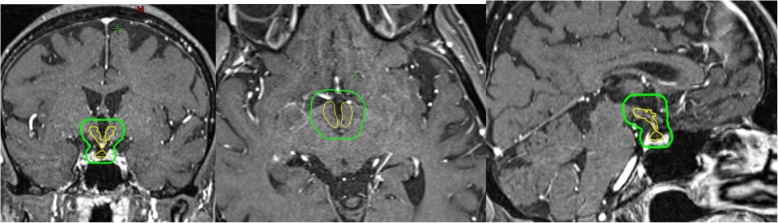
T1 contrast medium enhanced magnetic resonance imaging (MRI) scans of 865 patients with brain metastases (4,280 metastases) were reviewed. HT-P area was individually contoured with a margin of 5 mm in order to evaluate the prevalence of brain metastases in this region.
Involvement of the hypothalamic region was found in 26 patients (involvement rate of 3% for patients and 1% for metastases), involvement of the pituitary gland in 9 patients (1% for patients and < 1% for metastases). Binary logistical regression analysis revealed the presence of > 10 brain metastases as the only factor associated with hypothalamic involvement while no distinct factor was associated with an involvement of the pituitary gland.
The low prevalence of metastases within the HT-P area in patients with brain metastases calls for further studies examining whether sparing of this region might improve patients QoL.
定量分析涉及下丘脑-垂体(HT-P)区域的脑转移瘤的发生率。
全脑照射(WBI)会导致认知障碍和疲劳,这是脑转移患者常见的副作用,会降低患者的生活质量(QoL)。前者与放射诱导的海马损伤有关,而后者可能是由于 HT-P 区域放射导致的激素失衡引起的。因此,使这两个区域免受更高剂量的辐射可能会减少这些后遗症。
回顾了 865 例脑转移患者(4280 个转移灶)的 T1 对比剂增强磁共振成像(MRI)扫描。对 HT-P 区域进行单独勾画,边界为 5mm,以评估该区域脑转移瘤的发生率。
26 例患者(患者发生率为 3%,转移灶发生率为 1%)存在下丘脑受累,9 例患者(患者发生率为 1%,转移灶发生率<1%)存在垂体受累。二元逻辑回归分析显示,存在>10 个脑转移灶是与下丘脑受累相关的唯一因素,而与垂体受累无关的明确因素。
脑转移患者 HT-P 区域转移灶的低发生率需要进一步研究,以确定是否保护该区域可以改善患者的 QoL。