Department of Internal Medicine, Hanyang University Guri Hospital, Hanyang University College of Medicine, Guri, Korea.
Sci Rep. 2019 Aug 27;9(1):12444. doi: 10.1038/s41598-019-48925-4.
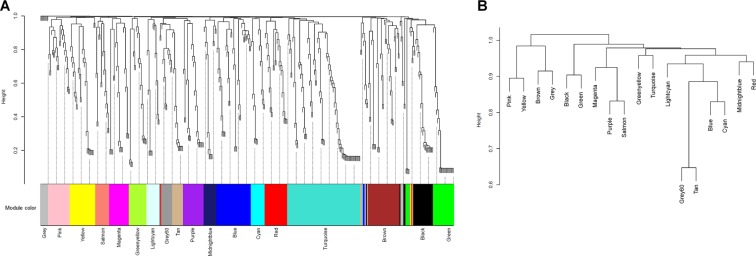
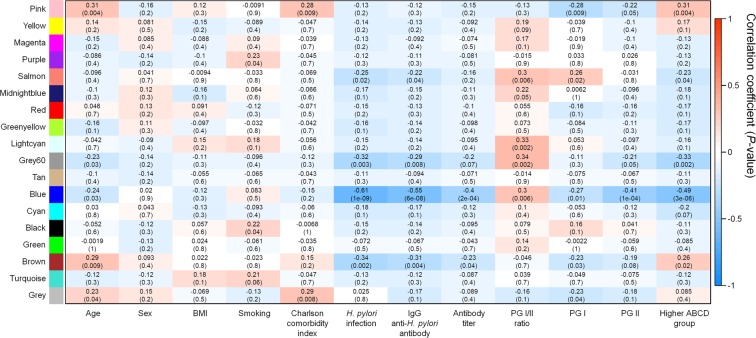
In addition to Helicobacter pylori infection, nitrosating/nitrate-reducing bacteria and type IV secretion system (T4SS) protein gene-contributing bacteria have been proposed as potential causes of gastric cancer development. However, bacterial modules related with gastric carcinogenesis have not been clarified. In this study, we analyzed gastric microbiome using the gastric mucosal samples obtained from the Hanyang University Gastric Microbiome Cohort by 16S rRNA gene sequencing. Weighted correlation network analysis was performed to construct a microbiome network and to identify microbial modules associated with gastric carcinogenesis. At the family level, 420 bacterial taxa were identified in the gastric microbiome of 83 participants. Through network analysis, 18 microbial modules were organized. Among them, two modules-pink and brown-were positively correlated with a higher-risk of gastric cancer development such as intestinal metaplasia with no current H. pylori infection (correlation coefficient [γ]: pink module, 0.31 [P = 0.004], brown module, 0.26 [P = 0.02]). At the family level, twenty-two and thirty-two bacterial taxa belonged to the pink and brown modules, respectively. They included nitrosating/nitrate-reducing bacteria, T4SS protein gene-contributing bacteria, and various other bacteria, including Gordoniaceae, Tsukamurellaceae, Prevotellaceae, Cellulomonadaceae, Methylococcaceae, and Procabacteriaceae. The blue module, which included H. pylori, was correlated negatively with intestinal metaplasia (γ = -0.49 [P < 0.001]). In conclusion, intragastric bacterial taxa associated with gastric carcinogenesis can be classified by network analysis. Microbial modules may provide an integrative view of the microbial ecology relevant to precancerous lesions in the stomach.
除了幽门螺杆菌感染,亚硝化/硝酸盐还原菌和 IV 型分泌系统(T4SS)蛋白基因贡献菌也被认为是胃癌发展的潜在原因。然而,与胃癌发生相关的细菌模块尚未阐明。在这项研究中,我们通过 16S rRNA 基因测序分析了汉扬大学胃微生物组队列的胃黏膜样本中的胃微生物组。进行了加权相关网络分析,以构建微生物组网络并确定与胃癌发生相关的微生物模块。在科水平上,在 83 名参与者的胃微生物组中鉴定出 420 个细菌分类群。通过网络分析,组织了 18 个微生物模块。其中,两个模块——粉色和棕色——与较高的胃癌发展风险呈正相关,例如无当前幽门螺杆菌感染的肠上皮化生(相关系数 [γ]:粉色模块,0.31 [P=0.004],棕色模块,0.26 [P=0.02])。在科水平上,粉色和棕色模块分别有 22 种和 32 种细菌分类群。它们包括亚硝化/硝酸盐还原菌、T4SS 蛋白基因贡献菌以及各种其他细菌,包括戈登氏菌科、越桔科、普雷沃氏菌科、纤维素单胞菌科、甲基球菌科和动胶菌科。包含幽门螺杆菌的蓝色模块与肠上皮化生呈负相关(γ=-0.49 [P<0.001])。总之,与胃癌发生相关的胃内细菌分类群可以通过网络分析进行分类。微生物模块可以为胃前病变相关的微生物生态学提供整体观点。