Plantin Jeanette, Pennati Gaia V, Roca Pauline, Baron Jean-Claude, Laurencikas Evaldas, Weber Karin, Godbolt Alison K, Borg Jörgen, Lindberg Påvel G
Division of Rehabilitation Medicine, Department of Clinical Sciences, Karolinska Institutet, Danderyd University Hospital, Stockholm, Sweden.
Institut de Psychiatrie et Neurosciences de Paris, Inserm U1266, Paris, France.
Front Neurol. 2019 Aug 12;10:836. doi: 10.3389/fneur.2019.00836. eCollection 2019.
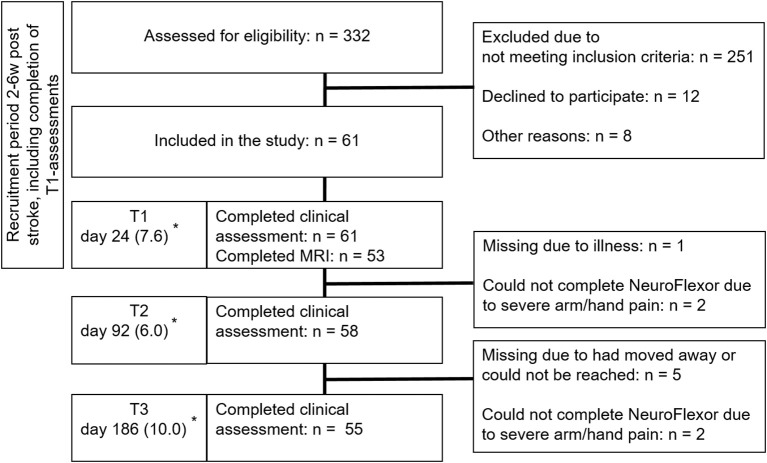
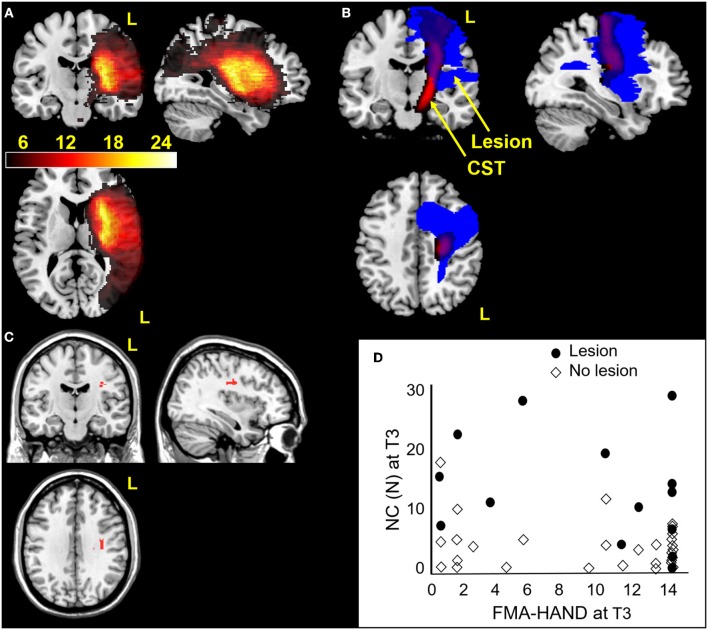
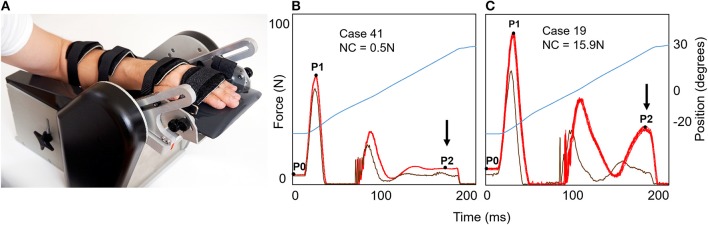
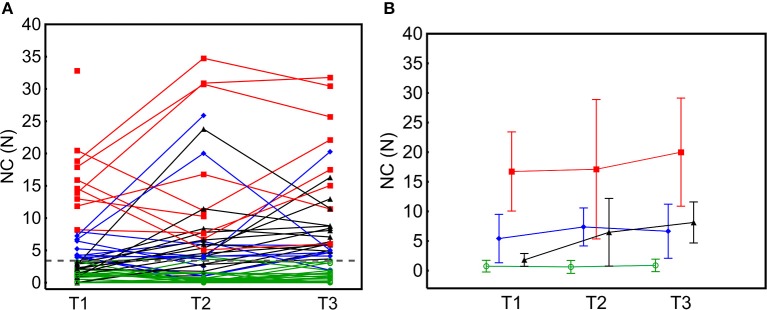
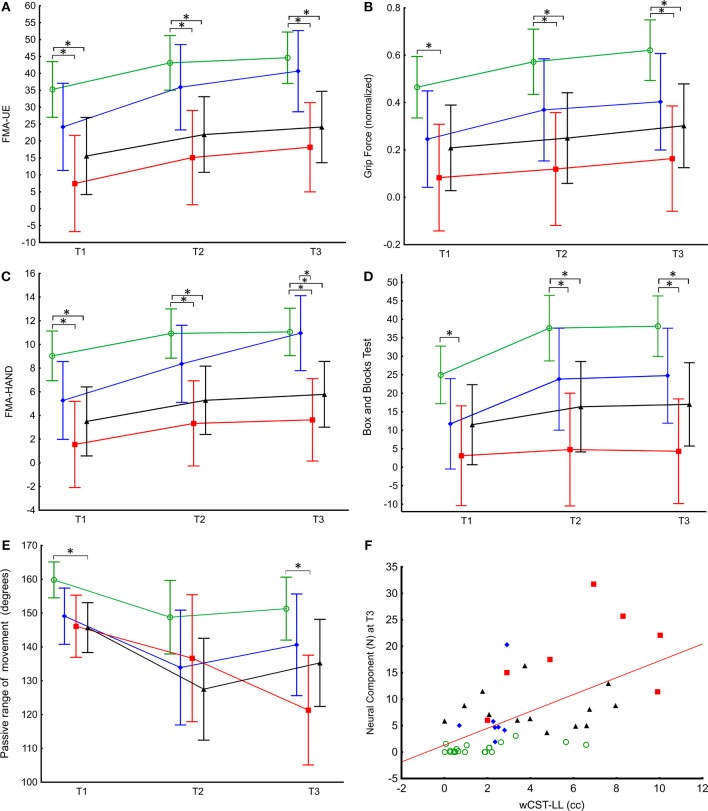
This longitudinal observational study investigated how neural stretch-resistance in wrist and finger flexors develops after stroke and relates to motor recovery, secondary complications, and lesion location. Sixty-one patients were assessed at 3 weeks (T1), three (T2), and 6 months (T3) after stroke using the NeuroFlexor method and clinical tests. Magnetic Resonance Imaging was used to calculate weighted corticospinal tract lesion load (wCST-LL) and to perform voxel-based lesion symptom mapping. NeuroFlexor assessment demonstrated spasticity (neural component [NC] >3.4N normative cut-off) in 33% of patients at T1 and in 51% at T3. Four subgroups were identified: early Severe spasticity ( = 10), early Moderate spasticity ( = 10), Late developing spasticity ( = 17) and No spasticity ( = 24). All except the Severe spasticity group improved significantly in Fugl-Meyer Assessment (FMA-HAND) to T3. The Severe and Late spasticity groups did not improve in Box and Blocks Test. The Severe spasticity group showed a 25° reduction in passive range of movement and more frequent arm pain at T3. wCST-LL correlated positively with NC at T1 and T3, even after controlling for FMA-HAND and lesion volume. Voxel-based lesion symptom mapping showed that lesioned white matter below cortical hand knob correlated positively with NC. Severe hand spasticity early after stroke is negatively associated with hand motor recovery and positively associated with the development of secondary complications. Corticospinal tract damage predicts development of spasticity. Early quantitative hand spasticity measurement may have potential to predict motor recovery and could guide targeted rehabilitation interventions after stroke.
这项纵向观察性研究调查了中风后手腕和手指屈肌的神经拉伸抗性如何发展,以及它与运动恢复、继发性并发症和病变位置的关系。61名患者在中风后3周(T1)、3个月(T2)和6个月(T3)使用NeuroFlexor方法和临床测试进行评估。磁共振成像用于计算加权皮质脊髓束病变负荷(wCST-LL)并进行基于体素的病变症状映射。NeuroFlexor评估显示,33%的患者在T1时出现痉挛(神经成分[NC]>3.4N标准临界值),51%的患者在T3时出现痉挛。确定了四个亚组:早期严重痉挛(n = 10)、早期中度痉挛(n = 10)、迟发性痉挛(n = 17)和无痉挛(n = 24)。除严重痉挛组外,所有组在Fugl-Meyer评估(FMA-HAND)中至T3时均有显著改善。严重痉挛组和迟发性痉挛组在方块搭积木测试中没有改善。严重痉挛组在T3时被动活动范围减少25°,手臂疼痛更频繁。即使在控制了FMA-HAND和病变体积后,wCST-LL在T1和T3时与NC呈正相关。基于体素的病变症状映射显示,皮质手结节下方的受损白质与NC呈正相关。中风后早期严重手部痉挛与手部运动恢复呈负相关,与继发性并发症的发生呈正相关。皮质脊髓束损伤可预测痉挛的发生。早期定量手部痉挛测量可能有预测运动恢复的潜力,并可指导中风后的针对性康复干预。